A Leader – More than a Timekeeper

There are examples of great leaders from our past that reinforce valuable leadership principles. This may also include leaders you would like to emulate and those you would like to stand clear of their practices. Athletics are a proving ground for a number of these lessons. There are some coaches you are more effective than others. 

I was a long distance runner in high school and college. The track coach was naturally, an integral part of the team. The right coach with the right talent could make the difference between winning and losing.

A retrospective look at one of my coaches brings very important points to mind about leadership. Yes, he had a vision for our team. He was interested in our performance and wanted us to excel at our event, whether it was track or field events. He kept us aware of our performance against our previous results or times, but he was more than a timekeeper. Based on the situation, he was a:

  • A teacher – coach, counselor
  • A personal trainer – nutrition & condition
  • A strategist
  • A mentor and confidante

He had a holistic approach to athletics, addressing performance and the entire person. He knew academic and social matters could distract us and interfere with our performance against our individual and team objectives. So he preached balance and sound judgment in juggling our affairs. He was not a psychologist, but he used psychology to challenge us to make the right decisions and to conduct ourselves professionally, on and off the track. 

Before each race, he decided which players would compete in various events. He wanted us to know our roles and his expectations. Sometimes he could not use everyone, but ensured that everyone was prepared, in case they were needed. He wanted to choose the strongest team, with the best chance to win the competition. This involved managing the egos and feelings of those who did not get in the race. His selection process was based on natural ability and performance during the practices.  He knew that excellent practices had a high correlation to an excellent result on the track. This also applies to how we function on many of our projects in the workforce.

The selected team members were spoken to collectively and individually to assess and discuss: 

  • Level of commitment
  • Goals and the times we were shooting for
  • His expectations and confidence in our abilities
  • Leaving everything on the track, to give our very best and therefore have no regrets
  • Blocking out distractions and focusing on the event
  • Finishing strong after a torrid pace

During the actual competition, he stood at strategic locations along the track and shouted out times, but he also: 

  • Stated progress toward the goal
  • Gave feedback on the location of the competition
  • Reminded everyone of their commitment
  • Shouted encouraging words, such as, “looking good, nice pace, you can do it, go get them, pass the next guy”
  • The number of laps left in the race

Our role as leaders, coaches and managers are similar. We state our vision for the team and each person. But we are more than a timekeeper. We have a role and responsibility before the race to choose the right team to put on the track. Before the race we must people are in condition, which includes ensuring that the team is well trained. We are concerned with healthy practices that go beyond the intake of the right foods and exercise to include what is read, watched, experienced, and heard by listening to the right people and development plans. And during the competition we must set up at strategic positions along the path to shout out progress (times), words of encouragement and the location of the competition.

We are consumed with evaluation measures of productivity. We are a performance driven culture and have developed excellent indicators to mark our progress toward our goals. Exposure to our teams, whether at meetings, on teleconferences, office visits, on the plant floor or in written and verbal communications gives us the opportunity to discuss more than just numbers. 

We need to avoid the emphasis on productivity that disregards the individual as a person. When this attitude permeates a sports team, players say they understand it is just a business. When it happens in business employees say it is just a game. People may become dispassionate and lose some of their fire and engagement for their roles and the goals.  

Results and statistics are important. They are the reason we are in leadership position within our fields. But we must not allow the pursuit of the results to disconnect us from the people and the purpose and soul of their work. Remember, we are more than a timekeeper. 

Copyright © 2009 Orlando Ceaser
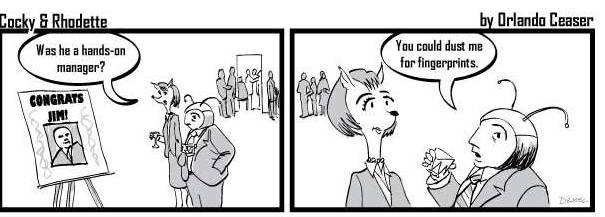
Read the label: The Hazards of Micromanaging


In our current economic environment, micromanaging incidents are on the rise. There are countless stories of employees being allegedly smothered by overbearing managers, who are relentless in requests for information. They want to document everything. Communication has escalated as data inquiries sky-rocket. Sales calls are choreographed and formatted to extract deviation, risk and ingenuity. Employees in some instances are not allowed to think, only to follow orders. Managers who were not micromanagers have hopped on the bandwagon as a self-defense mechanism to keep their jobs and opportunities for advancement.

If you were not familiar with the concept of micromanaging, “What would the word suggest to you? You might think it means managing the small details or managing something that is beneath your level, title or responsibility. Webster’s Dictionary defines it as “managing with great or excessive control, or attention to details.” Once you label something as micromanaging or a person as a micromanager, you are tipping your hand about your feelings about the manager’s involvement in your activities. If you were pleased with their input, you would call their assistance mentoring, coaching, being dedicated to personal development or as in an episode of the television program The Office, and “managing with a personal touch.”

Why are some managers, micromanagers? Why are they obsessed with every little detail to the extent of almost taking your job over from you? I have a few thoughts from years of observation, participating conversations on the topic, and working for a notorious micromanager.

  1. Feed their ego – It is a power play. They exercise position power to flex their managerial muscle.
  2. Control freak – They don’t trust their people. Employees will adapt and give them exactly what is asked and nothing more. They will not take risks, nor will they innovate and do anything differently.
  3. Won’t let go – If the manager previously performed the job, they may feel their way was the best way; after all it got them promoted.
  4. Accountability – They will participate in what I call rationalized engagement. Since they are accountable for the result, they want to be informed of every detail, for their career is on the line.
  5. Insecurity – They don’t trust themselves. They will not admit to being uncomfortable with certain aspects of the job. They view their lack of knowledge of all aspects of the job as a deficiency and weakness. They feel their inadequacy will be exposed; in a hostile environment this would threaten their career or standing within the organization.  Micromanaging may ultimately contribute to long-term ineffectiveness.
  6. Expectations – It is in their job description, written or implied. Their superior expects them to have an intimate, up to date, running total knowledge of everything.
  7. Self defense – They may be seen as a weak manager if they are not seemingly on top of their team to perform. This is linked to expectations. They may be looked upon as too soft by their superiors if they don’t practice micromanaging. It is called being on top of things and having deep knowledge and control of your responsibilities. The manager is protecting their personal performance rating, merit increase and career advancement.

Warren Buffett stated he hired the person he felt was best for the job and gave them the space to it. If they are unsuccessful, he would replace them. But many managers don’t feel this way. You might be working for one or be married to one of them. They will hire the best person for the job and relentlessly intrude in their performance of their duties.

These are some of the thoughts employees have boldly stated in anonymous employee surveys or to a stranger, when they were sure their comments could not be traced back to them. They would also aggressively shout their opinions in imaginary conversations and wishful confrontations. “Don’t sweat me. Get off my back. I’ve got this. Why won’t you leave me alone? Stop bothering me. Don’t you have something else to do; like your own job?”

Managers may inadvertently torment when threatened. Micromanaging is a perfect example of this reflex mechanism. This happens a lot when they are afraid of losing their jobs and making mistakes. The unemployment ranks are filled with those who challenged authority and did not know everything about their operation. Leadership tolerance and temperament changes in desperate times, so desperate measures are placed into action. Micromanaging is a tool of fear and desperation. It may lead to short-term benefits, but long-term problems through reduced engagement, lower productivity and compromised results.

Copyright © 2010 Orlando Ceaser

Authentic Feedback

Parents say to their children, “That was fantastic, awesome or terrific” knowing that they are exaggerating or stretching the truth. They wish to encourage and build confidence at a critical stage of their development. This practice however, spills over into the workplace as managers deliver the same inaccurate pronouncements, which can lead to a distorted picture of performance. People accustomed to receiving only positive comments are surprised when confronted by the harsh reality that they may not be as good as they think they are.

Ironically, some people are afraid to give negative feedback for fear it will hurt feelings, cause friction and effect relationships.  The inability to deliver honest and accurate feedback can backfire and cause more harm than good. It can generate feelings of entitlement and under performance. It is hard to know how far you have to go, if you have an incorrect GPS reading of your location. If people care for others and want them to improve, they cannot shelter them from accurate criticism. If there is something they need to know, they should be told the truth, as soon as possible.

Ideally, managers should be trained to select the right words, moment and situation to deliver the message, but this is not always the case. We cannot wait for the right training program to come along to get this done. Since, the real objective is improvement; full disclosure should be a no brainer. Imagine the chaos in the sports if umpires, judges, coaches and referees did not call the game with integrity in their evaluations.

Some people give erroneous feedback because they do not know what good or excellent looks like. They will use words like great, awesome, tremendous and superb because they don’t know any better. The meaning of these words is diluted and may ultimately lose their power due to inconsistent application.

Delivering authentic feedback is an issue in our personal lives. We notice weight gain in someone close to us before it is a health issue, but we say nothing. We witness destructive behavior and sit back silently, hoping it will go away on its own. We can intervene in a problem before it is magnified out of control, but we are more concerned with avoiding friction than preserving their health, improving their actions and overall performance. Sometimes, the recipient makes it uncomfortable for us to be candid by their reactions to other attempts at providing accurate and realistic assessment of their behavior.

Inaccurate information in our professional or private lives is disservice to everyone. If they go through life coddled and rarely told the truth about their performance, they will be shocked when someone tells them the whole truth.

“You can’t handle the truth” spoke so forcefully by Jack Nicolson as Col. Jessup in A Few Good Men is sadly a reality in many cases. Why can’t they handle the truth? They will have to learn to accept the truth, regardless of who is speaking it. We don’t often have the luxury to pick the messenger to bring us the message.

Some of our best teachers and coaches are reviled, revered and often feared because they told the truth. They were blunt and did not sugar coat the message. They gave us the hard cold facts. They treated everyone the same way. They were the equal opportunity abuser, but were appreciated because they were fair. Their candor and high standards were more constructive in our development than all of the face-saving inauthentic messages combined.

There is another barrier to effective feedback. This situation involves a restricted view of activities in the workplace. Many managers wonder why their direct reports results do not improve after managerial suggestions, input or feedback. They often give ineffective feedback because they are not seeing and commenting on reality. A sales representative was tentative in her response to a customer’s accusation. She fumbled awkwardly in her response, which was not her nature. Rather than comment on her actions, her manager was astute enough to recognize she was not herself. He asked how she would have handled the call if he wasn’t there. She gave a powerful, forthright, in your face, appropriate rebuttal to the customer’s challenge of the integrity of their product. She had been holding back because she didn’t know how he would react to her reaction. He told her to be authentic and show him reality. Otherwise, he would leave the day feeling he had given valuable input only to have her discard his comments, because they did not apply to her. All managers want their comments to be meaningful and relevant, but they need to see the complete picture. No one wants to engage in a game of subterfuge and wasting time.

A trust relationship is essential, so people can expose their weaknesses and have them evaluated and developed appropriately. Managers look for shortcomings to include in employee performance evaluations. Therefore, employees are reluctant to give them anything substantive to work with. They want the manager to work for it and discover information on their own. It is counter intuitive for the employee to risk demonstrating a weakness in front of their manager. Ratings, merit increases and jobs are based on managerial assessment. In the proper culture, it is advantageous to everyone, when the climate is ripe for risk taking and authentic feedback. This will allow real growth to occur and the entire corporation to benefit.

What should you say initially, when we are worried about being too harsh? Here are a few examples until you get use to giving feedback that authentic and tough enough to get the job done. I am sure you can select better ones, but the intent is to be transparent, truthful and authentic.

  • “I want to see more of that.” (When you catch them doing something correctly)
  • “Can you do that again, more consistently?”
  • “That’s it. That’s the way to do it. That’s how it should be done.”
  • “You are making progress or you almost had it.”
  • “You have come a long way in a short period of time, how can we make it better?”
  • “You are getting closer to your goal.”

The goal is performance improvement. Authentic feedback is the vehicle to accelerate this process. Inaccurate feedback can lead to unrealistic expectations and feelings of discouragement, disappointment and betrayal when the truth is finally revealed. This could have a detrimental effect on morale and productivity. Authentic feedback allows an accurate assessment of skills, abilities, talent utilization and performance. This is vitally necessary to drastically improve individual and group performance.

Copyright © 2010 Orlando Ceaser