Really, can I laugh at Work?


I started as a sales representative for a pharmaceutical company.  I was thrilled.  To think that someone would pay me to call on intelligent customers in offices staffed with friendly people who responded to my one-liners.  I noticed as I traveled from office to office that the environments reflected the personality or mood of the doctors.  Some were intense, frantic places to work, where the people rarely enjoyed themselves, rarely engaged in fun.  In other offices, although equally busy, the staff laughed appropriately and engaged in activities to cut the tension and reduce the stress.  They worked as a team, supporting each other, covering their backs to get the job done.

I’ve noticed this same phenomenon in business, school and other settings where people are together to accomplish anything.  Why are some places breeding grounds for stress and ulcers while others seem to mix enjoyment in their mix?  Why is this?  Why do some feel it is not professional or that it is against the rules to have a good time at work?  A common phrase in business is work / life balance.  The structure of the phrase insinuates that work is not life.  And if it’s not life, can it be fun?

One of my early managers attended one of my District Sales Meetings toward the end of a session filled with laughter.  One of my more humorous representatives was making a presentation that had the audience in tears.  I was parallel to the floor in my seat with tears streaming down my phrase.  I received a memo a few days later from my manager that stated that “judging from the level of laughter in the room he arrived, it was obvious that the meeting was not professional.”  There was the connection made that if there was laughter, we were not being productive, nor were we being professional. Recent research has disproved his theory.

Matt Weinstein in his book “Managing to have fun” says, “In a company where  the management begins to speak of “re-engineering,” the employees immediately think of “layoffs,”and morale plummets. And after the ‘downsizing” happens, many of their friends are gone from the company. In such a difficult time, is there any reason to initiate laughter, play, celebration? Absolutely. During these difficult times it si even more important to make sure that joyfulness and celebration are still a part of our work lives.”

This impression starts in our school days.  The class clown was relegated to someone who was not your serious student and therefore was not elected class president or voted “most likely to succeed.” We say that laughter is the best medicine, but are reluctant to prescribe it on the job.  Studies have documented the beneficial effects on our bodies and state of mind, when we laugh.  Physiologically, the body responds favorably.  It has been shown to reduce stress.  Laughter energizes and exercises the facial muscles and tones the disposition.  Yet on the job, many of us feel it is taboo to be relegated to the lunch counters, breaks or after work hours when we go on with our lives. There are a number of businesses devoted to infuse fun into your workplace.

We need to investigate ways to incorporate more humor into our work.  Some suggestions are to:

–      Let people know that it is OK to have fun

–      Model the behavior you want to see by poking fun at yourself

–     Establish a “fun commission” to develop ways to have fun

–      Discuss situation comedies that you saw on television, as well as movies

–      Celebrations are a good way to reduce stress on the job, i.e. birthdays, anniversaries, business achievements and other milestone events

–      Rather than look at the negative side of things, search for the positive view and the humorous perspective

–      Tell stories and share humorous nuggets from your past and weekend activities

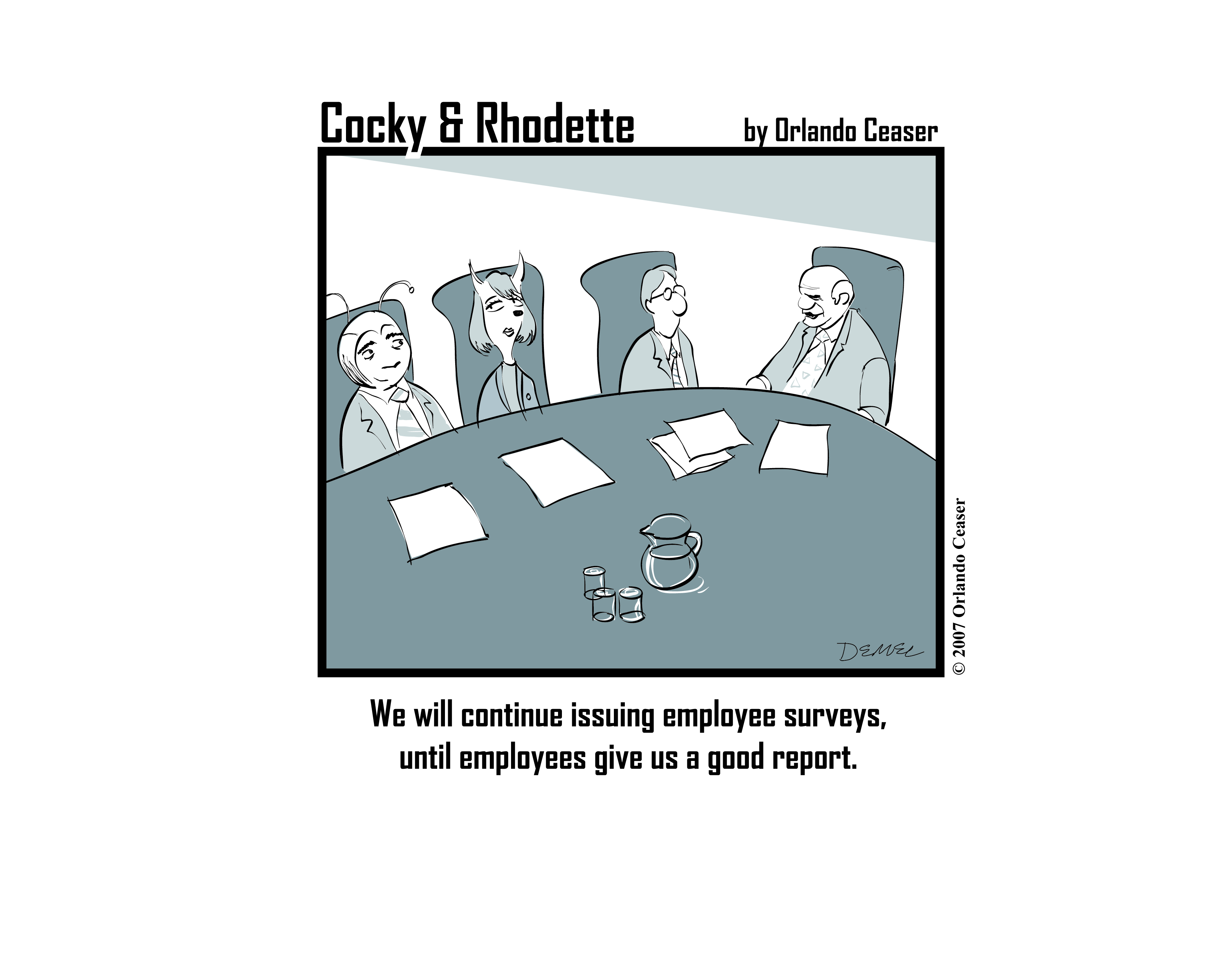
–      Hang cartoon and humorous sayings in appropriate places around work

–      Hire interesting people

–      Listen to tastefully presented jokes in books or CD’s

–      Beware of practical jokes and pranks that could hurt feelings or have negative results

–      Set limits to humor because it can get out of line so deliver the rules of the road

Someone needs to take leadership in setting the ground rules for laughter at work.  An environment that is fun can bring a team closer together, increase productivity, engagement and reduce employee turnover.  I use to say, “If is not fun, it is not fair. If it is not fair, it is up to us to do something about it. We have the power to choose fun.” Finding ways to implement or appropriately increase the laughter quotient in your place of work can have profound consequences and pay tremendous dividends.  Starting today let everyone know that it is OK to laugh at work and prove it.

Copyright © 2010 Orlando Ceaser
Loyalty, is it still relevant?


An underlying thread in the National Basketball free agency of 2010 is the concept of loyalty. LeBron James, a two-time most valuable player spent his entire life in Northeast Ohio. He transformed the Cleveland Cavaliers professional basketball team. He had an extremely positive impact on the local economy and the psychological stature of his team and the community.  Many felt he should have stayed in Cleveland for the rest of his basketball career. This was evident in the city almost begging him to stay. They were in denial around the possibility of him leaving.  Some fans reacted angrily by burning his jerseys when he decided to leave Cleveland for Miami. A scathing letter from the owner of the team was sent to season ticket holders and a 10 foot mural of LeBron was removed from the side of a building in downtown Cleveland. Loyalty was on the minds and lips of many around the state.

Dwayne Wade of the Miami Heat basketball team questioned the loyalty of The Chicago Bulls franchise toward their former players, especially those individuals who helped the team win 6 championships. Whether he was misquoted, misguided, misinformed or used this tactic as a recruiting ploy to discourage other free agents from signing with Chicago is immaterial. The fact remains, Wade injected the Loyalty Factor into the minds of the general public.

In our current business climate, companies are shedding employees in record numbers. Many of these workers are tenured individuals who helped build the companies and contributed to their success.  Since workers are often one of the largest expenditures a company has on their books, reducing numbers is a traditional means of managing the bottom line. Ironically, some of the people may have taken a risk earlier in their careers, by turning down better opportunities to stay with the organization. They may have felt it was disloyal to leave the organization. Additionally, unemployment lines are filled with loyal employees and many loyal workers are waiting daily to see if they will lose their jobs. Is loyalty a two-way street? Does it have an expiration date or a statue of limitations?  Is loyalty still relevant in today’s workplace?

Relationships, whether they are in business, friendships, romantic and athletics, involve working together and giving a certain amount of effort. When people show a greater level of commitment than they receive, there is a discussion around the Loyalty Factor.

John was the golden boy. He was on s fast track through the managerial ranks. Then one day, the unthinkable happened. John was given a Godfather offer; an offer he could not refuse. A competitor valued his experience and was willing to pay handsomely for it. His resignation sent shock waves throughout the organization. “How could he leave after all the company had done for him?” His loyalty was questioned. Given the size of the offer and the opportunity, was he being disloyal to the company or was he being more loyal to self, dreams and family? The Loyalty Factor suggests a long-term relationship, a list of expectations for work performed, terms and conditions to define the arrangement, to describe services rendered and actions delivered. The Loyalty Factor attempts to define the rules and regulations for working together. It is an understanding of how we work and interact together. In a work setting it may be unfair to expect loyalty to mean a lifetime contract.

In the classic book, The Organization Man, the company was responsible for much of the financial and social life of its employees. It provided the job, housing, stores, socialization opportunities and religious affiliation. In return for lifetime employment people were to work hard and stay with the organization.

The Employment Contract was eventually broken. Companies wanted to balance the budget in increasingly competitive environment and began to lay off people to reach their shareholders expected level return on investment. Additionally, because of increased competition, there were more options for employees. If they wanted more money or status or did not like how they were treated they could leave.  Employees gained more choice and power and left companies at will. The Loyalty Factor was openly discussed or at least thought about.

Organizations make decisions that are purely for the benefit of the company. They reduce staffed and over burdened remaining employees with higher workloads without a corresponding increase in pay. Many companies unintentionally and unwittingly train employees to look out for themselves, by following the model set by the company. Employees adopt this self-centered attitude, which may be detrimental to the company. Modeling and manifesting self-centered behavior, stifles productivity, engagement and innovation and weakens loyalty.

Let’s assume that loyalty is still relevant. An organization could not survive and stay focused if everyone is looking for greener pastures or everyone is scared of losing their position.  But what should loyalty look like in a job setting, where companies are under siege by global competition, unpredictable market forces and volatile economies? What should be the arrangement or understanding? Should we love the one we are with, while always looking for a better deal? Most companies have an “at will” arrangement with their employees which essentially means, either party can dissolve the relationship at anytime. Even with this understanding, managers are upset and vindictive when they find out that an employee is interviewing with another company. I recall an incident where a sales representative went to a job interview miles outside of his territory. When the elevator door opened, there was his manager and his manager’s boss. You can’t image the discomfort he felt in that situation. He gave a plausible lie for being at the hotel, but his perceived lack of loyalty was a dark cloud hanging over his career for years.

Loyalty is naturally questioned when there is an imbalance between expectations and contributions. If someone has done more for you than you have done for them, they may feel cheated. Loyalty is a word we use when we feel deprived, taken for granted, used or cheated. However, people and corporations like to own your services until they release you on their terms. In the workplace the slogan should probably be, “we will give the most to each other, as long as we are together.” If someday separation occurs, there will be memories of a productive and profitable relationship.

Copyright © 2010 Orlando Ceaser