0

1 Way to Breakthrough Thinking

Imagine a moment when accomplishment bursts through the final layer of resistance. You stand exhausted, but exhilarated as you breakthrough years of a prior situation and previous understanding. To breakthrough is converted from a verb into a noun to announce your victory. To achieve success you practiced a method of thinking which some would call breakthrough thinking. This level of thinking forced you to adopt principles that caused you to adapt to the innovative needs of the world.

Imagine cruising along in your current reality knowing that life is good or at least predictable.  You have become complacent. Life appears to be working well for you. The challenges are manageable and under control. You reside in a comfort zone because difficulties and hardships do not exceed your ability to handle them. But, you are not worried about the future for it promises more of the same. Inertia, that natural resistance to change is keeping the necessary objects of your world in orbit. The results are predictable, as you act consistently to match your values and beliefs. It is fortunate to be insulated, protected and feeling no pain.

The world of Normal, “the way it is”, “business as usual,” and the status quo will remain stationary until something bad happens to negatively rock your world. Sir Isaac Newton said that an object at rest will stay at rest and an object in motion will stay in motion unless acted upon by an outside force. When the outside force strikes it may throw you headlong into a crisis.

Suddenly, you encounter SBH (Something Bad Happens). You fall into or are struck by a crisis. This change in your circumstances threatens your way of living. Chaos and uncertainty are injected into your habitat. Your very survival, existence and quality of life are under attack. The panic button has been activated and you fear you may never experience the world as you knew it. While struggling to put the pieces together again, you remember the warnings received and ignored. The people who could stand on the parade route and look you in the eyes could shake their heads and say, “We told you so,” and “We tried to tell you, but you wouldn’t listen.”

When you find yourself in a crisis, you want to quickly get out of it. There is a transition phase at the latter end of the crisis. When in the tailspin, you bump repeatedly against a barrier which is the curtain to the next level of thinking. If the barrier is a wall you are trapped in your present predicament and level of thinking. However, if the barrier is a membrane, you can move to the other side in your thinking. Now you are ready to listen and obey. You beg someone to give you advice you will follow. You open yourself to Radical Thinking that was once considered taboo, irrelevant and unnecessary. Feedback is solicited that was previously resisted. You practice inclusion and involve everyone in the decision-making process. 

You are now willing to; 

  • Evaluate options that were never placed on the table or you would not allow their placement
  • Take Revolutionary Actions, which were out of character for you
  • Cast the net widely for suggestions, new ideas, and best practices
  • Encourage and implement these ideas and suggestions 

Individuals and organizations tend to restrict absorbing information from alternative data sources because they were inhibited by their files or biases and perspectives. Files in a computer are the areas where we place information. The information is neither good nor bad; it is just the data, experiences, conclusions, prejudices and thoughts in your minds. These files can be barriers to accepting new approaches. They may prevent us from reaching out and trusting people and creating appropriate relationships. We have to analyze these files and the problems they cause. A crisis causes us to rethink our suppositions and practices. We do not want them to be an impediment to growth and development.  Albert Einstein spoke of changing our level of thinking to match our current dilemma. He said, “The significant problems we face cannot be solved at the same level of thinking as when we created them.”

You are essentially in an incubation chamber, reforming and recalibrating your way of thinking. In this inquisitive, innovative state of development you face the challenges of the Crisis with the freedom and power of possibility.
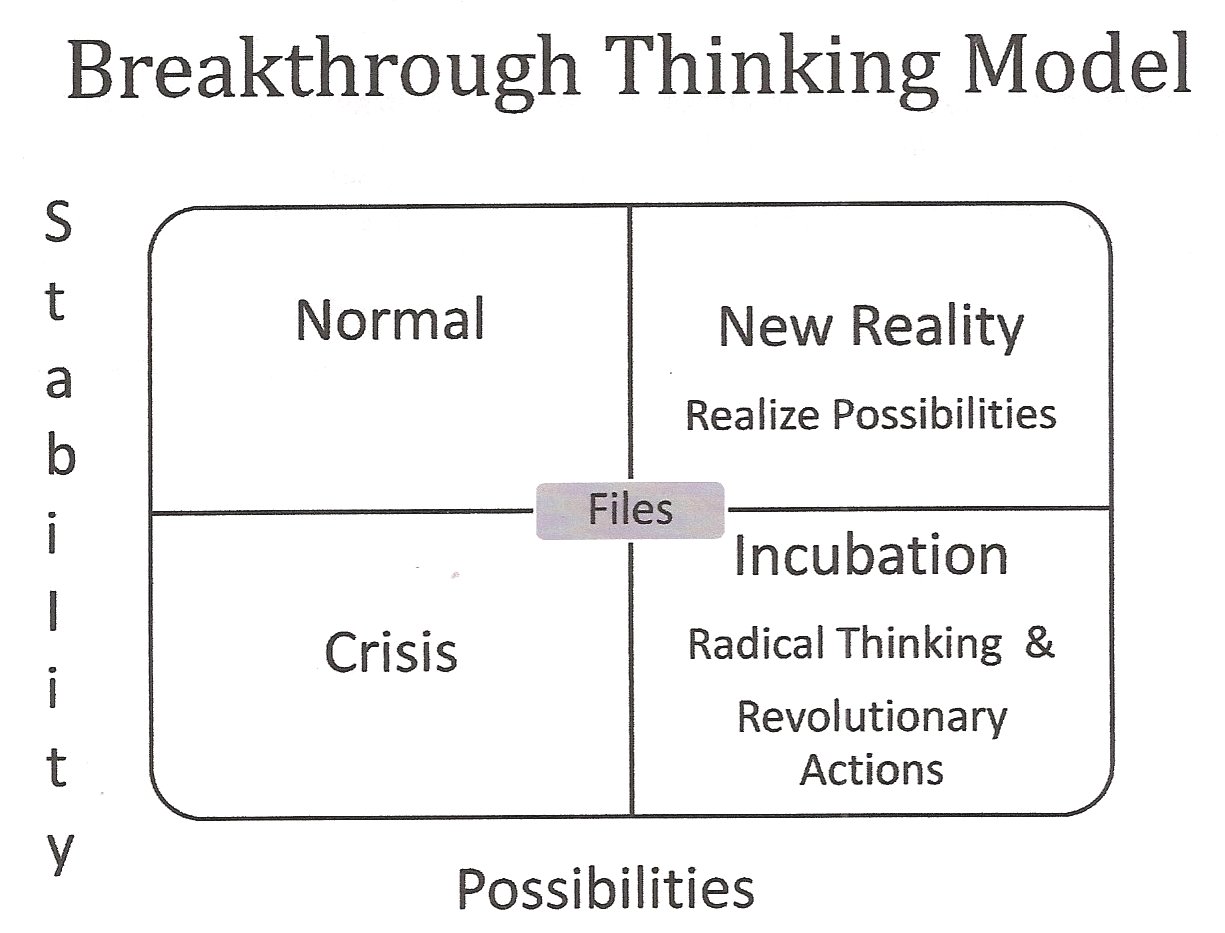
When you are receptive to new ideas and see approaches, problems and situations with fresh eyes, you will discover wonderfully new possibilities.  Acting on these new possibilities consistently will cause you to reach a new description of Normal. This new Normal over time will become your current Normal and the cycle could reproduce itself unless there is an intervention and a change in your way of thinking.

When you are stuck in Normal, complacency, in business as usual, it took a crisis to dislodge you and place you in a free-falling state. Some people have evolved beyond a crisis initiated creative process. They frequently move from their current Normal into the Incubation phase and then into a new Normal. This is done by establishing a climate of spontaneous evolution, always being calibrated to produce radical thinking, while being receptive to taking revolutionary actions to realize possibilities. Practitioners of Breakthrough Thinking strive to create a culture of acceptance and inclusion. They welcome new ideas and encourage all employees to give their candid opinions. This cultivated environment has an expectation of inclusion, participation and innovation and the results support the validity of this approach. 

It is best to enter the Crisis through a dream or simulations because then you can wake up or say; I will listen; I will do the right thing and prevent the bad thing from happening. I will engage in radical thinking and revolutionary actions consistently to prevent entering a crisis. By thinking strategically and anticipating potential futures, you are ready for the sudden adventures and possibilities that life has in store for you. 

The dynamism of this Breakthrough Thinking Model will keep you constantly evolving and reinventing yourself and your business. Some of the principles were shared with me in workshops by Gap International of Philadelphia. The Landmark Forum teaches some of the same concepts. The result of exposure to the Breakthrough Thinking Model will be an innovative mindset and culture, with the agility and responsiveness to survive in a very competitive world and marketplace.   

Copyright © 2011 Orlando Ceaser

0

Personal Evolution and Self – Development

To be a major player in the lives of others, we have to continually reinvent ourselves to meet their dynamic needs. This evolutionary process will enable us to exist among, to paraphrase Charles Darwin, only the strong who will manage to thrive.  

In the past, personal development was often external. Your manager told you what you needed to improve and if you were lucky, showed you how to do it. This tactic had some merit, but you may not have agreed with their observations or committed to their plans to improve your performance. The present and the future require personal development to be internal. You have to accept your strengths, weaknesses and development level and devise a plan to improve. Your manager will serve as a consultant and a resource. This approach will enable you to establish realistic goals and programs that are relevant to your personal needs. You cannot be a spectator in your own development.  

Ironically, you must share your weaknesses with others and accept their assistance in helping you improve. We are often reluctant to share our faults if they were not discovered by our manager. In the past, we would not reveal our shortcomings, but that has to change. The future has a bright light that will reveal our needs whether we want to disclose them or not. Remaining stationary in our skill level may have disastrous results. Our customers, the competition, the industry we work in and our professional and personal relationships are not standing still. We must adapt and change if we want to experience growth and progress.

We are responsible for our own learning. Organizations have shifted this massive burden onto the shoulders of their employees. Many will provide access to resources to assist in personalizing employee career and development plans. This requires a heightened state of self awareness and knowledge of your capabilities and blind spots. This conjures up images of evolving, changing and calibrating performance to keep pace with the rapids of change.  We could adapt our processes to match the changing face of industry. 

Profitability and Costs 

We have to look upon ourselves as entrepreneurs in every endeavor. We therefore, become involved in facets of the business that we paid little attention to in the past. Such items as profitability and the cost of resources become important to us. The decision must be made to resist the temptation of calling on a customer because they are friendly and available. Walking away from a call or a client who doesn’t have much potential is a wise use of time and effort. Managing your resources will have a positive impact on results and profits. 

Future Demands 

We often talk of developing new skills, but there isn’t a consensus on which skills are required. The skills needed today may be different tomorrow. We speak of developing a business orientation, social media expertise, cultural competence, analytical skills, relationship building, presentation skills, teamwork, strategic planning, financial and business acumen. All may be necessary today in varying degrees. However, we must determine how much of each is needed tomorrow and devise ways to get them. It is also important to plan for additional skill request that are uncovered during our journey.  Customers will want us to keep track of their skills needs so that we can advise them as a part of our excellent customer service. It is sensible to become indispensable and this will help distinguish us from our peers. 

We must be perched on the precipice of change, responding to current reality and anticipate the environment of the future. We can accomplish this by doing the following; 

  • Speaking with thought leaders
  • Reading the works of futurists and industry gurus
  • Learn to foretell and “fore-sell” the future to influence its outcome

Wayne Gretsky, the great Hall of Fame hockey players spoke about the need to anticipate by saying, “A good hockey player plays where the puck is. A great hockey player plays where the puck is going to be.” You must conquer the present and the future in order to be successful over a long period of time.

Personal evolution is a prerequisite for developing peak performance. Self development orientation is a mindset to accelerate the process. Continuous improvement is a necessary component. If you were to look in the mirror, would the reflection represent someone who is different today than they were yesterday? I’m not speaking of the aging process, but the reflection the customer wants to see? Are you someone fashioned to meet their needs? Do you have an image that’s beneficial to them and is always changing to match the times.

Copyright © 2011 Orlando Ceaser

1

Managerial Warfare: The danger of competing against the boss


There is conflict in many organizations caused by individuals competing against their managers and managers equally involved in managerial warfare. Much of the combat is out in the open, but many skirmishes occur secretly. Why does this happen? What is the cause? Here are a few possible explanations for the dissension.

Manager focused

  • The manager is insecure and wants to remove people they view as a threat to their position or ego  
  • The manager was appointed due to favoritism and may or may not be competent or confident   

Employee centered

  • The employees feel the manager took a job that should have gone to someone else; therefore they did not earn it.
  • An employee is asked to train their new boss which they resent because they personally wanted the job 

An insecure manager is dangerous. The threatened manager may demonstrate their insecurity by firing salvos to challenge people in public, undercut their ideas and take credit for their suggestions. The friction caused by their actions reduces the level of candid constructive participation by members of the team. When employees strike back they are acting in counter productive ways. They are operating from a faulty premise that if they can undermine, embarrass and sabotage the boss’s effectiveness, the manager will be replaced.  The job will be up for grabs and available for the right person. They believe a mutiny or coup is the only way to correct the injustice. 

People fail to consider that the manager was placed in their position by upper management, for a reason. Leaders do not like to be proven wrong in their selection process. A shot against the manager can be seen as a blow against the people who put them in power. 

Additionally, even an ineffective manager may have the influence and initiative to fight back and sabotage someone’s career. The manager can inform their superior of the difficulties caused by their subordinates. A manager, no matter how weak, can launch dangerous accusations against employees, which could damage their reputations, especially if they provide specific examples of insubordination. People who are cited for poor performance and insubordination can be removed from future promotional consideration. 

Case Study 1 

A manager was promoted to a job that Harold thought he should have received. When Harold heard about Bob’s promotion he was stunned. He felt he was next in line for the position and had been groomed for it. He was told by a former boss that everything looked good and that the job was his. Harold knew Bob. He was aware of his track record. They were in the same training class. Harold admired the growth in Bob’s career. He could not argue with his selection, other than the fact, he was promised the job. 

During a sales meeting Harold noticed Bob nervously pacing outside of a meeting room. He walked over to him and congratulated him on his new assignment. He told him he had interviewed for the job and would do everything he could to make Bob successful. He told Bob that he could count on him for anything. Bob thanked him and said he was pleased at his reaction. Bob also mentioned that he had been told that Harold may be a problem, because he wanted the job. Harold knew he was disappointed because the job was promised to him. Harold and Bob formed a strong team and less than a year later, Harold was promoted. The strongest endorsement for his new job came from Bob. 

From Harold response you can glean the following: 

  • Harold openly discussed his situation with his new boss
  • Harold did everything he could to help his new boss look good
  • Harold stayed committed to delivering excellence which made him a fantastic role model for others
  • Harold recruited his new boss Bob as an ally and advocate for his career development 

Harold remained positive and stayed with the organization as a constructive leader. If he could not be positive it would have been smart to leave the company. It would be career suicide to poison the company environment and change people’s impression of his maturity and leadership potential. When people are negative, it often confirms the decision management made not to give them the job. At least that’s the way management will look at it. 

Case Study 2 

John found out that his manager was threatened by him. He had not intentionally done anything he was aware of to cause this resentment. He was told by his previous supervisor that his current boss was threatened by his presentation skills and relationship with other leaders. His boss conspired to leave him off agendas and gave him smaller speaking roles and shorter time slots. John knew this explained his recent interactions with his manager. Apparently, managers had been very complementary of John’s presentations and his boss did not like their appreciation. 

John responded by continuing to perform at a high level and expand his exposure to customers and sales leaders. He even worked closer with his manager to take on more assignments and asked for more feedback on his performance. He tried even harder to make his boss look good and give him credit for the unit’s success. John was eventually promoted and his manager was demoted. 

Insecure bosses require a lot of time and attention and must be handled cautiously. Their egos are fragile and their actions may be calculated and destructive. People should work with their mentor to receive guidance on how to handle these individuals. 

There are rare circumstances when the boss openly competes against employees as an initiation exercise to test them. They want to see if they are tough enough. They will challenge them to see if they have the strength to make it in the organization. This situation when diagnosed should be pursued with great enthusiasm and competitive spirit. To lose would not be to their advantage. 

If you discover your boss is competing against you in public or behind your back, you may not be able to diminish the threat you represent to the manager’s career and ego. The general rule of thumb still holds true. Do not compete against your boss. Even when you win you may lose. The career consequences within your organizations may be destructive. Work with them to improve your relationship and job performance by making the company and your boss look good.   

Poor bosses have been replaced and great employees have left organizations. You must decide if you have the patience, faith and courage to stay or make the move that is best for you. If you stay or leave, it should be on your own terms. If you are thoughtful and strategic, even though there is conflict and warfare, you will make the right moves for your career. 

Copyright © 2011 Orlando Ceaser


2

The illusion of inclusion – when companies play games

Management called a meeting with several groups of employees. The objective was to gather input on a problem that needed to be solved. They allegedly wanted to hear directly from employees, so they could collectively create a workable solution. The employees would buy into a decision they helped to develop. As management laid out the problem they solicited suggestions. Each time a solution was offered by the rank and file, the managers told why it wouldn’t work and offered an alternative. This went back and forth for an extended period of time, until finally they were at an impasse.

The employees became frustrated by the leader’s rejection of their ideas. The managers had apparently arrived at a solution they wanted the workers to endorse, rather than give their opinion. The tension in the room was significant. Later, the workers learned that a proposal had already been submitted to Senior Leadership and received their approval. A document outlining the change had been printed. It was all a charade, the decision had been made. Some managers thought it would be a coup if they could run the program by the employees before implementation to receive their stamp of approval before rolling it out to the entire company. They could use employee input and endorsement to sell it to the entire population. Needless to say the strategy backfired and caused dissent and mistrust.

Another organization read the latest data on the importance of diversity and inclusion programs to improve the level of engagement in top corporations. They viewed themselves as a top-tier company and wanted to attract and retain top talent. Their definition of diversity was not limited to race and gender. It incorporated all of the ways people are different including variety of ideas and thought. One candidate was told in the interview that his independent thinking and ability to challenge existing methods was attractive to the company. When he was hired he was told to use the same forthright challenging method to shake up the establishment. He followed their suggestions. Almost immediately, there was trouble in paradise.

He spoke up against the status quo and was severely isolated and reprimanded. He reminded Human Resources of the conversations held during the interviews where he was told that candor was encouraged. When he referred to pre-hire mandate, he was told he had to take it slow. In essence they hired him for his brain and independent thinking but forbade him from using these gifts. He was chastised for not being a team player.  He was told that he did not respect tradition and demonstrated a low-level of emotional intelligence. In retrospect, he should have done greater research into the company culture before trusting the words of the interviewers. He felt he would be at home and would be readily accepted and included in changing the company. He ran head on into the illusion of inclusion.

If the company has an identity crisis and has not settled on its corporate values and personality, it may take a while to find itself. If a few individuals have good intentions about changing their culture, but does not have the support of leadership, be careful. There are at least three things to take into consideration.

  • People are smarter than you might think and will eventually see through the lies
  • It is better to be authentic about your intentions, even if it portrays a ruthless organizational climate
  • People should be involved as soon as possible in matters that concern their jobs

People are smarter than you think

People can tell when your actions don’t match your words or your walk doesn’t match your talk. People would rather you tell them the truth than to lie to them. They can respect you more if you are consistent, truthful and tell it as it is. They know where you stand and where they stand. No one likes to have someone underestimate their intelligence or play them for a fool. The highest form of arrogance is to think your employees don’t have the intellectual capacity to see through transparent acts of manipulation.

Be authentic about intentions

Career selections and company choices are critical decisions. Just as you want the correct match for your organization, the same is true of candidates. If the company makes a bad hiring decision, they have more room to regroup without much damage. However, an individual with a family to feed and a reputation to explain may not have the same flexibility, time and resourcefulness to recover. Don’t waste time on illusions and projecting a false image of your company and culture. People will find out soon enough. Eventually the marketplace will punish you for your lack of integrity. Top talent will avoid you. The community of candidates can create a potent grapevine to steer people away from your organization.

People should be involved ASAP

People like to be involved in matters affecting their employment, such as quality and quantity of work, culture of the environment and employment opportunities. Numerous studies support employee desire to be asked their opinions. Many companies have focus groups, employee surveys, suggestion systems and various means to hear from employees. Daniel Pink in his book Drive discusses the new information on motivating employees. The first quality is to have autonomy over their work. They want the ability to influence time at work, the tasks they perform, the people on the team they work with and the different techniques they can use to be effective.

If you work for a company that uses smoke and mirrors and other means of deception to project an ideal culture; that they have no intention of achieving, work can be frustrating. If you are a leader in such an organization, the plethora of data on engagement, culture, climate, diversity and inclusion, should remind you of the need to change. Authenticity will build trust. Inclusion that is genuine will have a profound effect on company culture, engagement, productivity and overall results. 

Copyright © 2011 Orlando Ceaser

0

Burnout – Living effectively near the boiling point

Burnout is understood by everyone as a condition you wish to avoid. Merriam – Webster defines it as exhaustion of physical or emotional strength usually as a result of prolonged stress or frustration. Individuals become less efficient and less effective and lose the very drive they need to make a positive impression. 

Additionally, many are functioning near the boiling point, within striking distance of burnout. People are working harder, smarter and longer and crashing and burning at a higher rate. Individuals are spinning out of control also, due to over indulgence, stress and sensory over load.

Burnout use to be synonymous with Type A personalities. They were legendary for flaming up and virtually evaporating from sheer mental and physical exhaustion. These individuals stood out in organization due to the small number of people who demonstrated their traits. However, the number of Type A look-alikes and Type A wannabes has grown as workloads in organizations around the world has increased. 

A common phrase I delivered to my managers who were on the verge of burnout was, “We will kill you if you let us.” This seems too often be a corporate attribute. It was the responsibility of the individual to know their limits and limitations. They were to be the circuit breaker to monitor the amount of stress they could consume. When the surge in activities became too high they were to find ways to regulate and distribute the volume of work. If they did not institute a self-defense regimen of burnout prophylaxis they would cause damage to their health, family and career. 

Burnout prophylaxis 

Most experts would agree that you can avoid or diminish burnout by a healthy lifestyle which would involve taking care of mind, body and spirit. This would involve exercise, proper diet, sufficient sleep, spiritual connection, strong relationships, and reducing stress as much as possible. At work it could involve prioritizing projects, dividing up the workload and delegating assignments. This is sometimes easier said than done.  

Just as you follow maintenance schedules for machinery such as automobiles, furnaces, air conditioners and other electrical equipment, the same should be done for your body.  Maintenance schedules in the form of a check-up and a consistent exercise routine can maintain your health. People tend to postpone their health check-ups when they are busy. These assessments are more important now than ever. Make a check list of areas of your life that could benefit from a maintenance schedule and then develop as needed. 

  • Try to maintain a healthy amount of sleep
  • Eat right and maintain as many family rituals as possible
  • Maintain your faith and spiritual development

Don’t obsess or overstress;

On minor matters focus less.

Sonya was a high energy, enthusiastic employee. Her favorite phrase was “Too blessed to be stressed.” And this mantra kept her in the emotional sate she required to manage her workload. 

Take care of your body. You are prone to illness if you don’t take care of yourself. In these difficult times, people are afraid of losing their jobs, so they go to work when sick and infect other people. Their condition gets worse and they end up taking a greater amount of time from work and cause others to miss work as well. There is a threshold over which overwork has diminishing return. Remember in college when you stayed up so late, that it took three times as long to read your assignment.

Everyone has a pain threshold, boiling point and breaking point. Know when you are being emotionally taxed by the stress associated with work. You may ask a co-worker or friend to let you know when you are particularly short or temperamental with them or others around you. 

Prioritization

You can’t be all things to all people and some areas are more important than others. If possible, speak to your boss about elimination or redistribution. Take the initiative because you are closer to the work and have a better understanding than your supervisor. 

  • Establish a ranking system for the important work and live with the reality that some things will not be done.  Since fewer people are doing the work in many instances, you may not be able to maintain the same level of commitment to lesser tasks.
  • Defer to the competition – give them more responsibility for minor matters, so you can concentrate on your core strengths. 

If you must take on the extra hours some things will have to go as you prioritize your work. Fred was told to take on an additional assignment which would take up 30% of his time. Since there is only so much work to physically be done, he asked which 30% of his current assignment could be removed from his docket. His boss was initially surprised, but Fred’s logical argument made sense. He developed a recommendation and the critical duties were performed, the new project handled and without a reduction in department performance. 

Teaming – Work and Home  

The valuable principles you learn at work about teaming applies in other areas of your life, such as the home and your community and church activities. 

  • Discuss workload and situation with family members
  • Plan activities for when the assignment at work reach a more normal level
  • Redistribute the workload at home
  • Be grateful that you have a job and don’t take it for granted
  • Gratitude and generosity – Continue to bless others as you have been blessed through sharing your time and resources
  • Find time to celebrate and have fun – laughter will help you make it through the difficult times
  • Find time to plan and focus on your dreams and your purpose 

Countless numbers of people are functioning near the boiling point and can successful manage to stay away from burnout. Burnout should be avoided at all costs. When you burn out, it will take a while to regain your composure, prior form and productivity levels. My philosophy around physical exercise is applicable to resisting burnout: “I work out to stay in shape, because of the pain associated with getting back in shape, when I get out of shape.” This will serve you well in preventing burnout. 

As the economy improves and business moves toward the black, employment levels should increase and you are hopefully rewarded for taking on a major increase in work load.  Hopefully, you can see the light at the end of the tunnel and it is not a train heading your way and blocking your path.

Copyright © 2011 Orlando Ceaser

1

Eagles in cages – Release the talent within

Family vacations were the source of many memories. Invariably our vacations took us to the local zoological establishment where we would compare that particular zoo to the many others we visited. On one such trip we were struck by the grandeur of the Golden Eagle. I watched the majestic bird as it stood confined to a small cage, while other birds were in an aviary with more room to fly. I pondered the concept of eagles trapped in cages, which was initially addressed in a poem in my book Eagles in Cages Leadership above the Rim – the poetry of possibility. 

In organizations and families all over the world, are a countless number of individuals who are not working up to their capabilities. They are functioning below expectations. They are as eagles, designed to achieve high altitudes, but are fettered, confined to a prison that restricts their mobility. These magnificent specimens reside in corporations of every size, on teams and in relationships. They sit on their monogrammed perches and make flights at low altitudes and of short duration. The toll on performance, engagement, productivity, personal satisfaction, self -actualization is enormous. Their captivity ensures that they do not;

  • Participate fully with their talents
  • Become fully engaged
  • Have their maximum impact on results
  • Stand out from the crowd by sharing their ideas
  • Take risks due to fear or lack of confidence 

Captivity extracts a psychic and financial penalty. The opportunity costs are staggering; lost wages due to missed promotions, impaired innovation, reduced productivity and other financial consequences. 

The Eagles 

Who are the eagles? They are a diverse group of individuals and teams. They may differ in age, gender, race, culture, level of ability, thinking and learning styles, education, class, religious affiliation, physical and mental capacity, country of residence and origin, and in other dynamics across the human spectrum. 

They are each endowed with talents, skills, abilities in search of opportunities for expression. They are wired to behave distinctively, in our unique way. Their passion is shown in different areas and dream of accomplishing and participating in activities that match their talents. In classrooms around the world children fantasize about beauty, greatness, wealth and the adulation of friends. In factories, the workers on the front line have ideas to improve their work environment, profitability and products. There are managers who wish to display artistic freedom in executing their job description. 

It is important for eagles to accept their role in expressing their abilities. After a speech in Austin, Texas a young lady ran up to me shouting, I am an eagle! I am an eagle!  She came to grips with who she was. This kind of fervor is rarely seen, but internally it must be felt. 

The eagles face numerous restrictions that stunt their growth and impair their development. The eagles respond in various ways; conforming, silently rebelling, optimistically hoping for the best, realistically responding to their setting. Consequently, they go along with the program, suppressing their ideas, spread negative thoughts through the company grapevine, watch the clock, and do just enough to keep their jobs. 

Eagle traits

You determine someone’s talents, strengths, skills, abilities and potential by: 

  • Personality assessments, motivational surveys, talent and strength finder questionnaires
  • Assigning projects and provide feedback
  • Observe the things they excel in on the job
  • Identifying their passion and capitalize on their strengths
  • Challenging them to exceed a higher standard
  • Determining what holds them down and what allows them to soar
  • Trusting them and relinquish some power
  • Delegating authority and give them room to expand
  • Not under estimating their potential

Eagles present with varying talents, abilities, skills and potential. When trained and coached in the proper environment with requisite aptitude, resources and motivation eagles fulfill their purpose and potential. When an eagle’s environment is expanded and their needs are met, they can fly higher and perform as they were born to produce. Dale was a sales representative who got in serious trouble with his girlfriend.  She had a parakeet that he would let out to fly around the apartment. He noticed that the bird always flew at low levels around the apartment. He felt the bird could not fly very high and its wings did not have the strength to fly away. So Dale decided to remove the parakeet from the cage and let it fly outdoors. He cupped the bird in his hands and threw it toward the sky. To his amazement the bird flew like it was shot from a rocket straight up into the air and immediately out of sight. Dale under estimated the potential of a freed bird when given the opportunity of a higher ceiling. 

Eagle cages 

The cages that bind the eagles are rarely of metal. They usually consist of: 

  • A person’s low self-esteem, fear and a desire to stay under the radar
  • Assimilation and peer pressure to stay within limits or expectations
  • A corporate culture that restricts innovation by a rigid set of policies / procedures that discourage risk taking and differentiation
  • Managers with weak leadership, coaching and people development skills
  • Poor reward and recognition systems
  • Poor training or lack of training to restrict skill development
  • An environment that lacks trust, where mistakes are punished

Eagles face personal impediments, barriers from people they know or restrictions from associations where they work-study or volunteer their time. Results are linked to expectations. Low expectations usually lead to low results and high expectations lead to higher results. But your level of ascension will also be affected by your beliefs through you self-image. Maxwell Maltz, MD, a noted plastic surgeon wrote, “The “self-image” is the key to human personality and human behavior. Change the self-image and you change the personality and behavior.” 

Emancipation of Eagles 

There are too many eagles in too many cages. One of the major tasks facing families, individuals, corporations and civic groups is how to get the most out of people. Families have the awesome responsibility to identify talents, create a nurturing environment, instruct the eaglets when they’re young and praise their successes. They have to strengthen them when there are crash landings until they learn to use their wings for maximum effectiveness. 

Leadership in organizations must play a key role in releasing the eagles and encouraging them to reach their potential.  Command and control tactics must give way to empowerment and engagement in order to experience the glorious freedom and results from the beauty of unfettered flight.  There was a video narrated by the late Orson Wells entitled, “To try again and succeed.” It tells the story of a baby eagle and the role of an older and wiser eagle in training, nurturing, challenging and using discipline to enable the young bird to fly. When the young bird is pushed from the nest and falls perilously into the depths, we are elated to see the eaglet emerge, able to fly.  Our role as eagles is to reach our potential, as we help other eagles exercise their purpose and reach their goals and the magnificent release of their talent.

Copyright © 2011 Orlando Ceaser                      www.watchwellinc.com

6

Secret dissent – (Undermining Leadership Effectiveness)

In many organizations there is a clandestine society you could label the silent opposition, the underground or the resistance. They do not agree with the direction or policies of the people in charge. They have problems with the vision, mission or some of the daily practices. They believe they could do it better or there has to be someone out there who could do a better job than the current leadership team. You may not know their real identities, opinions or intent because of their whispered opposition and secret dissent. They often;

  • Second guess every Corporate decision
  • Question or challenge the motives of management
  • Remain stuck in nostalgia and the good old days
  • Poison morale with negative and unproductive thought 

What has the organization done to earn their ire? The company may have made mistakes in the past, so the group perpetuates the negative reputation. The corporation’s current manner of treating people may desire improvement. There may be a culture of favoritism where the minions of the boss are rewarded with the choice assignments and better bonuses.  Or the contingent is dissatisfied with their own position and wrestle with a stagnant career trajectory. 

Secret dissent is also due to the fact that people believe the wrong people are in power. They may not approve of the person because of their affiliation with another leadership regime. They may also find it hard to work for someone who does not share their cultural, gender, racial, ethnic or other diversity related differences. People are known to give less than their best or more than expected based on their identification with the person or group running the operation. 

Execution has received attention over the past few years, as an area of breakdown within an organization. Ineffective execution could be due to a lack of understanding, poor leadership follow-up and low commitment to the mission and vision. They may inadvertently sabotage results by not believing in the strategy. Employees who do not believe cannot achieve at the highest level. Employees who do not buy into the program may be guilty of secret dissent. 

Many times employees are not committed to the program because they have their own agenda. Imagine showing up at an event when there is the main program and another agenda being circulated at the same time. There are times and performances listed and a different order of services, relentless sidebars and competing performances. The impact of the service would be diminished and it would damage the effectiveness of the program. 

Many organizations assess the corporate climate by conducting a cultural analysis, 360 degree feedback instrument, and employee and engagement surveys to determine employee perceptions. These resources enable an organization to gauge the corporate culture and climate, so that leadership can institute a strategy to improve the environment. This should ultimately lead to an improvement in employee engagement and results. The plan is also more scientific than cultivating a list of credible informants to give their assessment of the emotional climate. 

Leadership has to address the negative grapevine or live with ineffectiveness causing compromised results and poor morale. Secret dissent can affect alignment and the achievement of corporate goals. It is difficult to lead with a faction aggressively working to undermine your position. Imagine a general leading an army toward a goal of victory when there are people in their ranks giving contradictory orders. Imagine a sports team when the blockers are following their own plays and moving in a different direction. 

Counter instructions can limit the effectiveness of an organization. A sales region for a pharmaceutical company devised a 3 part strategy to handle the secret dissent within their region. New employees changed their excitement about Regional Office staff after spending time in the field with their co-workers. Apparently, some senior representatives corrupted the minds of the new recruits with bad information. Regional leadership developed a proactive strategy to counter the negative commentary. 

The new employees were told that some people may not share their enthusiasm for the company and its regional staff.  As a matter of fact some may question leadership sincerity and competence. When they hear disparaging comments they were instructed to simply ask three questions of the accusers; 

  1. “How do you know this to be true?” This is to determine if it is mere speculation or based on certifiable examples.
  2. “Why are you telling me this?” Since they are new with the company and full of excitement and promise, why does anyone feel the need to bring them down with negative views from the past?
  3. “If it is so bad, why are you still here?” This question usually gets to the heart of those who complain without offering solutions. They are mired in excuses and short on explanations. 

A few months after instituting this strategy a new recruit could not contain her excitement. She followed the 3 questions strategy. She reported that it worked like a charm. The sales person was delivering negative information. She caught him by surprise by asking the 3 questions. He froze in his tracks and abandoned the negative comments about the company. At least, this approach helped reduce some of the negative thinking directed at their new personnel. 

The objective is not to abolish dissent, but to encourage all voices to state their opinions and position in a consistent manner. For this to happen, a company must establish an environment where people can state their minds without fear of reprisal or retaliation. They must also teach people how to dissent. The old adage of disagree without being disagreeable is still valid instruction. Additionally, it would be helpful if everyone understood and embraced the meaning of consensus. They should fervently discuss debate and disagree, but when they settle on strategy and tactics, everyone should support it whole heartedly. Their objective should be for the greater good of the enterprise. 

It is difficult to succeed without alignment and everyone pulling in the same direction. Some resist the entire platform and other certain elements of it. Many times resistance occurs without allowing the strategy or tactics an opportunity to work. I was guilty of this early in my career. As a sales representative my manager wanted me to implement a program I felt had no way of succeeding. He wanted me to give a pharmacist 6 vials of three of our products as free samples (2 for each product). Each vial contained 12 tablets. The pharmacist was substituting generics for our products. My boss felt these 6 vials would stop him from this substituting a generic for our products. I was not concerned about these minor products because I was increasing the market share of our other products.  I told him I knew the pharmacist and he would lose a large amount of money on this approach. 

Needless to say, I did not follow his advice. I will never forget his words when he found out I did not implement his suggestion. He said, “You decided that it wouldn’t work without the decency of trying it out.” I realized my folly and put a program in place to implement and track the results. I was guilty of secret dissent. 

There may be an anti-leadership faction within your organization for many of the reasons listed. The leadership team has the responsibility to cast the vision and inspire the team and its leaders to commit to the organizational mission and vision. Incentives should be in place to reward the team when objectives are reached. Effort should be made to place the right people in the right jobs where they can have input into their development, learn mastery of skills to reach their potential and receive the joy of belonging to a higher purpose. But there is also the obligation to hear the individuals who may not be on board with the strategy. Well meaning individuals should be heard and their views taken into consideration. However, if their secret dissent undermines the integrity of the operation in a destructive manner, a decision has to be made on their value to the organization.

Copyright © 2011 Orlando Ceaser

7

3 Reasons Why Good Enough Isn’t

 In simpler times, one could comfortably establish a satisfactory level of performance in any area and pace themselves while delivering reasonable productivity.  A co-worker told me that he would set a high level of work output, which was nowhere near his maximum effort, and his boss was pleased and impressed. There were no engagement surveys, but individuals surpassed the objectives and expectations of management and the marketplace. Employment was not at risk and if someone did not like their jobs they could easily find a job at another company. Today, I don’t have to tell you that times are different. 

The current economic climate resulted in layoffs.  Remaining employees are doing the work of several people. It is impossible for mediocre performance to hide. Additionally, investors are desperate and aggressively scrambling to find investment options that warrant their resources. Business demands a skill set and a mindset superior to the requirements of the past. Today, the speed, endurance and techniques (SET) of yesterday are no longer good enough to make the grade, for a variety of reasons.

1.    Survival demands Excellence   

Companies are searching for a higher brand of talent and consequently, people’s jobs are at risk. Average performers are particularly vulnerable. Average performance will no longer be condoned or tolerated. In tough times the marginally effective are an endangered species. The mandate against mediocrity is strong. Only the strong survive and the survival of the fittest is the order of the day. 

Organizations are calibrating employees and force ranking them from the best performers to the lowest. Workers are also labeled as A, B, and C employees. The closer you are to the bottom of this rating scale, the more susceptible you are to personnel cuts. The angst this creates in the workforce perpetually reminds people of pay for performance. This also means that just good enough isn’t. 

Effort alone is insufficient. The old adage of working smarter not harder still has merit. However, when you work smarter without a corresponding increase in working harder management accuses you of loafing. My earliest recollection with working smarter was in college when I worked on an assembly line changing oven liners at a General Electric plant. I devised a way to work smarter to make time to read from a book. This infuriated my foreman who said, “If you are going to create more time, take that time and sweep the floor.” He really wanted me to work smarter and to work harder. 

Nearly twenty years ago, I gave my District Sales Managers an extra office day every quarter to create something that would benefit their sales team. It could be read a book to develop a workshop or anything that would improve their level of creativity. Companies talk about being creative, but most do not take the opportunity to put words into action. Some companies such as Gore, Inc. build creativity and thinking time into their culture.

2.    Changing needs of the Marketplace

Marketplace needs change due to demographic shifts in the customer base. The buying power of diverse consumers is steadily increasing and will cause companies to alter their marketing mix to include these customers. The four generations of consumers will motivate companies to customize their marketing messages to the desired customers. Marketing was already a sophisticated practice, but it will be even more specialized.

The Total Quality Movement made quality a non-negotiable; a standard part of every product or transaction. Poor service will not be tolerated and the market will run consistent violators out of business. The customer has many options in person or on-line. Companies are vying with their competitors to acquire and inspire customers to buy their products. For example, customer services procedures mandate that returns are handled without hassle, which is different from the interrogations people encountered a few years ago. Individuals and organizations must move from acceptable performance to exceptional performance, because only in the domain of excellence can they hope to prosper. 

The competition is changing in number, methods and locations. The stakes are higher as entrants are fiercer and more lethal in their promotional strategies. Some will advocate peaceful co-existent, while others will try to annihilate the competitors.  

Students prepare for and compare themselves to their class mates. Their limited view of the competitive landscape confined to their classrooms, schools and communities. Clearly, students are competing for resources and recognition on standardized tests in their state, but many of their competitors will reside in other countries. Students across the globe are sacrificing their time and dreaming of living the prosperity of our American dream. Globalization has created a global economy where people compete directly or via the Internet. 

Paradigm shifting is almost a dance of regularity as best practices and input from outsiders accelerate the rate of change in most industries. Theodore Levitt, the esteemed Marketing guru, popularized the phrase, “planned obsolescence”, which basically challenged companies to replace their product, before the competition made them obsolete. This philosophy also works with individuals. It is incumbent on each of us to make our current skills obsolete, as we replace them with a newer version, 2.0, 3.0, 4.0 or whichever version is needed to meet the needs of the future. A culture of innovation is imperative to stay ahead of the myriad of changes in the business world.

3.    Technology could make you Obsolete 

Companies must find a way to improve their products or the marketing of their products and services. Social networking and its many platforms and applications have spread the exposure of many brands to a larger audience.  Companies are evaluating the use of technological advances such as the iPad and the Internet to market their products. Technological advances are being solicited and evaluated and implemented to form a competitive advantage or maintain competitiveness.

Knowledge is doubling at a great rate, “as shown in patents and academic publication, knowledge doubles at different rates for different sectors, ranging from 2 years for nanotechnology to 21 years for other sectors.” (newsfan)

There is more to keep up with and more to master.  So everyone must keep up with new information, best practices and scientific applications for their brands, business and career. This applies to everyone, even if your focus is your education or managing a career. 

Everyone must stay on the technological wave and ascertain its value. We must find a creative way to promote our brand, even if the brand is our own identity.

Everyone must emphasize speed, endurance and techniques (SET) beyond what was previously acceptable, as we strive for the exceptional.  Clearly, we must embrace the reality that good enough isn’t.

Copyright © 2011 Orlando Ceaser

0

Career Fast Track – How can I get on one of those?

A fast track has a surface that allows the participants to move swifter than usual. The term is used in many instances such as horse racing, running and the condition of the field for athletic events. Wikipedia defines it as an informal English phrase meaning “the quickest and most direct route to achievement of a goal, as in competing for professional advancement”. 

Performance times are better under these circumstances. A fast track is also a career path that enables those who gain entrance, to move along the proverbial corporate ladder, at an accelerated pace. In business, the fast track exists for succession planning. Leadership wants to groom the next generation of managers and leaders. The leaders of tomorrow must have the necessary skills.  The top talent must be exposed to a holistic view of the company, competitors, and the challenges of the industry, which this track provides.

The fast track is reserved for the anointed ones, the heir apparent, and the chosen ones.  It is an envied path that many would like to travel. It is like the outside lane (HOV) in cities like Dallas, Texas, where you can move quickly if you are traveling with a passenger. The corporate prodigy is the passenger riding with the sponsor for their career. The track can be customized to hold one person or a field of talented individuals receiving special treatment. 

Organizations may determine there is not enough variety of thought in their leadership pool, so they structure a plan to accelerate the movement of certain individuals within the organization. Fast track status may be awarded to people as part of a diversity initiative with the focus on fairness and adhering to organizational standards of excellence.

One company established a Corporate Program to facilitate the movement of recent college graduates within the company. Aligned to prestigious universities, the plan brought in some of the best and brightest graduates and rotated them through different departments. The strategy ensured that fresh ideas from academia would continuously flow into their company.

How do you gain entrance onto the fast track? The invitation goes to the high fliers and top talent, but how do you become one of those elite players? Everyone wants to be one of those individuals who are routinely exposed to Upper Management and fluidly move through different roles to gain the background and experience to take on higher levels of responsibility. The key tactics are listed below. 

Fast track tactics

  • Phenomenal Performance – Excel short-term on the job and draw attention to your effort, intellect and results
  • Acquire education and expertise – Develop skill sets that are unique and in great demand
  • Connections and relationships – Make contacts with key leaders and obtain their advocacy for your potential and impact on the organization
  • Beyond your control – There may not be anything you can do 

Phenomenal Performance 

Fast break people many times are identified and targeted shortly after they join an organization. Their first impression is phenomenal. They get out of the starting blocks quickly and hit the ground running. They are the one’s whom management very early on says, “We have to keep our eyes on them.” They speak out in meetings; demonstrate leadership and exhibit a fresh perspective in their responses and interactions with peers. Some are new to the organization. Nevertheless, they are courageous and confident enough to challenge and question the status quo. Occasionally, they are recruited by the organization with promises regarding their career mobility. Ideally, most fast trackers are home-grown and developed through the company ranks. 

Education and expertise 

Astute employees may analyze skills and competencies that are not available in their company or in a large enough supply. They are students of the industry and corporate culture. They propose new techniques, best practices from their professional reading and experience. They work above and beyond the call of duty, which includes longer hours. They acquire the skills their research shows are lacking or they identify the need and ask to lead a project team assigned to explore and make recommendations. 

Connections and relationships 

A third strategy involves making the connections to develop the relationships to be one of those fair-haired boys and girls. This will test your political competence. You need a sponsor and an advocate. Boldness and tenacity are required to ask a senior leader to be your mentor. Introduce yourself to those in power and share your ideas for the company and your career.  Another valid technique is to ask someone to contact key personnel on your behalf and arrange a meeting. Know the culture within your organization to gauge the acceptance of your ideas before interacting with Senior Leaders.

Beyond your control

You may not be able to influence your placement on the fast track. A secret committee with secret criteria and a secret handshake may decide its members. They select people to continue the status quo or people who think like the founders of the company. One CEO placed someone as a possible successor who reminded him of himself at an early age. The fast track may be filled with people selected based on preferences and biases. Diversity initiatives may influence the placement of some individuals. These individuals cause less controversy when their talent match or exceed the qualifications of other members on the track.

When vying for FTS (Fast Track Status) use performance evaluations as a great venue to review your work against company objectives. Lobby for positions to advance your career, always strengthen your portfolio and strive to make yourself indispensable. 

Self Assessment

Be objective when reviewing your skill set for possible inclusion on the fast track. You must be objective; otherwise you will resent someone who is more qualified and suitable for the role. Get a second opinion other than your own. Be honest if you discover your talents are significant, but not among the best. Don’t worry, you can be recognized and rewarded by not being on a fast track; since most people are not on a fast track. 

Bear in mind that members on the fast track may be willing to perform and make sacrifices you are not willing to make. I had an employee who felt someone was on a fast track and he resented the promotion they were offered. The job was located in Headquarters many miles away. He felt he was being deprived of the opportunity to compete. I asked him if he was willing to relocate to HQ, he said “no”. It is not reasonable to resent someone who qualifies for a promotion, you either did not want, or were not willing to meet the conditions. He excluded himself by refusing to relocate. The information he distributed about his career aspirations and relocation restrictions denied him access to the fast track. 

If you can’t join them – Align with them 

Wise people align themselves with the anointed ones. They are cordial and cooperative with the golden men and women, in order to form a strategic alliance and gain insight into the company. They realize that someday they may be able to help each other. 

Ironically, many times the favored ones leave the company after they have amassed a stronger resume. This is particularly embarrassing to the leader who fawned all over the fast tracker, only to be used and discarded when they receive a better offer from outside the company. The previous fast tracker may ask you to join them as a part of their team in the new organization. This position could be a promotion and the stimulus your career needed to increase your portfolio, income and broaden your network. 

If you feel the rise of the anointed one will blunt your career and deprive you of promotional opportunities; you must do a few things;

  • Consistently perform at your best
  • Maintain morale – It helps to reduce stress and model behavior
  • Exhibit leadership in the face of adversity  
  • Remain positive – Complaining to your peers is not advisable
  • As you evaluate your options, devise an exit strategy, even if you don’t use it

The fast track is great if you are on it and a source of mystery and suspicion if you are not. Continuous excellent performance over time could pave the way for you to move onto the fast track at a later date, so don’t give up too quickly.  However, you can have a robust career with professional and personal growth without being on the proverbial fast track. Good luck.

Copyright © 2011 Orlando Ceaser

1

Leadership – 7 Acts of Love

Leaders don’t like to use the language of love when speaking about their constituents. However, caring for their people can enable them to obtain outrageous output from people who will joyfully capitalize on opportunities and achieve better results. Seven Acts of love can generate power by demonstrating compassion for those responsible for making the leader look good. 

  1. Leaders want you to develop and deliver your best work
  2. Leaders want you to be interchangeably self-sufficient and interdependent as needed to achieve your goals  
  3. Leaders will praise you when you excel and instruct you when necessary
  4. Leaders will admonish you when you are wrong and astonish you with service and generosity
  5. If you leave for greater opportunities, leaders will encourage your journey, admire your risk taking and wish you success
  6. Leaders will continuously invest in themselves, so that they will have more to give to you
  7. Leaders will connect you to a cause bigger than yourself

Act l – Leaders want you to develop and deliver your best work

Leaders who care about their people want them to reach their potential in a role that best suits their talents. They provide opportunities to gain experience in assignments that stimulate personal growth. These assignments are chosen to stretch their employees by extending their spectrum of skills.

Leaders are not satisfied if their followers are performing below their abilities. Leaders take it personally. If they can’t extract the desired effort from their team, they feel responsible, because they are accountable.

Act ll – Leaders want you to be interchangeably self-sufficient and interdependent, as needed to achieve your goals   

The role of the leader is to teach their people to fish, but also to fish in community. They want them to acquire the skills and knowledge to learn how to function on their own. A manager cannot stand over their people’s shoulders at all times monitoring their behavior. Leaders have to trust their people, but trust is based on a track record of success. This is accomplished through instruction and inspection.   

A crucial expectation is for people to work in teams, because the results are superior when a group puts their brains and brawn together to tackle the problems of the workplace. Most assignments require interacting with co-workers, customers and classmates. Knowing when to work in isolation and how to work in a team is a notable competency. 

Act lll – Leaders will praise you when you excel and instruct you when necessary 

People respond favorably to praise. They want their effort to be appreciated, but their effort must achieve a satisfactory result. A leader who loves and cares for their people wants them to know that they are valued members of the team. Additionally, the leader knows it is their responsibility to intervene when feedback is required. A leader who cares about their people wants them to have the benefit of expert instruction and a realistic assessment of their performance. The feedback and instruction must be delivered in a timely manner. Timeliness refers to instant correction when mistakes are made and frequent evaluations of progress, rather than waiting for an annual performance review. 

Individuals who feel their leadership is committed to them will reciprocate by giving their highest level of engagement. Leaders are aware of the phenomenal results from a team of highly engaged individuals. 

Act lV – Leaders will admonish you when you are wrong and astonish you with service and generosity

A leader who cares for their people will institute disciple for behavior that violates policies or standards of excellence. People are aware of expectations and consequences, which are administered fairly to all employees. John Stout, a British theologian said “Love without truth is too soft; Truth without love is too harsh; our objective is to speak the truth in love”. A leader must have the emotional strength to deliver tough information, especially in the name of achieving excellence. 

The leader must intermittently astonish their people with generosity. This can be in the form of compliments for excellent behavior or random acts of praise, favors and material gifts.

Act V – If you leave for greater opportunities, leaders will encourage your journey, admire your risk taking and wish you success 

Invariably, a leader will lose members of their team to other organizations or departments. The initial emotional response borders on anger, disappointment and betrayal. They gave time, effort and resources to help them grow; now they show their appreciation by changing roles. These emotions are natural; however, if the leader ever cared for the person, their feelings should not have been contingent upon them staying with them forever. If they are an expert leader and developer of people, at some point they will not have enough opportunities to satisfy everyone needs for promotional growth. Leaders should be content with seeding the marketplace with excellence guided by their hands. By releasing them they may be able to return someday or offer opportunities to others. 

A leader should want only the best for those who serve them well, with a history of very high performance.

Act Vl – Leaders will continuously invest in themselves, so that they will have more to give to you 

I relocated seven times during my professional working career. These were excellent opportunities for acquiring additional skills and personal growth. Our children were perennially the new kids on the block, but they gained new skills. For example, we exposed our children to travelling, sports and musical instruments. The experiences allowed them to discuss many subjects and play multiple sports and instruments. 

I also benefited from the moves. I cultivated new aptitude, gained insight into many different jobs which made me more valuable. As I poured new skills into myself I was able to be a greater resource to my people. To speak firsthand about job assignments, relocations and the adjustments needed to be successful in today’s corporate environment was an advantage to my people. 

Act Vll – Leaders will connect you to a cause bigger than yourself

One of the yearnings of the heart is to be a part of something greater than self. A leader who can link individuals to such a cause or vision will be highly respected. People will be energized to wake up each morning knowing that they make a difference. When direct reports realize they are connected to something that makes the world a better place, it elevates their spirit and sense of purpose. 

Self actualization is achieved when each person is working at their optimum capacity. When a leader cares, followers will go the extra distance to make everyone successful.

Copyright © 2011 Orlando Ceaser