The 4th Monkey – “Do No Evil”

We grew up with the story of the three monkeys. I imagine that many of us have the same interpretation of what they represent. We were exposed to pictures or statues. One monkey had his hands over his eyes, the second monkey with hands over his ears and the third monkey’s hands were over his mouth. They were see no evil (Mizaru), hear no evil (Kikazura) and speak no evil (Iwazura). There were actions and behaviors demanded of us based on the three monkeys, but nothing was said about the fourth monkey. The fourth monkey was do no evil (Shizaru).

four-wise-monkeys

The stories of the four monkeys were popular in Japan in the 17th century. Their origin is between 2 and 4 BC in China. The Storyologer web-site (www.storyologer.com) has this account of Mahatma Gandhi who carried around a small statue of the three monkeys.  “Gandhi had a statue of three monkeys in three different postures. One was shutting his mouth with his hands, the other was shutting his ears similarly and the third one had put hands on his eyes. A visitor to his house became curious and questioned Gandhi about the various postures of the monkeys. Gandhi politely replied, ‘The one shutting his mouth tells us that we should not speak ill of any body. The one shutting his ears tells us that we should not hear the ill of any body. And the one shutting his eyes tells us that we should not see the ills of any body. If we do so, we will have all goodness and nothing but goodness.’

Travelers will often find local markets with carved depictions or artwork featuring the three monkeys. My wife was able to purchase an angelic model of the same concept. There are three angels; one was covering her eyes, one was covering her ears and the other was covering her mouth. However, the fourth monkey was not shown. The 4th monkey, when pictured, is usually shown folding his arms (the body language of being closed) or covering his crotch to signify inactivity.

It is fascinating the different interpretations of the four monkeys. In Buddhist tradition it meant don’t spend your time preoccupied with evil thoughts. In the West it relates to not facing up to our moral responsibility, for example turning a blind eye. But in my household, the monkeys were presented to us as a model of proper behavior. Our parents wanted us to identify with the images, to supplement our moral code.

See no evil (Mizaru)

We were told to pay attention to people and location(s). The idea was that if we were in the right location, we would minimize seeing trouble develop before our eyes. This was applicable in school and at work. We were instructed against being at the wrong place at the wrong time. We were also told not to look for bad things in people or in certain situations. There are people who see bad things when they don’t exist, which could explain the manifestations of bias, stereotypes and profiling. We were not taught to be naïve, but to be careful and respectful.

Hear no evil (Kikazaru)

We were told to shield ourselves from bad language and bad intentions. We should stay away from people who spoke ill of others and gossiped. If we were not in the wrong place we could minimize hearing things that we should not hear. There was an exception: if we could acquire evil information and use it to do good or to help others, that would be permissible.

Speak no evil (Iwazura)

Speak no evil was used to discourage gossiping or speaking ill will about someone. We were told to watch our language and to speak kind words. “If you can’t say anything good about someone, don’t say anything” was a part of this same philosophy. Adults told us that spreading bad news or malicious information could come back to haunt us. We should also, apply this same advice to the workplace.

Some of us have adopted a code of silence in the workplace and would not tell when someone was not pulling their own weight. We would rather silently complain or resign, before talking about a employee who was not working. It is our responsibility to find a way to report injustice, illegal behavior and practices that undermine people and the organization.

One way to break the code of silence is by offering incentives to whistleblowers. These individuals are people who step forward and report unlawful activities in an organization. They are generally paid a 10% bounty if the measure goes to court and fines are levied against the lawbreakers. In neighborhoods where people know the perpetrators of violence, but fail to come forward, there are no such incentives. Residents may be afraid of retribution, as the rationale for their silence.

Do no evil (Shizaru)

The fourth monkey’s actions are truly related to the others. The workplace is a common place for the four monkeys to be used as an operating system. Employee bullying and intimidation, sexual-harassment claims, the presence of racial discrimination and sexually charged language and actions exists in some organizations. Where improprieties and liberties are taken with people’s rights in the form of disrespectful words and actions, there are laws in place to prevent and punish these actions. Employees, who adopt a see no evil, hear no evil, speak no evil mindset are not helping to develop a positive company culture or a respectful workplace

Do no evil is a perfect monkey to enforce the values of character and integrity. He reminds us of proper behavior and etiquette. Our choices have consequences and the more we can emphasize a positive corporate culture and a respectful workplace the more effective our organizations will be become. There is conduct and behavior norms which must be identified, emphasized and enforced vigorously. Character will minimize stress in the workplace and reduce the number of lawsuits and discipline related to improper behavior.

How can we create an environment in our workplaces, families and communities, where people are held accountable for their own unlawful actions and the private citizens who come forward can feel safe and protected. If the fourth monkey was modeled, we would have less of a cause to talk about the other three monkeys.

Do no evil should be magnified and connected to many of our guiding principles of behavior.  The Golden Rule and its equivalent in many cultures advise us to treat people the way we want to be treated. The Platinum Rule which asks us to treat people the way they want to be treated. The 10 Commandments implores us not to do a series of acts which could be seen as evil, such as murder, stealing, etc.

We must clearly outline expectations of behavior and the judgment related to them to improve the climate in our organizations, homes and places where people meet. Correct action is essential to achieving healthy results in our relationships.

The imagery and practices espoused by the 4th monkey holds the key to making this possible. I am hopeful that by emphasizing the fourth monkey, we can improve our behaviors, connections, interactions and relationships of all kinds.

Copyright © 2016 Orlando Ceaser
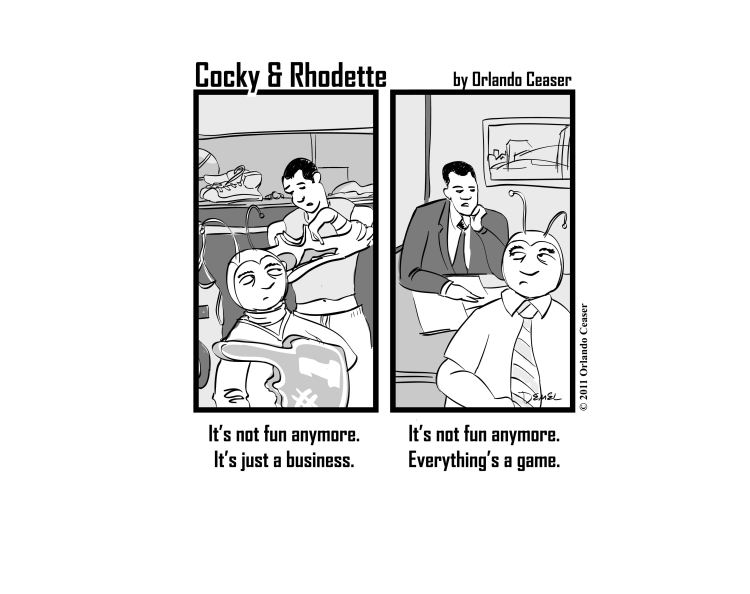
Loyalty – To be or not to be?

Just_a_Game_b

Loyalty is an awkward discussion topic within organizations. The relationship with our jobs is complicated. Layoffs, reorganizations, mergers and acquisitions, plant/store closings, and outsourcing jobs overseas have a negative impact on employers/employee relations and more row. Managers in some organizations think, “Why should I be loyal to my employees, after all this is business.” Company survival trumps loyalty is their current mindset. Employees wonder if they should stick around.

Additionally, employees who were loyal to their companies find themselves out of work and feel betrayed and used by their former employers.

Loyalty can be defined as allegiance to something or someone. Loyalty is earned and its compliance is given by consent. We are speaking of loyalty in terms of fidelity to your company. We may also view loyalty on several different levels: loyal to your manager, coworkers and team

Loyalty is an intriguing concept. We know what it is and the circumstances where it should be exercised. It is emotional and enhances the value of a relationship. Relationships have expectations. If these expectations are not met or are threatened, loyalty is affected. When loyalty is coerced or forced, people will stay on the job until the right opportunity arrives to ease their conscience as they leave the organization.

We are loyal when someone or something is worthy of our trust. However, when there is a breach of trust, loyalty is retracted.

Loyalty Demonstration

Loyalty must be discussed in the context of equality and reciprocity. After all, reciprocity is a part of the transactional currency of loyalty. The company is providing something to the individual and the individual performs the work commensurate with the salary and the environment. Loyalty involves fairness and keeping your promises. The employee’s level of engagement reflects their level of appreciation for the services rendered. If the employee is treated fairly, allegedly, they will work hard, speak highly and positively about the company and remain a part of the organization. Loyalty is given as long as both parties fulfill their part of the obligation.

A leader who is loyal to their people may fight hard to justify retaining good people at the expense of others. An organization/leader that has a reputation of doing everything to minimize layoffs and retain employees can influence the number of loyal employees who choose to stay and speak highly of the company. Some companies may take less profit, in the short term, and minimize turnover in their organization.

What do you do to develop loyalty within your people? Some may argue that loyalty is not something that you develop, but like trust, is something that is earned. What steps can you implement that will save your business and earn loyalty from your employees? Do you show that you truly value their contributions? Do you adopt strategies that protect your people during the hard times until profit improves? Do you honor your promises and meet their expectations? Discuss the big picture to keep employees apprised of company challenges and performance, where appropriate.

Seeds of defection

Organizations will frequently make decisions and state that they were made in the best interests of the company. Budgets are cut; people are reassigned or displaced in order to improve the bottom line. Some leaders will not search for an alternative view that would spare jobs and careers. Leadership will quickly reduce headcount. This plants the seeds of defection, as people realize they are only a number, a statistic, headcount and a line item on a budget.

A selfish organization risk creating a selfish, culture where people stay or jump based on their individual needs being met. Therefore, everyone is treated as expendable. People respond by acting as mercenaries or hired guns. This removes the stability that people like to experience.

If a company reduces staff, so they can bring them back later, employees become stressed. They are constantly performing emotional gymnastics in a toxic environment. Conversely, if the company goes out of its way to inform and retain people and they know it, they may go out of their way to stay or deliver higher levels of engagement, retention and overall performance, to protect the company and their jobs.

Loyalty used to be defined in the context of fidelity, as it related to staying with an organization long-term. However, there’ve been countless instances where people passed up job offers from other organizations, only to be terminated by their own company. Individuals are angry at themselves for being loyal to a company and then the company does not show the same kind of loyalty to them. When did these stories circulate around an organization, people vow to never let that happen to them if they can help it.

Mindset in Today’s market

What kind of mindset should you have in today’s precarious job market? Should you keep your head down and not worry and everything will be alright and work itself out? Should you be open-minded to the flirtations from other companies promising a better deal? Should you put the word out that you are interested and seeking a different long term relationship? When people approach work with the mindset of the, “it’s just a job,” loyalty can be compromised.

Some people strategically interview internally and externally to keep their interviewing skills sharp. Their rationale is that it keeps them sharp for jobs inside and outside of the company. Other employees interview for ego and the self worth to see if they still have the skills desired by another organization. Others want to test their market value to benchmark for raises.

Loyalty Risks

People are hired who have demonstrated the propensity to jump frequently from job to job. Their track record is firmly stated on the resume. They are hired hands or have a mercenary mentality. They have an unspoken understanding with management that they are there to fulfill an assignment or until they can’t get something better. This may ultimately become a disadvantage.

I was impressed by a young man who fits the above the description. We met between sales calls and he asked if my company was hiring? He was very impressive; He went on to say that he was always looking for a better job. He made a very elaborate presentation of his thought process of always looking out for something better. As a hiring manager, I pondered the risk of recommending or hiring someone like him who was always looking to leave for greener pastures. Loyalty with him would be misplaced and could be detrimental to the survival of the new organization.

Loyalty is a learned trait. It is generally observed and imitated. Individuals learn from an environment where loyalty is practiced. They learn the components and the guiding principles and foundation regarding its use. Both parties in the employer/employee relationship are evaluating the value of the arrangement. Both groups are under enormous pressure to behave in a manner that is considerate of each other.

If a company lays off employees as a last resort, it may be the nature of the business that is the business required it. Employees may not like it, but ultimately will understand.

If an employee receives an outstanding offer from another company that could benefit them and their families, it may be the right decision to take the job. In some industries, it is the nature of the business to change jobs frequently to build a resume of different experiences. In each situation, the ideal objective is to be respectful of each other and perform in the best interests of all parties involved.

Loyalty also mandates that you honor your decisions, whether they are to work for the company, leave the company, hire or release employees; act in a manner that shows you are respectful and deliver the best you can in the relationship. You can always show loyalty by working as hard as you can, as long as you are on the job. An organization may have to reduce staff, as a last option to remain viable as a company. An individual may be faced with the tough decision to leave a job that has good to them; in today’s turbulent times we should respond to these difficult situations with dignity and respect in all roles and for all employees. Loyalty must continue to be an important value for us. However, loyalty is strained and tested; we must combine it with trust to build stronger organizations and relationships that benefits all participants.

Copyright © 2016 Orlando Ceaser