Be More Interesting – BMI

Improve relationships, recruiting, culture, retention, and productivity

Be More Interesting (BMI)

Acronyms are nifty little devices that help us memorize concepts. Acronyms are excellent to create a mantra for repetition.

People look detached and disengaged in the presence of someone whom they feel is bland and uninteresting. They may be in a relationship with someone who is dull and appeared to be sucking the life out of them. The spark is gone, and an infusion of excitement is necessary.

My college roommate told a story of asking a question of a professor who was not very dynamic. At the end of an exceptionally long, drawn-out, boring explanation, the instructor turned around to find my roommate sound asleep and snoring. The class found this to be hysterical. I found it historical, standing the test of time.

Picture this; the first date through a dating app, two people sitting at a table and staring away from each other. They are floundering in meaningless conversation, losing interest by the minute. The situation would be much better if the parties were interesting and increases the likelihood of being interested.

The workplace may need revision to increase engagement and participation. Additionally, Recruiters can recall interviews where candidates answered questions with a lackluster demeanor. They were not able to sell themselves in a persuasive manner. They may have been suitable for hire, but their personality blocked their chances.

We remember speakers and teachers who were not able to hold our attention, which caused our minds to wander. We could save ourselves the trouble, and create livelier discussions if we could make ourselves and others more interesting. Therefore, we need people to BMI. I am not speaking about “body mass index” or the Broadcast Music Corporation; I mean to Be More Interesting.

Relationships

Relationships would be more fun, interactive, exciting, and engaging if people were more interesting. Personal development can lead to a life that is more fulfilling and enjoyable. Time is well spent and used wisely when we interact with people who have great content in their conversations. Imagine having a conversation with someone who consistently provided content that is intriguing, and humorous with a substantial amount of depth and clarity. I’m not necessarily saying that they are more intellectual, but they have depth and breadth of knowledge. Interesting could be cultivated by the following methods:

  • Read more, extensively traveled and educational exposure and life experiences.
  • A well-developed “HIT List” – refers to Hobbies Interests & Talents
  • Emotional intelligence and conversation skills emanating from self-awareness and people skills
  • A sense of humor that is not condescending, but has a hint of self-deprecation
  • A curious thirst for knowledge, as they continuously learn new things
  • Optimistic in their worldview and a positive approach to life and people
  • Empathetic and humble, while taking an interest in others

Work

Work would be more enjoyable if it were more interesting. It would be a place we would look forward to going to each day. If the work and the people in it were more interesting, productivity and culture would be amazing, especially if the interesting people were allowed to fully express themselves. Gallup’s research has linked engagement to having a best friend work. They also said that people do not leave companies but need managers. Imagine a company where managers had the requisite skills of being more interesting and more interested in the people. We could revolutionize the workplace.

Personally, we should do a self-evaluation to determine how interesting are we to other people. We could ask that question of our nearest and dearest friends and associates. But we can also ask them what could we do to increase our BMI. Take notes and try to put their suggestions into practice. Also, we could ask employees about the interesting elements in the workplace, i.e., leadership, work content, workflow, and coworkers.

Interest should not necessarily be equated to popularity and an extroverted personality. We are speaking of depth and our ability to tie your exposures, experiences, and expertise in a manner that others may find compelling.

You could also add adjectives to describe interesting. They may be;

  • Authentic, transparent, empathetic, humorous, caring, trustworthy, safe, creative, adventurous, supportive, goal-oriented, with a zest for life
  • Willing to help others succeed, generous and well-rounded
  • Loyal and less likely to leave their jobs, thus enhancing retention

When we are more interesting, our relationships flourish and our connections at work can be more vital, and productive. Being more interesting would enable us to be more creative, with less stress, and retain more information. If we adopted the mindset of BMI, we could transform ourselves, the workplace, and the people we connect with daily.

Copyright © 2022 Orlando Ceaser

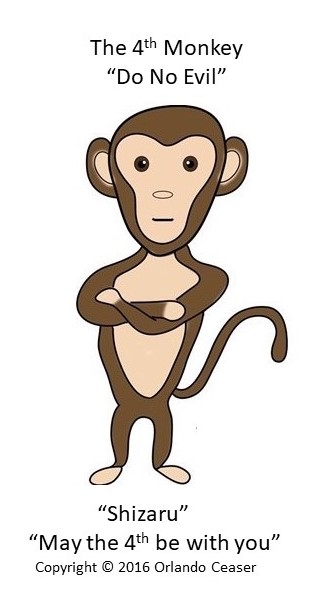
The 4th Monkey – “May The 4th Be with You”

Integrity and Character – Values for the Ages

The 4th Monkey – Do No Evil

Our current climate exposes the need for character development and truth. Integrity is highly regarded in our daily affairs, yet we don’t emphasize it as often as we should. We grew up thinking about values, truth, sportsmanship, ethics, and etiquette. Now we focus on winning at all and any cost. Conscience is seldom referenced and seldom discussed to govern our actions.  We must focus on universal values and principles to teach us to work together to build connection and teamwork. My most popular blog post, The 4th Monkey is being re-issued to concentrate on behavior to improve our interpersonal skills. The universal application of these age-old concepts is a tremendous value that should build connection and our ability to work together in harmony toward a worthy ideal.

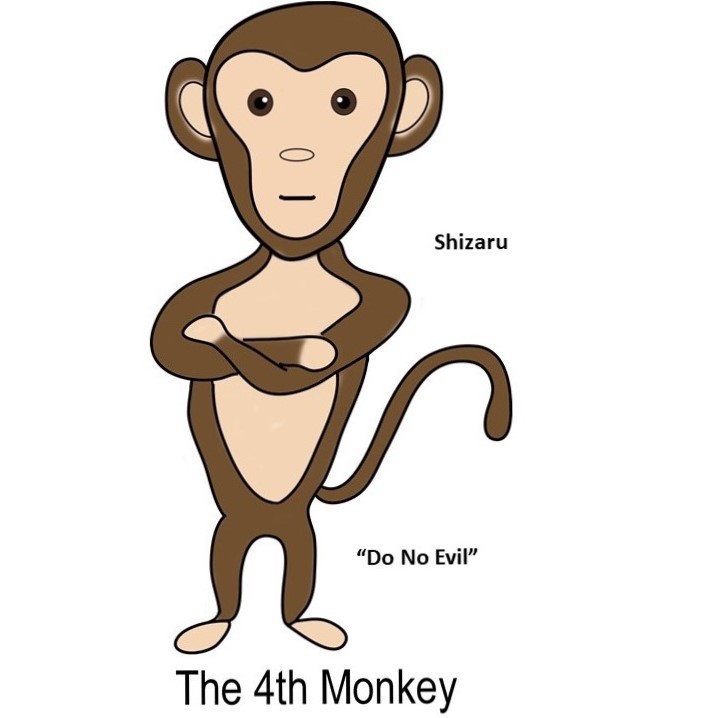
We grew up with the story of the three monkeys. I imagine we share the same interpretation of what they represent. We were exposed to pictures or statues. One monkey had his hands over his eyes, the second had hands over his ears, and the third monkey’s hands were over his mouth. They were See No Evil (Mizaru), Hear No Evil (Kikazura), and Speak No Evil (Iwazura). There were actions and behaviors demanded of us based on the three monkeys, but nothing was said about the fourth monkey. The fourth monkey is Do No Evil (Shizaru).

The stories of the four monkeys were popular in Japan in the 17th century. Their origin is between 2 and 4 BC in China. The Storyologer website (www.storyologer.com) has this account of Mahatma Gandhi who carried around a small statue of the three monkeys.  “Gandhi had a statue of three monkeys in three different postures. One was shutting his mouth with his hands; the other was shutting his ears similarly and the third monkey had put his hands over his eyes. A visitor to his house became curious and questioned Gandhi about the various postures of the monkeys. Gandhi politely replied, “The one shutting his mouth tells us that we should not speak ill of anybody. The one shutting his ears tells us that we should not hear the ill of anybody. And the one shutting his eyes tells us that we should not see the ills of anybody. If we do so, we will have all goodness, and nothing but goodness.” 

Travelers often find local markets with carved depictions or artwork featuring the three monkeys. However, the fourth monkey is rarely seen. The 4th monkey, when pictured, is usually shown folding his arms (the body language of being closed) or covering his crotch to signify inactivity.

The different interpretations of the four monkeys are fascinating. In the Buddhist tradition, it meant don’t spend your time preoccupied with evil thoughts. In the West, it relates to not facing up to our moral responsibility. But in my household, the monkeys were presented to us as a model of proper behavior. Our parents wanted us to identify with the images, to supplement our moral code.

See no evil (Mizaru)

We were told to pay attention to people and location(s). The idea was that if we were in the right location, we would minimize seeing trouble develop before our eyes. This was applicable in school and at work. We were instructed against being at the wrong place at the wrong time or the wrong place right. We were also told not to look for bad things in people or in certain situations. There are people who see bad things when they don’t exist, which could explain the manifestations of bias, stereotypes, and profiling. We were not taught to be naïve but to be careful and respectful.

Hear no evil (Kikazaru)

We were told to shield ourselves from bad language and bad intentions. We should stay away from people who spoke ill of others and gossiped. If we were not in the wrong place we could minimize hearing things that we should not hear. We were also instructed not to listen to foul or vulgar language. If we heard people’s language, especially regarding someone’s evil intentions, we could use the evil information to do good or to help others, that would be permissible.

Speak no evil (Iwazura)

Speak no evil was used to discourage gossiping or speaking ill will about someone. We were told to watch our language and to speak kind words. “If you can’t say anything good about someone, don’t say anything” was a part of this same philosophy. Adults told us that spreading bad news or malicious information could come back to haunt us. We should also, apply this same advice to the workplace.

There is a misconception about the concept. This misconception has led people to adopt a code of silence in the workplace and in politics when a person is not pulling their own weight or has committed offenses. We would rather silently complain or resign, before talking about an employee who was not working. We would not want to be labeled a snitch or a stool pigeon. In the streets, people would say, “snitches get stitches.” To speak evil of someone means telling a lie, bearing false witness, or defaming their reputation. However, it is our responsibility to find a way to report injustice, illegal behavior, and practices that undermine people and the organization. Our intention should be to speak the truth in love without malice or premeditated negative objectives.

One way to break the code of silence is by offering incentives to whistleblowers. These individuals are people who step forward and report unlawful activities in an organization. They are paid a 10% bounty if the measure goes to court and fines are levied against the lawbreakers. In neighborhoods where people know the perpetrators of violence, but fail to come forward, there are no such incentives. Residents may be afraid of retribution, as the rationale for their silence. We must also realize that justice requires telling the truth and this should not be regarded as speaking evil of someone.

Do no evil (Shizaru)

The fourth monkey’s actions are truly related to the others. The workplace and politics are common places for the four monkeys to be used as an operating system. Employee bullying and intimidation, sexual-harassment claims, the presence of racial discrimination, unconscious bias, and sexually charged language and actions exists in many organizations. Where improprieties and liberties are taken with people’s rights in the form of disrespectful words and actions, there are laws in place to prevent and punish these actions. Employees, who adopt a see no evil, hear no evil, speak no evil mindset are not helping to develop a positive company culture or a respectful workplace

Do no evil is a perfect monkey to enforce the values of character and integrity. He reminds us of proper behavior and etiquette. Our choices have consequences and the more we can emphasize a positive corporate culture and a respectful workplace the more effective our organizations will become. There are conduct and behavior norms that must be identified, emphasized, and enforced vigorously. Character will minimize stress in the workplace and reduce the number of lawsuits and discipline related to improper behavior.

The Do No Evil mindset would influence our participation in the political process. Our dialogue in conversations around those who are different from us or have different opinions would be positively affected. If we operated each day thinking in terms of Do No Evil, we would be more empathetic in understanding of each other. We would put ourselves in the shoes of our neighbors and seek to understand their point of, listen to their words, and lay the foundation for greater chemistry instead of conflict.

How can we create an environment in our workplaces, families, and communities, where people are held accountable for their own unlawful actions and the private citizens who come forward can feel safe and protected? If The 4th Monkey was modeled, we would have less of a cause to talk about Mizaru (see no evil) and Kikazuru (hear no evil).

Do no evil and speak no evil should be magnified and connected to many of our guiding principles of behavior. The Golden Rule and its equivalent in many cultures advise us to treat people the way we want to be treated. The Platinum Rule asks us to treat people the way they want to be treated. The 10 Commandments implore us not to do a series of acts that could be seen as evil, such as murder, stealing, etc. you are instructed to love your neighbor as yourself. If we began from a position of love, it is easier to think in terms of speak and do no evil.

We must clearly outline expectations of behavior and the judgment related to them to improve the climate in our organizations, homes, and places where people meet. The correct action is essential to achieving healthy results in our relationships.

The imagery and practices espoused by The 4th Monkey hold the key to making this possible. I am hopeful that by emphasizing the fourth monkey, we can improve our behaviors, connections, interactions, and relationships with everyone.

Copyright © 2016 Orlando Ceaser

Managerial Monsters in Haunted Workplaces

Pandemic reflections about scary supervisors and managerial monsters in haunted workplaces were a dreadful way to spend time. The Covid 19 pandemic has shone the spotlight on jobs, managers, and workplaces, as we reassess our values and careers. Many people decided not to return to their previous workplaces. This is evident by record resignations.

There are many reasons for the work shortage. The Gallup survey told us that people don’t leave companies, they leave managers. However, the workplaces may not be an enticing place to return to. Haunted workplaces and managerial monsters may both be a problem. However, we will concentrate on the managers in this article.

The traits of these individuals influence their leadership practices. They resort to fiendish tactics or insensitive methods to get results. Where there is a monster, there is fear. Where there is fear, there must be an antidote or a strategy to eventually relieve people from the threat of the monster and the power it has over them in the workplace.

There were six favorite monsters or categories that dominated the movies in my childhood; Wolfman, Dracula, the Mummy, Frankenstein, and the Bride of Frankenstein, and various reptiles or insects mutated by their exposure to radiation. For this segment we will concentrate on the top five; Wolfman, Dracula, Frankenstein, the Bride of Frankenstein, and The Mummy.

My favorite character was the Wolfman. He was a frustrated man who was bitten by a werewolf and had to spend the rest of his life howling at the full moon. He wanted to be different, but Lawrence Talbot was overpowered by the curse. The Wolfman manager is driven by the curse of ambition or trapped in the expectations of the culture. Have you seen the Wolfman Manager in your organization? They were nice but tormented by their role. They are subject to the curse of what represents success in the organization. They are mimicking a role for survival.

Secondly, there was Dracula, the vampire. He was charismatic, smooth-talking, and mesmerizing. He spoke with a distinctive accent. People liked his charm, appearance, and professional demeanor. But Dracula was still a bloodsucker planning to render his victims hopeless and under his control. Dracula lacked empathy and emotional intelligence. His intent was to drain others until they were no longer of use to him. You may have seen a vampire walking around your company with that same arrogant, cold, uncaring look. The look that says they are interested in you for what you can do for them. The Vampire Managers walk around feeling as if they would be there forever and no one would discover their secrets. You may wonder if somewhere, there is a coffin containing their native soil, buried in an undisclosed office.

Thirdly, Frankenstein was a collection of body parts, sewn together to create a living breathing inhuman being. Frankenstein’s monster in our story may be our own creation. We have given them unlimited power over us. We let them get away with behavior and practices that are against the company policy.

The Frankenstein Manager appears in organizations as the protégé of their mentor or sponsor. Eventually, the protégé will turn on its creator, causing destruction in its wake.

Fourthly, the Bride of Frankenstein was an interesting monster because she was a woman with top billing. Most marquee monsters were male. This female monster was known for her ability to be dangerously independent and competitive. Her aggressive personality proved she was just as frightening as the men. Additionally, you can find a female personality that applies to each of the monsters listed.

Lastly, the Mummy was cursed to guard the tomb or temple of his beloved. He was slow of foot but was relentless and powerful. This is a creature driven by an overpowering love and allegiance for the object of their affection, which is power. This person within your organization has an undying love for the status quo and the good old days. They would destroy anyone who tried to harm or change it. They will blindly institute unethical policies and cover them up, especially if an investigation is pending or inevitable. This individual will persistently pursue anyone who has anything negative to say about the company or anyone they personally admire within the organization. They will practice a technique known as delayed retaliation, a slow-moving process, to seek revenge against their enemies.

Each generation has its own monsters; whether they are zombies, Aliens, the Predator, Jason of Friday the 13th, or Freddy Krueger from Nightmare on Elm Street. These Monsters have tendencies that can describe leaders in organizations around the world.

Copyright © 2015 Orlando Ceaser

The Crowd Pleaser Syndrome™ – Attention for Acceptance

The Crowd Pleaser Syndrome™

As early as I can remember, I had a craving for attention; a sweet tooth for popularity. Even when I was silent, I would look at people and want them to know me and notice me. I wanted attention, acceptance, and approval. They were my straight A’s. I wanted to play to a crowd or a small group. This Crowd Pleaser Syndrome™ (CPS) was my affliction, which fed my ego and drove me to success and notoriety. However, it also exposed insecurities and vulnerabilities.

I discovered that I was not alone, there were others like me. We needed the mentors and people who understood what we were going through. We did not have support groups to help us understand and cope with this beautiful character trait. Additionally, there were public and private assaults against our reputations for a variety of reasons.

An early manifestation of the CPS was an instance in grammar school, where I misbehaved and angered my teacher. This was during the era when teachers and corporal punishment were synonymous. The teacher called me to the front of the room for a spanking. I had the attention of everyone in the classroom. She asked me to bend over and face the class. She gave me a swift smack on my backside and sent me back to my seat. She was satisfied knowing she had dispensed justice and I felt great, knowing I gained the recognition I needed.

The Crowd Pleaser Syndrome™ is present and prevalent. It shows up at work, as individuals please their peers and supervisors. There is a tendency to deliver good news to the boss in the form of withholding negative information or results. People do not fully disclose information to analysts and the public because of the negative stock implications. Employees may be too aggressive and take unnecessary risks to look good personally. The Crowd Pleaser Syndrome™ may infuse us with the desire to win at all costs.

Crowd pleasers realize at an early age, their ability to entertain others. They may have engaging personalities and athletic and the musical prowess. Here are more Crowd Pleaser Syndrome™ characteristics.

Crowd Pleaser Syndrome™

  • Confident risk takers
  • Highly active in social and professional gatherings (parties and meetings)
  • Work hard to stand out from the crowd
  • Seek acceptance on Maslow’s Hierarchy Needs (belonging)
  • Thrive on competitive activities
  • Develop attention-getting behaviors, strategies, and tactics

Unhealthy Challenges

  • Workaholism and lacking balance by focusing only on the area giving them stimulation
  • Unethical conduct may suppress the competition and put others at risk
  • Failure to share the limelight, especially in developing others, and giving credit on group assignments
  • People tried to sabotage their careers
  • They meet the needs of others and deny themselves
  • Put others first to their personal detriment

Popularity is a stimulant which can have positive and negative effects. The Crowd Pleaser Syndrome™, when managed properly, can have a profound effect on performance, relationships, group culture, and the development of individual strengths. CPS individuals can entertain, educate, enrich, and inspire us to achieve the greatness inherent in each of us to make this a better world.

Copyright © 2021 Orlando Ceaser

Website: OrlandoCeaser.com

Watchwellinc.com

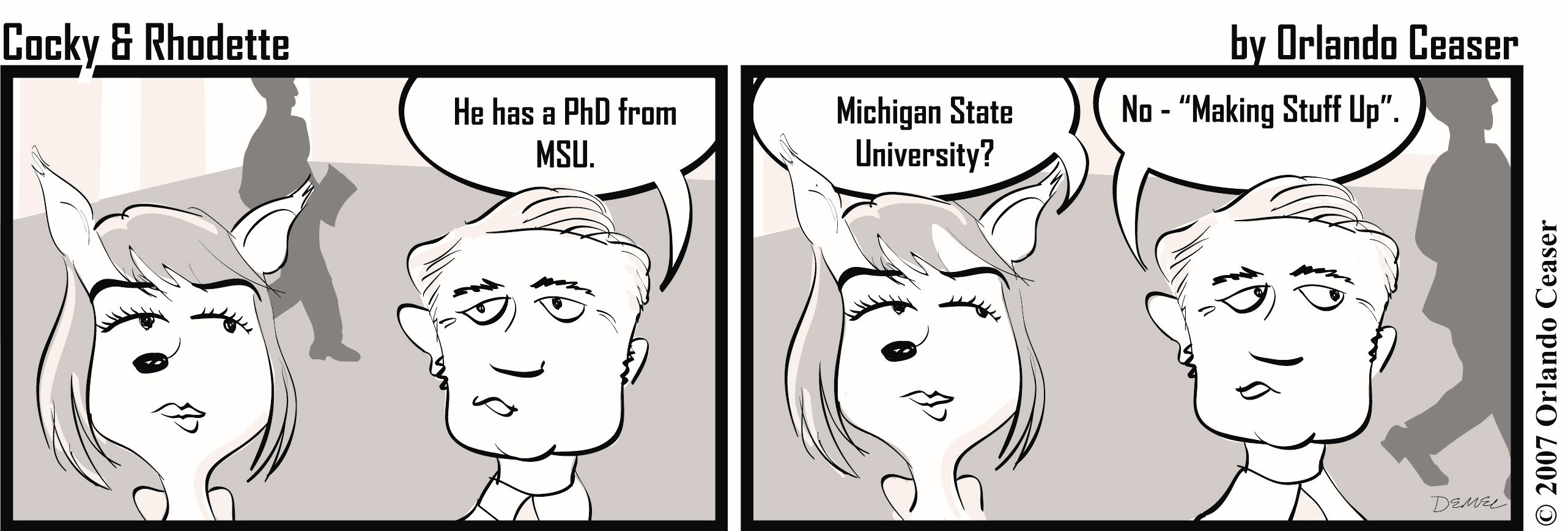
MSU (Making Stuff Up) – Credibility and Creativity

MSU C (2)

I began speaking about the concept of MSU in 1986 when training sales representatives as a Regional Operations Manager. A few representatives, when faced with a difficult question, tried to bluff their way through their answers to tough questions. Their responses contained misinformation and outright lies. A few of them demonstrated unbelievable creativity under pressure to make up fantastic stories but distorted the facts. I was rather angry because we took the truth very seriously. We boasted to have one of the best trained sales forces in the industry. You had to achieve 90% to pass our product examinations. We stated the company policy around misinformation. Their credibility and the company’s reputation was on the line, therefore MSU was forbidden. We would not tolerate MSU (Making Shit Up). I apologized for the language, but it was a profoundly serious matter. Additionally, we told them that it made them look stupid because the doctors probably forgot more about medicine then they would ever know.

I must admit that some of the responses were rather creative. We applauded creativity but not in the dissemination of product information and following company policies and procedures.

MSU was such a catchy concept that we included it in our regular training vocabulary. We would openly talk about Making Stuff Up and the dangers of resorting to that practice in answering physician questions. MSU had value as it related to creativity and other areas. When I introduced the concept of MSU I would state that it did not stand just for Michigan State University.

Years later we were training physicians on presentation skills. I decided to drop in on one of the sessions. I noticed that on one slide were the letters MSU. This piqued my curiosity and I sat for the session. The presenter opened the session by saying he wanted to talk to them about MSU and it did not just stand for Michigan State University. It stood for Making Stuff Up. I was impressed but, I sat there speechless. I did not recall reading about MSU before that fateful day in 1986 in our sales training seminar.

15 years later I was in my office as an Area Sales Director. One of our trainers (Field Development Leaders) gave me a book. The book was titled MSU (Making Something Up). And 10 years later in Zambia, South Africa, one of our pastors conducted a workshop on MSU, Making Stuff Up; obviously, it was a well-established concept.

MSU is therefore a viable practice. It is a catalyst for creativity and a warning. We must use it wisely because authenticity and transparency are required to enhance your credibility. As a leader, is important to be aware of MSU and how adopting this mindset can be used to make decisions, answer questions, solve problems and enrich our world through creative thinking and innovation.

Copyright © 2020 Orlando Ceaser

Websites: OrlandoCeaser.com

watchwellinc.com

A Call to Decency & Integrity (D&I)

The 4th Monkey (3)

Decency is not a trade he frequently discuss. Yet, people know what it is when they see it. We would agree that people who are decent are trustworthy, with strong character traits, such as integrity. They are respected and held in high esteem. Decency is an acquired state. It is a function of diligence, conditioning, and a propensity to do the right thing. It is combination of characteristics, attitudes, and positive personal values, which causes people to gravitate to the as a magnet.

You may not have it as a goal, nonetheless it is a byproduct of being a good person. Decency is a positive side effect of good behavior. The individuals possess high moral standards and a solid reputation and track record.

Google defines decency as “behavior that conforms to accepted standards of morality or respectability.” It is often used in the context of someone being modest.

Decency surfaced on my first interview trip as a district sales manager. I was sent to help a district manager fill vacant sales of territories. The company had a structured interview program based on behavioral questions. We looked for competencies or behaviors necessary to do the job. Past performance / behavior was a predictor of future performance. Whereas there were no questions related to decency, it was evident, among the candidates.

One candidate rose to the top of my list. He had the requisite potential to be an outstanding sales rep. This was during a time when we were hiring recent college graduates for sales positions. There was one sales territory that was hard to fill. My favorite candidate evoked the word decency. He had the requisite skills, but I kept thinking, he is a thoroughly decent individual.

Decency translated into a culmination of many positive character traits. His overall demeanor was supported by quantifiable, specific behavior related outcomes.

Our interviewing questions covered such areas as presentation skills, product knowledge, administrative abilities, persuasion, teamwork, tenacity, resilience, creativity, and organizational skills.

Sandwiched between his answers were examples of

  • Fairness, equality, and good judgment
  • A hard-working personality
  • Faith centered living
  • Integrity and moral behavior with clients and competitors

Decency is an attribute, we relish in people who lead us, serve us, and befriend us. They have integrity which is characterized by the 4th Monkey (Shizaru) which is “Do No Evil”. Decency is not something we feel we can teach, but believe it was necessary for longevity and success in the long term. It may be a function of upbringing, conditioning, modeling behavior, practice, and reinforcement. Decency is often described as; you know it when you see it, or you can feel its presence in your gut.

In a highly competitive marketplace, decency can be a tiebreaker in hiring employees and building relationships and collaborations. We should determine whether candidates can play well in the sandbox, are good listeners and strong team players. They could essentially play well with others, driven by a sense of fairness and purpose, emotional intelligence, likability, and a desire to excel and achieve their inner greatness.

When we visually survey our workers and coworkers, if we find they have a sense of decency we could probably see the following.

  1. Authenticity
  2. Integrity
  3. Honesty
  4. Strong work ethic, based on productivity, quality and execution
  5. Treats people fairly, with dignity and respect
  6. Moral character as reflected in the stories they tell
  7. A sense of fair play

Answer the following question. Are you a decent human being? How do you know this to be true? Asked the coworker, relative or friend if they would consider you a decent person. Ask for examples.

The decent human being is the team player that people like to work with and want on their teams. Strong character individuals are sought after in every interaction that is important to us. It is advantageous to associate with decent people and hire, develop and promote in our organizations.

Copyright © 2020 Orlando Ceaser


Resilience and Another Starfish Story

starfish

Resilience is a way of describing your bounce back ability (BCA). A trait that is wired into our mental framework to give us the tenacity to govern our behavior. It is a portrayal of our stamina and stability and the survival instinct within us. We are formed, fortified and framed with the mindset to resist tough times. We are not saying that we are challenge proof, but challenging resistant, enabling us to bounce in the presence of hard times and hard surfaces.

Let me tell you another Starfish Story. This is different from the traditional starfish story. This story takes place in the ocean. Our hero or heroine is an injured starfish, that is wounded in the ocean. The injury either by accident or sustained damage from the encounter with a predator or a vessel in the water.

During this mishap the starfish was badly damaged and lost one of its points. The starfish has five arms, as we know from the pictures we’ve seen or the animals in an aquarium. However, they may have any number ranging from five arms, to over 50, but I digress. You may have been lucky enough to see these fascinating creatures, sometimes referred to as sea stars, and the they are not really fish.

Our starfish suffers what would be considered a devastating injury to most animals. Imagine this wounded animal moving around in the water eligible to die from the mutilation. However, the starfish has a quality that allows it to rejuvenate or regrow its arms. It is as if the starfish’s body, metabolism or inner programming remembers its original structure and works to replace it. This fascinating attribute allows it to live for 35 years.

Humans do not yet have this ability to physically rejuvenate, however mentally we are resilient. We may face a devastating appointment which takes away our drive and self-esteem. We may make a mistake which appears to be career ending. We may have our reputation tarnished to the extent we feel we may never recover. But like the starfish, we can rejuvenate, regenerate, replenish and reestablish ourselves with proper a mindset.

We can re-institute a positive, reassuring and confident state of mind. When we were infants and toddlers, there were qualities we had, such as curiosity, adventure, stamina, persistence and endurance. We could focus on something with relentless intensity and if we fell trying to get it, we had the resilience, the bounce back ability, after a moment of pouting to get back on our feet and resume our pursuit of the goal.

Later in life, many of us periodically, have these traits badly damaged and removed from our repertoire or body of skills. We may go through life psychologically impaired when we have the inmate ability to do something about it. We need to rejuvenate and regenerate the mental demonstration of renewed strength and resilience.  We need to re-grow these former strengths in order to sustain ourselves and renew our level of effectiveness.

Think back to a time when you were whole and constructed for success and survival. Remember how it felt to be fearless and confident. Remember the other starfish story and recapture what was lost or taken from you, so that you can replenish yourself and be structured to become your best. Remember the words of the philanthropist W. Clement Stone who was the proponent of PMA (positive mental attitude). He said that what the mind could conceive the and believe, it could achieve.

Think of the starfish and reach down within yourself to repair the damage and regain whatever you lost, the world is counting on you and your leadership.

Copyright © 2020 Orlando Ceaser

OrlandoCeaser.com


Leadership – Phenomenal in a crisis Leadership Response to 9/11

September 11
I will always reflect on where I was was on September 11, 2001 and the leadership response we experienced in this horrific crisis; one of the finest examples of corporate leadership I could imagine.

The 2001 Respiratory National Sales Meeting had the earmarks of a memorable event. Joe Canning and Betsy McKenzie had pulled out all stops to create an agenda that would educate, motivate and elevate the skills of the entire Respiratory Sales Team.

The Leadership Team which consisted of all of the managers met to receive a final review of the meeting. The individual managers then met with their Districts to review suggested topics. At 5 PM we assembled in the Meyerson Symphony Center which is 3 blocks away from the Adams Mark Hotel in Dallas, Texas, where most of us were staying.

The short program featured a stirring organ performance by a member of the Dallas Symphony Orchestra which was the opening act for the legendary Ray Charles. Ray was in fantastic form as he played through many of his standards. But the highlight was his passionate rendition of “America.” The standing ovation was deafening as the group showed their appreciation. Joe and Betsy knew that they had created a phenomenal week. The 1500 participants dined on hor’d’oevers and finger foods in the atrium of the Meyerson Symphony Center and slowly filtered back to the Adams Mark and Le Meridien, the principal hotels for the meeting.

The second day began with a lot of promise. We heard people talking about how great Ray Charles was the night before. Many stated their disbelief that we would bring Ray Charles to such a meeting. There were numerous conversations inquiring about his age.

The meeting began with an opening by Joe Canning, the National Sales Director for Respiratory Products. He was succeeded by Tony Zook, VP of Sales and Marketing and Michael Hickey, the VP of Sales, along with Rich Fante and Josh Tarnoff, Product Directors. The group was dismissed for a break. The break was also to allow the large group to reassemble in 2 smaller groups representing the East and West Areas of Respiratory. Doug McNamee was to be with his team in the East. I was to be with my team in workshops in the General Session room to receive the product strategy message. It was during the break that the word circulated about the World Trade Center bombings. The news rapidly moved through the crowd, as we began to piece together the entire horrific event.

The decision was made to announce the bombings to the General Session and to dispatch Regional Sales Directors to the different workshops to break the terrible news. Individuals who were directly impacted were asked to contact their families. Joe broke the news to the audience and you can imagine the shock and terror and disbelief. Tears rolled down the cheeks of many as fear took over.

Joe turned the meeting over to me, the stage that is, for a 5 minute introduction into the next phase of the agenda. I had planned several snappy introductory comments, but I had to change the tone. No one including myself was in the mood for motivation. I turned the program over to Demir Bingol, the Product Director for Rhinitis products. Demir was approximately 10 minutes into his presentation when Joe and Tony took the stage and stopped the meeting. Everyone was asked to take the next 3 hours and contact their families to check on their loved ones and reconvene at 1 PM.

The Leadership Team and higher level managers and people from the various support groups were asked to meet in the Executive Boardroom to discuss the plans for the rest of the week.

I spoke to Scott Climes, one of the Respiratory Regional Sales Directors who was dispatched to the workshops to deliver the news about the bombings. This message was to individuals from the Eastern half of the US. Many of them potentially had family or friends that were affected. He said he had never experienced such a reaction in all of his life. The tears; the terror.

People were wandering in the hallways. Many rushed to their rooms to begin the daily ritual of following the news coverage. Who did this and how would we respond? How many were in the two buildings and the pain and the grief that touched their families? Was it Osama Bin Laden? Who were the terrorists?

The Executive Boardroom would be the war room for the next few days. Here the highest ranking officers of the Company would determine how to guide its people through the tragic events of New York, Washington DC and outside of Pittsburgh, Pennsylvania.

Tony Zook, VP of Sales and Marketing took center stage. With marker in hand and flipcharts close by he began with our objectives. No one has ever gone through anything like this. How can we take care of our people? How can we get them home, the ones who need to get home? Should we continue the meeting? What is known? How should we communicate this to our people? When we formulate our recommendations remember cost is not a concern. Our people are our number one priority.

He elicited the key communication points that we needed to flesh out. Some buckets or titles were as follows: Travel, agenda, communication, an update on the situation, accountability. Each point was assigned to a team with a leader to bring up all of the key issues in that area.

We were fortunate enough to have 2 members of our Sales Team who had anti-terrorist experience. Additionally, our Chief of Corporate Security was present at the meeting because of the resources present and number of people. Bud Bender also had contacts within the FBI which would come in handy during the week.

A leader was assigned to each team and other individuals were assigned and asked to align themselves to a team where they could provide input. American Express One was the travel company. Julie Whalen, our meeting planner was asked to head the travel committee.

We were asked to take 45 minutes to discuss all pertinent issues and to reconvene, to make a flip chart presentation to the group. This allowed the group to provide input and fine tune the response. We were under the 1 PM deadline. We needed to complete our assignment early, so that we could present our recommendations to the group. MJM our production company would need time to input the information and create a Power point presentation.

My team headed by Doug McNamee covered accountability. We wanted to make sure that for the next 24 hours we knew the location of each employee at the meeting. We discussed the sales representatives staying in the hotel that evening until we knew more about the extent of the problem. Reps needed to contact their management team twice a day to state their locations and any changes. Managers needed to notify up the chain of command that everyone was present and accounted for. If anyone left the meeting to go home, it should be documented. The buddy system was suggested as a good way to keep track of each other, which was easier said than done.

The dynamic interchange during the presentation facilitated by Tony Zook was a pleasure to behold. Senior Leadership eliciting and contributing comments and suggestions, motivated by how we can help our people was marvelous. We were fortunate to have strategically or luckily assembled the highest ranking officials in our Field Sales force at the same meeting. We also were fortunate to have the talent from the military, security and Travel at the same site. The diversity of talent and experience made it easier to handle our mission. For with over 1500 people at a Sales Meeting, with many of them fairly young, who had not face any national emergencies in their lifetimes, this was a significant challenge for all of us.

One by one the teams presented and the adjustments and suggestions were made to the strategy and the presentation.

We were developing a game plan to keep people comforted and focused for we wanted to show our employees that we valued them. The human side came out repeatedly. There were times we wanted to over protect, but backed down because over protection can heighten fear. We discussed how to care for those directly impacted. We knew that the meeting was secondary to our people, but we also knew the meeting was necessary to keep people focused on something not related to the terror in the land. After all, the meeting was scheduled to last until Friday and this was only Tuesday. It became clear that air travel was not going to be an option for an indeterminate period of time.

The stories began to appear. People worried about their loved ones and tried frantically to locate them. The hotel telephone system was overloaded. Cell phone transmission had difficulty for a while. Some people did not wait for the 1 PM meeting to see what the company proposed to do in this tragedy. Several instances surfaced of people renting cars and driving toward home without letting anyone know they left. One manager rented a van to drive their people back home. Alternate travel plans were cropping up all over the place. Some of this is to be expected when you have sales people who are action oriented.

The meeting reassembled at 1 PM. On the stage were the principal contributors led Tony Zook, Michael Hickey and Joe Canning. What followed was another example of leadership at its finest. The depth and professionalism of the presentation led many to wonder how we could put together such a professional presentation is such a short period of time. Most commented that they worked for a great company. We continued with the meeting for that was the best option to care for our people. There were interfaith religious services arranged by Scott Buchanan and others in attendance.

Arrangements were made to get everyone safely home. The travel team rented 20 luxury travel busses to send to 20 different parts of the country to get our people home. They were richly equipped with food, DVD players, games, blankets and all manner of creature comforts to make the trip comfortable. One bus left with only one person on it for he was the only one going to that region of the country. There was a story of the Company renting two limousines to get one sales rep home in time for the birth of their child. Watching this tragedy unfolds and our reaction to it validate our history of being phenomenal in a crisis. People left saying what a great company we work and what a great country we live in. I appreciated being a part of leadership making a difference in the lives of our people during a very unsettling time in our Nation’s history.

Copyright © 2011 Orlando Ceaser

Authenticity Messages from The Scrolls of Greatness™

Mothermirrorlion1
There are countless archaeological discoveries that add to our knowledge of earlier civilizations, cultures and beliefs. You heard the stories of individuals stumbling upon a discovery, which greatly increased our knowledge. There may be scrolls of information in the earth that enlighten our paths.

There are scrolls of knowledge within you that validate your greatness. These texts confirm the greatness within you. The question is, how will you search through the caves, caverns and catacombs of memories and earlier instruction, to recover and discover knowledge and wisdom to achieve your grander purpose.

There are messages on authenticity that I gleaned from my excavations. They will ultimately be published in a future work entitled Scrolls of Greatness.

An Authentic Life

“Is your life a quotation or a paraphrase of the life of another or is it the original authentic paragraph God has written for you to include in His magnificent manuscript?”

Authentic Faith

“Most of your knowledge is based on faith. You were exposed to information packaged and provided to you by strangers and people you know. You are placing a lot of faith and trust in the character, motives and authenticity of others, which is the way it should be, because you cannot verify everything.”

Authentic, Non-manipulative Love

People should know that you genuinely love them; authenticity without manipulation. You want them to be happy, expecting nothing in return, no strings attached. I told a group of students that I drove an hour and a half to speak to them and I was not being paid for it. I wanted them to know that there are people who love them and expect nothing in return, but their excellence. We must learn to give back and I was compelled to do this, because it was done for me. “A young man spoke,” I wouldn’t do it, if I was not getting paid for it.” I responded, “If you thought as highly of you, as I think of you, you would do it, because I know you are worth it.”

Forgiveness

“Forgiveness should not dependent on receiving an apology or the knowledge of an impending apology. It may not be automatic. It may be difficult. But it should be authentic when experienced and expressed.”

Observations

“Many times, your words should serve as an observation and not a critique. However, there will be times when the order should be reversed. Authenticity improves the power of your communication.”

Share the Journey

“My message seems more powerful when I profile my pain. When I accept the blame,
I seem human. When I discuss my shame, I am vulnerable and real. People relate and identify with me when they can connect and feel that I am genuine, with good intentions.

Sometimes we do our journey a disservice when people only see the finished product and not the rough parts of our development. A glimpse into the construction, deconstruction, destruction and production processes, will heighten their awareness and appreciation of our struggles and what it takes to be successful. We will connect. The authenticity of raw, without disclaimers, and revealing our flaws, will open people to our stories and increase our chances to inspire growth.

The world wants to know how we made our names, the obstacles faced and how we overcame. Otherwise, people will surmise, we obtained the prize and never made mistakes, always received the breaks, were never afraid, that we possess a passing grade, but it was easy, and we always had it made.”

Copyright © 2019 Orlando Ceaser
OrlandoCeaser.com
Watchwellinc.com

Artificial Experience (AE) and Performance Enhancement

William James change your life
Early in my sales career, I came upon a quote attributed to William James, the Father of American Psychology. The message was profound. “The mind cannot tell the difference between something that is real and something that is vividly imagined.” These words were mind blowing and changed my life. They were simple, crystal clear and sensible. I instantly recalled a dream that I had in childhood. I dreamed that I came upon a large mound of coins. I took a handful of coins and clinched them tightly in my hand. I wanted this to be true. I awakened with my fist clenched, my heart pounding and filled with anticipation. However, as I slowly opened my fingers, the disappointment was obvious. It was only a dream. A very vivid dream, but still a dream.

I became so fond of this technique, which was all around me, but I never noticed. It seemed sophisticated and more structured then daydreaming. Additionally, it was consistent with visualization and mental rehearsal. These were techniques used by athletes and performers to prepare themselves for competitions, performances, presentations and other events.

My usage initially was preparing for sales calls. This was very evident in my initial sales training in pharmaceutical sales. The six new sales representatives were preparing for videotaped presentations with our sales trainers. The tension level was very high in the room, as five employees were rushing to make practice presentations before presenting to the trainers. I was in the hallway visualizing my upcoming scenarios and preparing my responses. I realized that I could mentally role play more presentations than I could physically demonstrate, therefore I was structuring my thinking. This would allow me to create artificial experience and have déjà vu moments within each sales presentation. My confidence was elevated, and I performed better than I would have otherwise. I was not as nervous as my peers and felt more comfortable through my means of gathering artificial experience. I explained my method to my peers, and everyone implemented this technique, which I feel was helpful in completing our sales training, especially the videotape portions.

The practice of cultivating artificial experience allows us to simulate many situations and improve our performance in our current reality. We also can accelerate the pace of learning through many scenarios to increase our ability to think on our feet.

Airline pilots go to through many hours of flight simulation training to expose them to a variety of scenarios which may occur in flight. The objective is to create the type of muscle memory or response memory, so that when they are in actual situations, they can draw on this artificial experience to perform effectively.

Many people new to their assignments feel apprehensive because they do not have the same level experience as their peers. New managers may be in situations where they are managing teams where individuals have been with the company longer. Millennials may be managing baby boomers. Managers may be managing a very diverse team. It is a reality that artificial experience, along with coaching, mentoring and researching the past can contribute to elevating competence and confidence.

Artificial experience along with other leadership techniques, such as emotional and cultural intelligence can assist in individual and team performance and personal development.

Copyright © 2019 Orlando Ceaser