4 Directives to Influence Behavior

Instructions since childhood were designed to teach and guide us. Over the years we have noticed remarkable similarities between the directives given in our youth and the requests made of us as adults. In retrospect, their effectiveness varied based on our circumstances and development level. The same is true at work. Leaders and managers give instructions using the same memorable phrases. The objective of these phrases is to elicit our compliance with their demands, commands or requests for action.

“Do as I say, because I said so”

People have used a variety of commands to get the kind of behavior they want. “Do as I say, because I said so,” is the classic power phrase of authority. Parents use it often. The power can be based on position, where they can administer rewards or punishment if someone fails to comply with their request. The sentence could easily end with,” or else.” The job, held by the speaker, confers position power. They are the boss, the parent, the person in charge and when they speak they want others to jump quickly into action. The person using this phrase does not wish to be questioned or challenged. People will also use the specter of fear, brute force, physical strength and threats to persuade people to fall in line. Threats may be physical or assaults to someone’s character or reputation.

Frustrated parents and managers have used this phrase when they run out of answers. When they are busy or in a hurry, they resort to this language to end conversations. They do not want to discuss the matter anymore. They want people to listen, obey and stay quiet.

“Do as I say, because I said so,” is a technique that can influence a number of people. When matched to the right individuals, it is very effective. It is useless when delivered to the wrong person.

“Do as I say, not as I do”

Some people adopt a hypocritical style to exert influence on others. They recognize that they don’t have the discipline or integrity to practice what they preach. Yet, they insist that others listen and obey their dictates and commands. This works in situations stated in example number one, however, the inconsistency and hypocrisy will render it ineffective in some cases. The resistant ones will not comply and they will use the leader’s hypocrisy as justification for refusing to follow their commands.

There is a certain amount of arrogance associated with telling someone to do something that you are not committed to do. The advice may be solid, but the absence of following your own advice, may compromise its impact. They may do what you say, but only when you are watching.

A powerful story was told about Mahatma Gandhi at http://www.witandwisdomstories.com. The blog post “Mahatma Gandhi’s salt less diet” contains the following story. “One day an anxious mother, along with her son visited Mahatma Gandhi. She told Bapuji, “My son is suffering from a kidney disease, Bapuji. I am really concerned. I took him to the doctor and the doctor has advised him to take food without salt.” She continued, “the problem Bapuji is my son refuses to follow the doctor’s orders, but if you tell him he will listen as he worships you and he will not deny you.” The Mahatma asked the mother and son to see him after a week.

After a week or so, Mahatma Gandhi called the mother and the son to his house. He took the boy aside and looked him in the eye and said” You are very important for your mother’s happiness and your health worries her. It is my wish that you follow doctor’s orders and stop taking salt in your diet.”

The boy who was in awe of the Mahatma was so pleased with the Mahatma worrying about him, agreed at once. He turned to his mother and said” no more salt for me Ma.”

The relieved mother stood puzzled for a while and asked Gandhi “But Bapuji, you could have told him this when we came a week ago, why didn’t you?”

To this Gandhi replied, ”But madam at that time I was taking salt in my diet and it has taken a week for me to give up salt myself. How can I advice your son to eat a diet without salt with a clear conscience? How can I tell someone to do something which I myself do not practice?”

Hypocrisy will not be tolerated in today’s climate of transparency and authenticity. Some will follow this request, but must see the benefit or fear the speaker.

“Don’t do what I did – Learn from my mistakes”

It is well-known that experience can be the best teacher. Rebellion is a natural part of the human spirit. Many of us have received instruction, but elected to ignore it to listen to our own voice or the voices of others. Going down the wrong path has caused us discomfort and ultimately we realized we were wrong. Armed with the experience, we wish to let others know the value of staying on the right path. We don’t want them making the same errors in judgment that plagued our lives. We therefore, become an ambassador for the truth. We say to people,” Don’t do what I did. Learn from my mistakes.”

This is sometimes seen as a tough love message or using scare tactics. Former prisoners have used a” scared straight” philosophy to convince youth to stay away from a life of crime. They feel that education on the negatives associated with criminal activity would discourage youth from hanging with the wrong crowd and making questionable decisions. They take the glamour out of disobedience and use their lives as proof.

Conversations in a corporation may involve older employees telling younger employees about the mistakes they made. These mentoring sessions or coaching moments are an effort to steer less tenured employees toward making better decisions on their career path. There is value in information sharing. That occurs when the different generations in the workplace tell their stories of arrival and survival within the context of the organization.

This approach also works on some people, but not on others. There will always be people who think they are too smart, clever, intellectual, lucky, cool or too good-looking to suffer the consequences of their actions. They will view the sad story, as something that only applies to others.

“Do it like I did it – Follow my lead”

This is normally a very potent approach. It is the lead by positive example model. People will look at you, your reputation and your execution and realize the value of your words and actions. Learning occurs through imitation or modeling behavior. “Let me show you how it’s done, makes “Do it like I did it ” even more powerful. Many times, “Do it like I did it” and follow my example, is not verbalized. Yes, there are many occasions where people will issue these words to give a standard to follow, but often its power is in seeing someone act out the phrase. It is the practice that occurs with or without the preaching that makes it work. It is the example exhibited on a day-to-day basis.

Most of the time, “Do it like I did it” and “Follow my example” are positive exhortations. But, it may not work in all cases. People will imitate and follow negative leaders and negative examples. If the culture of an organization is filled with intimidation and a lack of appreciation, individuals desiring to be leaders will pick up on the signals. They will emulate the same kind of insensitivity broadcast by their leaders.

However, leading by example does not work on everyone. Someone will find a way to discredit your work or assign your accomplishments to favoritism or inequality, they cannot duplicate. These 4 directives to influence behavior collectively have been used to get individuals and groups to act and follow orders. They are spoken to move people to action. However, individually, we have found that they may not work on everyone all the time.

Copyright © 2014 Orlando Ceaser

6 Personalities on the Path to Progress

leadercouldbewaiters1
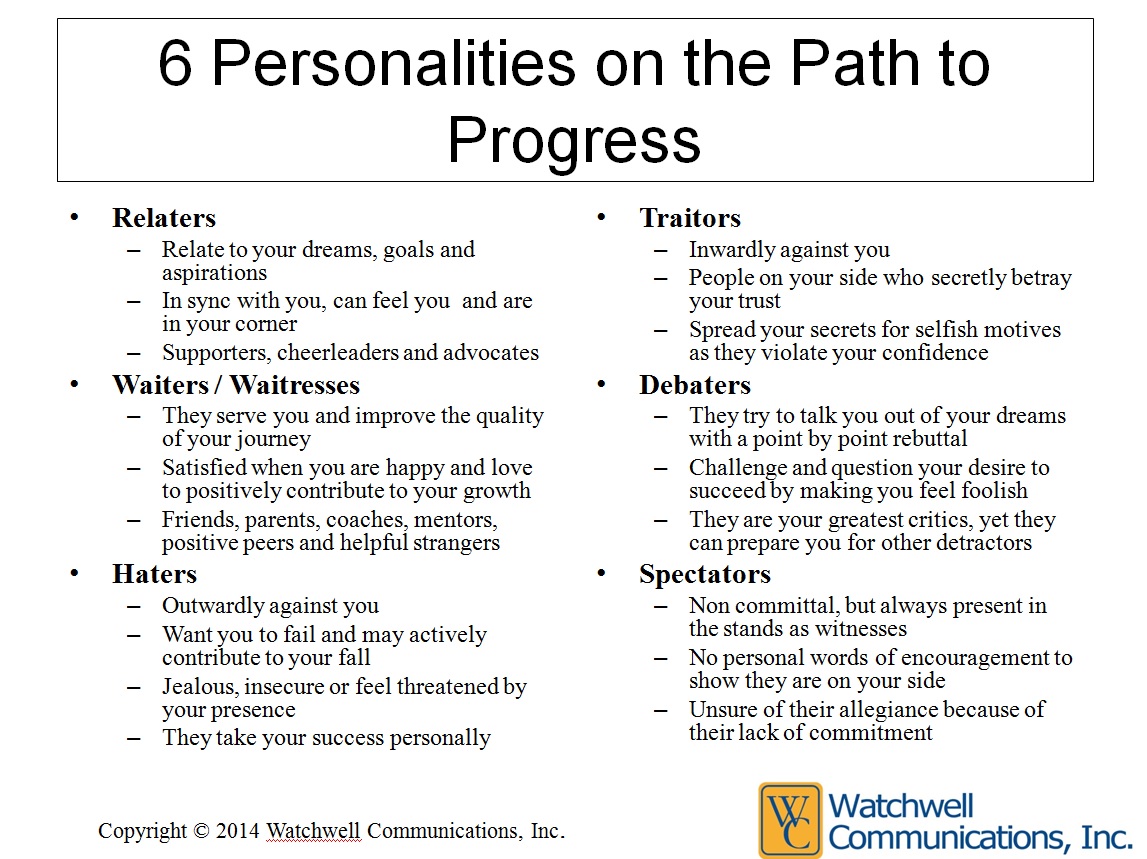
You will encounter a variety of people along the path to progress. There are a number of personalities on your journey willing to provide assistance or to be an impediment to you. Six profiles are highlighted based on personal and group observations. They are the relaters, waiters, haters, traitors, debaters and spectators. No one is exclusively one profile all the time. You may vacillate among the characteristics depending on the situation and the people involved. It is important to identify these personalities in order to enlist their assistance or to avoid their negative attacks on your well-being and your ability to achieve outstanding results.

6_personalities1

Relaters

These individuals relate to your dreams, goals and aspirations. They are in sync with your mission to succeed. There is a connection, commitment and compatibility with your dream. They relate positively to your intentions and seeking the best for you. They are on the sidelines and in the game as supporters, cheerleaders and advocates. It warms your heart to look in your corner and see relaters wanting you to make it.

Waiters / Waitresses

Waiters and waitresses have ‘. They are not individuals hired by you, but people who voluntarily serve you on your journey. They are your friend, parents, teachers, coaches, mentors and positive peers. They may be anonymous or strangers say a kind word or perform a good deed. These individuals derive satisfaction from being of service to and being a part of the delegation responsible for your achievements.

I ran the Chicago Marathon twice and the streets were lined with people with signs encouraging the runners. They screamed out the numbers of the runners and some of them provided us with water and beverages. You may recall a waiter or waitress who gave you outstanding service. They asked poignant questions in order to serve you better. They went out of their way to make your visit an enjoyable and memorable experience.

Haters

You may have come in contact with these individuals. They are outwardly against you. They may be jealous, insecure or just plain malicious in their attitude toward you. You may not have done anything against these people, but they see you and immediately resent you and your accomplishments. Haters are committed to bringing you down. They celebrate and laugh when you stumble. They have the resentment to match your contentment and find great satisfaction whenever you experience difficulties. Haters are prone to go to great lengths to place barriers in front of you and to turn people against you. They are constantly questioning your motives, while developing conspiracy theories to discredit your work.

Haters are very dangerous because of their capacity to spread malicious lies, rumors while attacking your reputation. Their outward expression of contempt may not be to your face, but many people will be exposed to their feelings.

Traitors

Traitors may get very close to you and win your confidence. You may trust them only to find out that they were false friends. They will work inwardly to unravel and discredit your progress to success. They will secretly try to undermine your efforts and tell people about your innermost secrets and weaknesses. Traitors may start out as relaters, but somewhere along the way they turn against you. Hopefully you will find out soon enough that they cannot be trusted. They are back biters and back stabbers. They may be passive aggressive, sneaky and secretive. Traitors may ruin your reputation by selling your secrets to the highest bidder.

Because traitors are believed to be your friends, their words ring with truth and credibility to an unsuspecting audience. Traitors will break your heart because of their proximity to your inner circle. They are on the inside and privy to your thoughts, feelings and actions.

Debaters

While you are committed to your journey, you will find a number of people challenging you every step of the way. They try to talk you out of success. They will question your sacrifice and try to discourage you from wasting your time. They will give you countless counter arguments and examples of others who failed through no fault of their own. They will persistently challenge the value of your dreams and the foolishness of your work ethic. Debaters will make you question your intelligence and qualifications for your objectives.

Debaters, however, can strengthen your resolve and survival skills. When you successfully counter their arguments, you will be stronger against other opponents. They actually prepare you for meaningful discourse with the conscientious objectors who are against your desire to be successful.

Spectators

In many respects your journey to succeed is a competitive event. There are spectators who are on the roadway in the field. There are other individuals who are in the stands watching the game. They do not get involved in the activities. They may cheer, but the cheers may not be for you. You may see the spectators in the stands, but you do not know their allegiance. You just know that they are present. They do not personally give you words of encouragement, as is the case with relaters and the waiters. You may not know if they are against you like the haters, debaters and the traitors.

Haters and traitors are potentially destructive. You need to find out who they are and develop strategies, structures and individuals to shield you from their insecurities. Haters and traitors attack you from different positions. Haters are outwardly against you. Traitors are inwardly against you. They gained your confidence and many times, you were unaware of their insidious nature.

Some debaters are convinced they are trying to protect you by talking you out of your dream. They may feel the dream is too dangerous and you may be hurt and they want to spare you the grief and humiliation associated with failing. However, many debaters are insecure and don’t want you to succeed because they will take it personally. If you succeed and they do not, they will see themselves as failures.

The spectators may be harmless, but they should be more than a witness along your path to progress. Spectators should get involved in the game and become relaters and waiters to support your cause. It is wonderful when spectators decide to be a part of the success of others. This service to others could be a major personal development growth opportunity on their path to becoming a leader.

These six personalities are present any time you try to accomplish something. They are the people you meet along the path to progress. The supportive personalities such as the relaters and waiters are essential to give you the moral support and technical proficiency, you need to succeed. Words of encouragement and acts of kindness from these individuals are instrumental in giving you the confidence and competence to achieve your goals.

Copyright © 20014 Orlando Ceaser

Protectionism in a competitive marketplace

Protectionism is designed to discourage others from competing for your talent or resources. Barriers are put in place to keep markets, company, or department restricted from outside forces. People try to artificially maintain or mandate the status quo, because it is a beneficial, but questionable policy.

Insecure organizations who are afraid to lose top talent will institute external mean to keep their people, which may deny their people freedom, benefits and promotional opportunities.

Protectionism is a preemptive strike aimed at discouraging others from hiring or tampering with your personnel. Countries try to control their markets by setting up impediments to prevent others from fairly competing with their industries and companies.

Protectionism is at work inside organizations. A regional manager was constantly near the top of the organization in sales. He experienced very little turnover in his sales organization, through promotions or resignations. Many in the organization were puzzled to learn that stellar results were not accompanied by promotions. Conversations with the regional manager revealed that the top performers, in his estimation, were somehow flawed and not ready to receive more responsibility. This manager’s protectionism policies were personally beneficial, yet detrimental to the career growth of many hard-working employees. He did not want to go through interviewing to replace them and training a new crew. Careers were inhibited because he had labeled them as insufficient to assume greater responsibility.

A successful sales representative accepted a promotion to the human resources department. She wanted to return to the field as a manager. After several years, she had lunch with a sales manager. He lamented the fact that she wanted to stay in HR. She was shocked at his opinion and asked why he felt she did not want to return to the sales force. He said he had been told by an HR director that she was happy with her new career path and it did not want to leave. Needless to say, she was stunned by the misinformation and the inaccurate portrayal of her career objectives. The protectionist policies of her department backfired and she subsequently resumed her sales career.

Protectionism leads to the creation of policies to restrict the penetration of their borders by competing companies. One company raided another company and hired some of their best sales people, when they started a new division. The losing CEO was angry by their practice. He instructed his lawyers to write a letter to the company stating his displeasure and threatened legal action. The response he received was carefully worded. The acquiring CEO defended his hiring practices. He asked the other CEO to see his actions as the risk of doing business. He suggested the people were leaving on their own volition. If the people were happy they would not have been so anxious to leave. Needless to say, the other company continued to hire his representatives, but at a slower pace.

People will gravitate to top talent. In the era of social media, networking events, savvy recruiters and employee referral fees, the best performers will be identified. There is an incentive to keep people happy and there is an incentive to recruit them to other organizations.

The hiring CEO delivered a very powerful message. What can be done to minimize employee’s propensity to jump ship? What can be done to the culture to make them want to stay with your organization longer term?

Organizations can change managerial mindsets to mandate mutual benefits for all parties involved. This philosophical shift is initiated and enforced by senior leadership. Intuitively, it is difficult to pour a lot of effort and time into someone, only to see them walk away to a perceived better opportunity. As stated earlier, there are risks involved in developing people. At some point, you will have more people than you have promotable positions. This may cause some people to be patient and wait for better jobs internally; however others may be impatient and look for greener pastures outside of the organization. You have to chalk this up to the price of doing business and wish them well.

There are tremendous advantages short and long term for a full scale long term development program. This may ultimately lead to future business alliances and collaborations with companies who have hired your people. It may also be a recruiting tool for prospective employees. A reputation for hiring and developing talent can lead to an influx of extraordinarily qualified candidates. Higher employee engagement levels and productivity is currently seen as a positive benefit of a stronger culture.

If you constantly assess and provide opportunities for personal and career growth, you minimize employee flight. Today, Millennials are subject to career impatience, if you do not sufficiently reward and challenge them, your organization will constantly be under pressure due to rapid turnover.

Sensors can be put in place in the form of stronger leaders and mentors to assess and regulate career development. Employees will gain an up-to-date, real world view of their skills and abilities and prospects for career development. Organizations have established career academies, equipped with resources, such as class room work and online training programs to help employees can grow their technical and life skills.

Protectionism in theory is about holding on to your talent against unfair pilferage, but it will work against you in the long run. You must update your training and development practices to create stronger leaders. Additionally, you must:

  • Pay attention to the company culture to treat people with respect and harness their skills and abilities.
  • Provide an honest assessment of performance through clear cut performance objectives and regular evaluations
  • Career discussions should be held to understand and to share employer and employee expectations
  • Develop confidence in your training and development program to rapidly replace people who leave the organization or leave the team
  • Strong managers and leaders are necessary to ward off protectionist tendencies, as they strive to develop the best teams imaginable

Organizations have been known to offer retention bonuses during a time of uncertainty, such as during mergers and acquisition, to keep their top talent. A variation of this practice is to ensure that the best performers receive the best rewards, whether financial, special projects or greater career opportunities.

Protectionism is usually a policy instituted when an organization fails to put a coherent people strategy in place. In their haste to prevent people from leaving, they  blame outside forces for problems in their culture. Protectionism practices that strikeout at the employee or toward outside forces are rarely successful. Organizations should look internally at their leadership practices and career development strategies, to see if they can be more conducive to creating a culture where leaving the organization is to difficult for an employee to imagine or implement.

Copyright © 2014 Orlando Ceaser 

Free e-book, Leadership Greatness through High Performance Poetry at http://www.orlandoceaser.com

The “A” Game Chronicles – Discover and deliver it

Keeping_Up_C
How often have you heard someone say or someone is told to bring their “A” Game to the competition? They don’t say bring a game, but the capitalized “A” game. I wonder if people know what their “A” Game looks like. How often have they seen it? Would they recognize it when they saw it? I wonder if they have ever challenged themselves at such a high level that it brought out their “A” game. Then they would know what it looked like and could therefore, duplicate it upon demand. They are told to get an “A” for effort, but you need the results to back it up

Their “A” game is heavily in demand. “A” is for action or “A” is for achievement. “A” is for the highest performance. I knew managers who were never rated at the top performance tier within their organization. Yet many of these managers would distribute these ratings without hesitation. My questions were always two fold. First, “How could you?” and secondly, “Do you know what awesome looks like, since you never received the rating? The same applies to someone’s “A” Game. Do you know what it looks like and does a manager know when it has arrived and how to bring it out in the open? An accumulation of “A” games should lead to the highest performance ranking and rating within the group.

There are apparently different standards for an “A” game. I suppose it is in the eye of the beholder. What measuring device are you using for an “A” game? Your “A” Game could be a function of the following:

• Attitude – your disposition spells confidence and could cause your best performance to explode out of your potential.
• Awareness refers to self – awareness, for you are in touch with your physical and mental capabilities. Your emotional intelligence (EQ) involves knowledge of people and relationships. When combined with competitive knowledge and personal or self knowledge you create a climate for your “A” game to develop.
• Aptitude – (IQ) – intelligence referring to mental skill and thinking enhances by hours of hard work, reading and analyzing your performance and expectations.
• Alignment – consistent with goals
• Achievement focused
• Action oriented – execution, passion and initiative

What the “A” Game is not – pseudo “A” Game or false positive

• Avoidance – hiding from your best performance and abdicating to other work you should perform yourself
• Absent – missing and engaged in inaction when you are expected on the job. When people are depending on you.
• Awkward – uncoordinated, undisciplined due to a lack of practice and poor technique.
• Average – In the same level as others. Your “A” game should be a moving target. The best you have today should be better than yesterday and below the high bar, you have established for tomorrow. This gives you something to aspire to within the range of your potential.

In delivering your “A” Game on a bad day you may be slightly short and deliver an “A-“Game, which is an A minus Game. But this is a whole lot better than a negative “A” Game. For this is the polar opposite to your best performance. This is essentially an “F” Game which is not acceptable.

Everyone brings a game to the arena, but you should make sure that it is your “A” game; an awesome effort that leads to an astonishing performance.

Copyright © 2011 Orlando Ceaser

Quick decisions – Decisive or deceptive

CreamRises

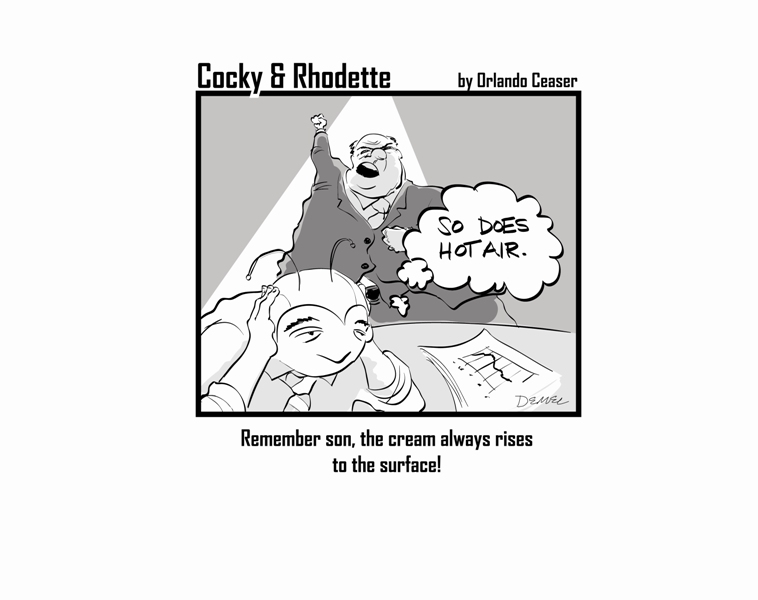
Speed is often admired in the communication process. A leader who makes snap decisions is seen as forceful, decisive and endowed with qualities that command attention and admiration. However, in some instances the quick decisions may mask insecurity, incompetence, lack of authenticity and integrity issues. The observer may miss the signs as they focus on the flashy presentations.

Difficulties in business relationships arise when the false and manipulative motives are discovered and revealed. Lack of integrity violates the rules of emotional intelligence as portrayed by Daniel Goleman in his book Primal Leadership. The snap decision from a disingenuous leader is pretentious and undesirable. They may be hiding something.

People with cruel intentions will ultimately be discovered. Perceptive people are everywhere. They will play the role of an investigative reporter and will eventually unmask the leader through the clues provided through their communication style. The early signs of skepticism may be initiated when snap decision are made without collaborating with others. This could be the tip of the iceberg that will lead to their downfall. A gut feeling may signal that something is wrong. The observer may decide to register their actions as suspicions and commit to keeping an eye on the leader. The unscrupulous leader may use their quick decisions to impress people, shield their incompetence or to ward off threatening opponents. But, their dishonestly will be discovered, because someone is watching them.

Quick decisions on their own are not a problem, particularly if based on familiarity with the situation and subject matter and a reputation of sound judgment. Snap decisions do not automatically mean a character defect. They may be the result of a keen business mind that thinks through multiple options with split second timing. These traits must be respected and appreciated. However, people have been known to make knee jerk reactions without thinking through all of the data and evaluating the options in order to hide their selfish or libelous intentions.

Let us take a moment to review, explore and extol the benefits of a leader being decisive.

If the leader is an effective communicator and demonstrates balance in their decision making, people are impressed. People are not tempted to look for problems. They analyze the messages from formation, to delivery, receipt and response and nothing seems out of order. When messages are filtered through the receiver’s value system, experiences and beliefs, the communicator seems perfectly in line.

People look up to and study the leader. They innocuously look for signs to learn how to communicate better and to ensure they are properly following the leader. Additionally, people;

• Pay attention to, notice and respond to more than the leader’s words. By this I mean, they watch the leader’s facial expressions. The non-verbal signals are launched before the verbal. It’s like lightning arriving before the sound of thunder.
• Messages incompatible with the leader’s intent are intercepted and clarified. They will clarify by saying,” I don’t think if I made myself clear.” They may ensure understanding by asking, “May I restate what I said?” They place the onus on the leader rather than on the receiver for the accuracy of the communication, which should minimize misunderstandings.
• The leader has an obligation to do their best to clear the arteries of communication. Then it’s up to the person hearing the message.

The first time the perceptive person (investigative reporter / listener) suspects there is something improper about the leader, they may feel uncomfortable. They know biases and prejudgments cause us to think the worst in human interactions. If they are objective, they may feel they could be biased against the leader because the leader may remind them of someone else, who dealt them a dirty deed. Initially, they may question their own judgment and objectivity.

The investigative reporter recognizes that it is wise to go slowly in such serious matters. They are patient and thorough, as they compile the information. They look for a trend in certain behaviors before jumping to conclusions. When they consistently see snap decisions made that devalue people, witness inconsistent messages that seem illogical, they are pressed into a deeper state of scrutiny. They do their homework and move carefully to gather data on relationships and careers that were trashed by the leader’s impulsive and damaging words.

There is a certain rhythm and communications in the workplace. There is a standard of how people should perform and how people should be treated. Invariably, you may find a leader with character issues, such as a lack of integrity and this will upset the rhythm of the environment through their communication style. Snap decisions in their hands are a weapon and a shield. When they are discovered, they should be replaced or the organization risk losing credibility for a lack of commitment to standards.

Snap decisions, that are the wrong decisions and those delivered for the wrong reasons, may cause continuous stress and conflict. They will create a constant state of turmoil due to internal and external pressure. But they may be an indicator of a major cover-up that is happening right before your very eyes

Don’t forget. Be impressed by quick decisions made by skillful leaders with the gift of discernment and execution. However, where they are made with insufficient data with a disregard for people, they may reflect a skill deficiency or the leader is hiding a major insecurity or character flaw.

Copyright © 2014 Orlando Ceaser

Secrets of Success in Sales and Leadership

This interview was given to Pharmaceutical Sales Representative Magazine and contains information that is still current and vital for today’s professional in any field.
“How do you describe your job? Do you feel that you are simply a salesperson whose only real duty is to sell as much of your products as you can? If so, this month’s column is for you! The average rep might get away with this mindset, but the best reps in this industry see their jobs in terms of both sales and leadership.

This month we speak with Orlando Ceaser, author of Leadership Above the Rim: The Poetry of Possibility. He has authored numerous articles, books and CDs, and has a comic strip on leadership, motivation and personal development. Formerly the Senior Director of Diversity for AstraZeneca, he is now a motivational communicator for Watchwell Communications, Inc, We speak with him this month to tap into his over 30 years of experience to learn how the best reps use leadership skills to get to the top of their field.

Orlando, you have worked with reps from a variety of vantage points. Why don’t we start by giving us a definition of leadership as it pertains to a pharmaceutical sales representative?

Leadership is defined in the eyes of the customer. The pharmaceutical sales representative, who helps their clients reach their vision of quality patient care, will be perceived as a leader. They will lead by example and develop credibility through technical expertise and outstanding customer service. Their responses to questions will be in the best interest of the customer. Their objectivity will create meaningful trusting relationships. They will be in the upper echelon of sales reps by using their talent, skills and resources to provide value and exceed customer expectations.

How do you see the industry’s most successful representatives using their leadership skills to advance their careers?

These individuals are not afraid to take risks. They will openly ask questions in meetings, volunteer for special projects and coach and challenge their peers. They recognize that each interaction is an interview, so their time in front of senior leadership is used as an opportunity to demonstrate their talent and tactics. They realize that the first step to a promotion is doing their current job to the best of their ability. The most successful representatives know that advancing their careers does not necessarily require a promotion or relocation. They may accept a lateral move, as well as a higher rung on the career ladder.

The successful sales representative will use a mentor or coach to help them improve their performance and counsel them on their career. They will develop advocates who are aware of their track record. These representatives are continuously learning and looking for ways to excel among their peers, by being competitive, but not in a negative manner.

If a rep doesn’t have a lot of experience in leading other people, where can he or she begin to get that experience?

Experience leading people can be gained on the job by taking the lead on projects and volunteering to assist their manager on special teams and with field training new representatives. They will gain valuable experience leading a team and learn to influence without authority. Additionally, there are opportunities away from the job where they can hone leadership skills. Sales representatives may volunteer in local community, religious, social, military and sports programs.

Sales representatives should let management know the scope of these leadership opportunities and the skills being developed. It is a good idea to have leadership development as a career objective and read books, take classes, attend seminars to help fulfill the leadership objective.

What do you think are the top one or two qualities and/or habits that make a great leader in this field?

Great leaders have the ability to rally a team to a cause greater than themselves. Marcus Buckingham, the author of First break all the rules and The one thing you need to know, says, “Great leaders rally people to a better future.” This vision of the better future is passionately presented, designed and executed. People follow because they can see how it will benefit them. Clarity in defining the future and optimism as they alleviate the fears of their team is necessary to keep them focused on achieving corporate and personal objectives.

What one or two qualities or habits do you think are very destructive in people who are in leadership roles?

I have noticed a number of leaders lose control of their organizations lacking integrity and trustworthiness. These are more than moral failing; they strike to the core of motivating a team to strive for the future espoused by a leader. If people don’t trust the leader this will impact morale, levels of engagement, productivity and sales results. It will also prevent the leader from retaining their top talent.

Additionally, in a global economy, leaders who are not inclusive or culturally competent will be a liability to their organizations.

What would you tell a representative who feels that they don’t have the basic skills or characteristics to be a leader? Perhaps they don’t like to be in the spotlight, or lack confidence in speaking out and giving their opinions, for example.

I would suggest reading books on leadership and discussing leadership skills with their manager. They may be mistaken regarding their ability to lead. In these current economic times, it may be a competitive advantage to acquire leadership qualities. For example, speaking up at meetings is a skill set that can be developed. Some people are introverts who like to process information differently and may take time to think through a response before commenting. Participation strategies and tactics can be devised to increase confidence and engagement. I know people who write down questions before and during a meeting to structure their thoughts. Others role play their responses before a meeting through mentally rehearsing their questions or practicing out loud.

Senior leadership makes decisions about the value of sales representatives from their ability to sell and their ability to lead. Expertise in selling today will cause leadership to ask the question, “Do they have what it takes to lead, tomorrow?”

6 Ways to be discovered at work

I remember many stories of people being discovered at some point in their career. This language is often associated with artists, entertainers and movie stars. The person or group was performing in a small nightclub and that night, a record producer was in the audience. The young lady was working behind a cosmetic counter and a modeling agent was stunned by her beauty. The painter’s work is shown in an obscure art gallery when seen by a critic. These situations also happen in the business world. A hard-working employee is brought to the attention of an influential manager, who inquires about their performance and subsequently takes them under their wing. A person delivers a presentation and suddenly, upper management is aware of their existence.

Many times, the act of being discovered was portrayed as being lucky, something beyond the individual’s control. However, life and experience teach us, that there are actions a person can take to put them in a position to be discovered. What is the secret to being discovered? What role can you play to ensure it happens to you or your people? Is it a matter of luck or do you play a major role in achieving the dream you deserve.

There are at least six things that an individual can do that will increase the odds of exposure and discovery. They are as follows:

• Professionalism and expertise
• Market yourself to the right people
• Visit places of the powerful and influential
• Ask people to view your work and give feedback
• Acquire an advocate
• Ask for recommendations

Professionalism and expertise

It is correct to assume that working at a very high level and excel at your craft will attract attention. If you are selling more product than your peers, this will eventually be noticed by people in higher levels of authority. If you are generating more ideas, working longer hours, volunteering for leadership roles on major projects, standing out in the crowd by asking pertinent questions, you will be noticed by influential people. Your expertise will lead to higher performance ratings and greater rewards and recognition.

Display character and a positive work ethic. This will draw attention to your career and people who can help you succeed. They will be attracted to your talent and pristine work history.

Market yourself to the right people

Find the people who make the hiring decisions or pull will the purse strings. Create a career plan that includes the components listed below, as tactics in your strategy. Share your success with the right people. Don’t be bashful; let them know how good you are without bragging. Always remember, “Every interaction is an interview.” My coach James Malinchak has a saying that is pertinent here.”ABM, Always Be Marketing.” Look for ways to perform your job and make people aware of your contributions. Be subtle, but effective in sharing your words to key decision-makers. Being discovered is the reward you deserve for hard work and dedicated focus. The right people can place you in a position to maximize your contributions organization. Position yourself so that people in power or those who have hiring authority can see the impact of your work.

Visit places of the powerful and influential

Place yourself in a position where you can be seen and heard by decision-makers. I know people who join groups and associations or volunteered because it placed them in the presence of important people. They were committed to helping others, but doing it in the presence of some of their managers provided an extra incentive. People in power like to align themselves with people with similar interests. Increasing your visibility and participating in similar activities, can accelerate the process of being discovered. This is a prime motivator for people to take up golf, tennis and other athletic activities. The presence of influential people is a lure for being discovered.

Ask people to view your work and give feedback

Many people love to assist someone who are committed to excellence and are anxious to improve. Hard work and dedication to excellence attracts people who want to play a role in your success. By asking people to observe your work and give feedback, it shows that you are open to improve your performance. The rapid implementation of their ideas will show them that you are sincere and respectful of their suggestions.

Acquire an advocate

If you acquire a person who is very interested in your growth and development, they will refer and recommend you to other people. As a matter of fact, they may be so excited about you that they will tell everyone about your potential, your talent and your ambition. If these individuals are highly regarded, their words of praise will help open doors for you. You will be amazed at the number of people that other people know who can benefit your career.

Ask for recommendations

Show your initiative by asking for the names of people who could help you. When you ask for the recommendation, ask them if they can let the other party know they have their support. I heard a statistic on a radio program that 70% of people landing new jobs were due to employee recommendations. If you want to be discovered, if you want people to know who you are and where you, recommendations can help speed along the process. Over time, you will master the skill of being in the right place at the right time, highly skilled and ready to be discovered.

Copyright © 2014 Orlando Ceaser

Leaders are not mind readers

There is value in leaders being aware of critical issues in the workplace. The quality of leadership decision-making is based on the quality of information or data on hand. You may feel that any leader worth their salt should have access to information that will help them do a better job. Leaders have many talents, but clairvoyance and mind reading are not within their skill set. Therefore, it is important for their teams to practice full disclosure on matters critical to the success of individuals, teams and organizations.

There are three areas I would like to emphasize to make my case. They are career status and updates, environmental hazards and new ideas.

Career expectations and updates

Current aspirations

Is your manager aware of your career expectations and personal goals? An employee became frustrated when he did not receive an assignment he cherished. He felt his performance would convince his boss that he was the ideal candidate for the job, but he never stated his interest. When I sold encyclopedias, I often used the ‘B’ volume for its excellent article and pictures about birds. The article began with a picture of a mother bird with a worm in her mouth. There were several baby birds in the nest. The question on the page was which bird will get the worm? The answer of course was the ones who made it known that they were hungry, by screaming with their beaks open. Individuals must vocalize their interest and make them known to their leaders by their actions.

Career alerts – changes in expectations

If you have career aspirations that have changed, wish to lead a project team and possess insight and ideas that could benefit the company, you must let them know.
Leaders have an understanding of your career limitations or restrictions. If this information becomes outdated or you have changed your mind, the only way they will know this, is if you bring it to their attention.

If you have changed your relocation flexibility, please keep your manager informed. Leaders are not like the notice included in your monthly bills. The notice asks if there is a change of address, please provide the new information. You must adopt the same procedure regarding career updates. It is also important for you to be objective when others around you are promoted who do not have your restrictions. You cannot be frustrated when others are moved ahead of you because of their ability to relocate to accept choice assignments.

Greg was very upset when a person with less tenure was promoted and relocated to the home office. He spread negative comments and felt it was unfair. When confronted with his displeasure, he indicated that he should have been considered for the job. When he was asked if his relocation restriction had been removed, he lowered his head and said it had not. He was reminded that he would have been in consideration if he could relocate. He was challenged to be more positive and to represent himself as the kind of leader who could be promoted in the future. He stated that that he wanted someone to ask him if his status had changed. He agreed to take responsibility for this task, since it was his career.

A reluctance to keep leadership informed on key aspects of your career can cause you to develop an unhealthy and unwarranted negative attitude towards leadership and the organization.

Acquisition of new skills

If you have acquired new skills through education or volunteerism outside the company, these new skills should become a part of your corporate resume. Skills such as organizing, administration and facilitation acquired on large civic, association or church projects might be transferable to the workplace.

Environmental hazards

A leader may not know about the poor working habits of some of your coworkers. These employees may not be shouldering their fair share of the work load. These individuals could be a drag on the team by damaging the morale of the group. These people are environmental hazards who could erode the culture of the unit. The attitude that says,” the leader is being paid the big bucks, so let them figure things out on their own,” undermines the effectiveness of hard-working individuals, the team and the organization. Failing to expose inefficiencies and ineffective people will eventually harm everyone.

If there are time wasting and budget draining activities, they should be discussed with your leadership as soon as possible. Ineffective procedures should be disclosed in a tactful manner.

A leader may inadvertently offend someone in your department or group. The manager may not be aware of this. Find a way to bring it to their attention, rather than allowing it to fester and endanger productivity.

The presence of such dangers may impair the well-being and effective functioning of the team. It is incumbent upon you to step forward and tell the leader. When you are close to the situation, you have the best view. The leader cannot read your mind and extract the necessary information. You must tell them.

New ideas

If you have talent and a skill set that is not been shared, maximum benefits are being minimize. Find a way to inform people about your gifts, whether in a meeting, by memo or through your mentor. If you have an idea or a better way of doing something, which could cost the company time and money, it would be a travesty for you not to disclose this information. The personal recognition and praise you receive could be financially rewarding.

Sharing information should not pose a threat to your career. If the organization punishes the messengers, you have to be very careful, but the information must be disclosed. You may handle this by participating in employee, satisfaction and engagement surveys, writing anonymous memos in suggestion boxes and / or relying on a trusted member of leadership in another department. The leader is not a mind reader, so you must adopt creative and straightforward measures to keep them informed about information vital to the well-being of everyone.

Copyright © 2014 Orlando Ceaser

6 Ways to Cope with Irreconcilable Differences at Work

There are relationships where both parties decide that it is pointless to continue. They do not and probably will not ever understand each other. They are constantly in a state of disagreement whether verbalized or not. Some type of discontinuance, whether separation or divorce is contemplated to dissolve their partnership. They have reached the boiling point of irreconcilable differences.

There are similar circumstances on the job. There is a cold, but cordial work environment. The job may even be hostile, intimidating and dead end without opportunities for advancement. People cannot get along with their coworkers or their supervisor. The tension in the air becomes unbearable but resignation is out of the question. Quitting for a variety of reasons would not be in their best interests. The economy is treacherous and finding a new job is risky. They have a family to feed and financial obligations.

Let’s bring the situation closer to home and make it more relevant. Your manager may be a jerk. She is making life unbearable. She cannot get rid of you because you are doing your job and have not broken any laws. She would rather have her person working in your position. She cannot remove you for fear of a lawsuit.
Additionally, you may have a skill set that the organization values and the manager cannot afford to get rid of you, but you no longer find the job challenging. You want to be promoted to another position, but they cannot see you doing any job other than your current assignment. You are stuck in corporate cement as opposed to career quick sand.
You are at an impasse. You can’t live with her and you can’t live without her. You have to cope with irreconcilable differences.

A manager for a small company inherited an employee who was a powerful, persuasive salesperson, but ultimately could be a liability to the organization. Management loved this individual and viewed him as a sales representative for life. However, the sales person had aspirations to be promoted. The more he was held to corporate standards, the more frustrated he became. One day in frustration, he stood up in a restaurant, pointed his finger at his boss and said these words; “I understand that you don’t like me and have never liked. If it was up to you I would’ve never been hired. If we can’t get along, we might as well get it on” (a reference to physical confrontation). The rep was at his wits end and surely felt he was coping with irreconcilable differences.

How do you cope with irreconcilable differences, when you cannot walk away from the job? What do you do when you have no place to go and are unable to leave your position? You must first acknowledge that the situation is toxic. A negative state of mind could damage your health and other areas of your life. Conduct an accurate assessment of your performance and career aspirations. Recognize that you may have played a small role in the bad relationship. The six tactics below may help you cope with irreconcilable differences at work. You may wish to debate these suggestions with co-workers and friends in order to arrive at a strategy that will work for you.

1. Make the most of the situation
2. Work hard and try to get transferred?
3. Work hard and try to get your boss transferred?
4. Seek counseling through the Human Resources Department
5. Recruit advocates – mentors, coaches or allies
6. Schedule a meeting with your boss

Make the most of the situation

This is generally seen as a grin and bears it approach. This does not necessarily mean for you to suffer in silence. You may look on the brighter side of things, such as being grateful that you have a job. You may display a positive attitude and devote yourself to the quality and quantity of work needed to excel. Through this entire process you must throw yourself into doing your best work, although you may not be fully engaged.

Beware of persistent anger. If you are constantly angry, you may develop ulcers, headaches and an overall feeling of grumpiness at work and at home. People around you will suffer with you; work performance will be stunted by your low level of engagement, because you are not happy. You can be patient and tolerate your plight. Your boss may leave the department through resignation, termination or promotion.

Work hard and try to get transferred

People have been known to put their nose and shoulder to the grindstone in hopes of working their way out of their circumstances. The prevailing philosophy is to work as hard as you can and be rewarded for your diligence and discipline. This strategy can work, unless your manager is working to undermine and missed represent your effectiveness. You can be driven to succeed, even in a toxic environment when you are growing your skills and working toward a goal.

Another manager, through networking with other departments, may request your services. They may become aware of new skills you required. Obtaining additional education and training may work in your favor and increase your value in the eyes of others.

Work hard and try to get your boss transferred

The same methods used above may catapult your manager into a new position. You may breathe a sigh of relief, but if the underlying problems have not been solved, this individual can harm your career aspirations from a distance. If there are misunderstandings that need to be addressed, you may have to face them courageously alone or have a trusted mentor intercede on your behalf. It may seem insincere, but you may have to act as if things are not as bad as they are, in order to survive. You may have to use your acting skills to minimize friction and give the illusion of a harmonious working relationship.

Seek counseling through Human Resources

Many people are reluctant to go to the Human Resources Department to complain about their manager or the environment on their team. They fear HR is working as the right arm of leadership and will sabotage their employment. Some companies have an Ombudsman who is present to hear employee complaints, which makes disclosure easier. If individual courage is viewed as foolhardy, the power of a group may be necessary to add additional credibility to your complaints. This is often the last resort when the person feels they cannot take it any longer; when the benefit outweighs the risks.

You have heard manager say,” you don’t have to like me or love me, but you must get the job done.” The same applies. Your manager or coworkers do not have to like you or love you but they must respect you, as you get the job done.

Recruit advocates – mentors, coaches or allies

You may have a mentor, coach or ally on speed dial or retainer to help you plan your strategy for coping with a manager who is out of control. They can advise you on the next steps take in dealing with your predicament. If the manager goes beyond acceptable rules and regulations, they can advise you on the approach to HR. They may also be helpful in calming you down and allowing you to see your role in any of the difficulties. It is always good to have consultants to bounce ideas off of to learn from their seasoned perspective.
You may have a trusted friend in higher places who can hear your tales of woe and help craft a strategy to make your life easier. They may talk to the guilty offending party or help you get reassigned.

Schedule a meeting with your boss

You can call a meeting to discuss your feelings and job performance. This will enable you to clear the air of all misunderstandings, so that your boss knows how you feel. Ask for their assistance in helping you achieve your goals for the betterment of the organization. Solicit feedback on the things you can do better to help them in their job.

If you try this approach before and it did not work, be careful. If you heard others try the same tactic and suffered, scratch this suggestion from your list.
A good leader would take your information and check the perceptions of others in your group. The appropriate corrective actions will strengthen the leader’s ability to achieve personal and team objectives.

It is important to strengthen the relationships with people at work. Invariably, difficult relationships will exist in the workplace. You may have to address the problem head-on, because walking away may not be an option. As uncomfortable as it may seem, coping with irreconcilable differences may be the only course of action.

Copyright © 2014 Orlando Ceaser

Aha moments of a different kind

The Aha moment is that period of enlightenment when you realize a profound truth. The Miriam Webster dictionary defines it as, “a moment of sudden realization, inspiration, insight, recognition or comprehension.” The concept is everywhere, ubiquitous if you will. Business conversations around the water cooler, comments made in meetings, and words printed in business literature and popular magazines focus on the aha moment.

Today’s aha moment is only one interpretation of the word that I encountered when I was growing up in the city of Chicago, Illinois. My first perception of the aha moment was not the classic definition around a moment of illumination. I was not trying to solve a problem and the solution eluded me and then out of the clear blue sky, presto! The answer appeared.

I would like to talk to you about aha moments of a different kind. Aha moments in my early days could have easily referred to the word that was shouted at me whenever I was caught. Someone jumped out of the bushes and screamed aha with the emphasis on the second syllable. It was a gotcha moment. I was busted, found out. It was a sound of discovery. My friends had cornered me in a game of hide and seek. I can hear him saying I got you.” I guess you can say my aha moment meant that I was discovered. I did not have a personal revelation, I was the personal revelation. I was the object of a surprise attack and my assailant screamed loudly to punctuate their victory.

In the first aha moment we discussed, equal weight was given to each of the syllables. The second aha moment had a greater accent on the second syllable. I am proposing a third aha moment where the stress is on the first syllable. This is the aha that was used when people laughed at me or ridiculed me. I can still hear the strident sound on the first syllable as they yelled out, “aha!” I heard this mocking sound several times during my childhood. Many times I was the new kid on the block and there was always something about me that caused others to laugh. Additionally, I remember low levels of disrespect occurring early in my college days. Whenever someone wanted to make fun of me, I would experience one of those aha moments which did not elicit fond memories.

There may be value in the three interpretations of the aha moment. In the classic sense, when did you encounter enlightenment and insight when searching for a solution to your problems? If you are constantly focused on your problems and screening potential solutions, you may have the Eureka moment and scream aha!

Secondly, you may recall the times you were caught performing a positive or negative activity. You may successfully devise a strategy to ensure it doesn’t happen again. Strategic planning of this nature can ensure that you stay far ahead of the competition and your adversaries.

Thirdly, you may remember when you were intimidated by those in control who wanted to stifle your influence. This awareness of competitors will keep you on your toes and cognizant of those who want to replace you or thwart your efforts. This awareness can lead to the appropriate counter response to gain credibility and respect.

In our age of seeking clarity in our communications, it is always critical that we are on the same page with the same interpretation of words, concepts and strategies. When we say an aha moment, we have to make sure that people have the same understanding to match our intentions. I know, in most instances, people are generally speaking of an aha moment as filled with profound insight and inspiration. However, in the back of our minds, we may find value in thinking about aha moments of a different kind.

Copyright © 2014 Orlando Ceaser