Unlock Your Leadership Greatness

Preface—Keys to Leadership Greatness

To unlock your leadership greatness, you must start from the premise that greatness exists within you. Greatness is an infinite potential to reflect a significant purpose. It is not arrogance of superiority, but rather a hunger to live a life of meaning. As humans, we are intrinsically drawn to excellence and, when we are separated from it, we crave to re-establish contact. Access and exposure to this reservoir of experiences and expertise will enable you to lead yourself and others to a better future.

Leadership is an integral part of our lives and is instrumental in achieving results that represent success. Experts discuss the need to include diversity and inclusion as a part of training, rather than as a standalone program. Effective leadership, incorporating individual distinctions, will enable you to instinctively make decisions that include everyone. You will capitalize on the talents, ideas, and contributions of the team as well as every individual to improve innovation and decision-making.

The climate you have has a profound effect on your results. Some experts believe 30% of your financial results (profits and revenue) can be directly related to organizational climate. Climate can impact employee engagement levels, which also influence results.

The climate/culture you create can be seen through the acronym OASIS. OASIS = Open and Share Ideas Safely. The climate must be a place where people are in a safe place to state how they feel and how they can help you and the company excel and meet personal objectives and the needs of clients.

It was Friday of my first week as the Senior Director of Diversity and Work/Life Effectiveness, after nearly thirty years of sales, marketing, and training experience. I was called to a meeting of our Research & Development Department. It was an actual meeting with people participating across the world as a video conference and a teleconference. At one point in their discussion of the eight questions from the Employee Survey related to diversity, one of the directors turned to me. “Orlando, since you are the worldwide expert of diversity, what do you think we should do?”

“Thank you very much,” I responded. “Since I am the worldwide expert as of Monday, let me speak to you from my depth of experience. One of the questions asks, ‘Are you afraid to state what’s on your mind without fear of reprisal?’ The last survey result gave an average response of 64%, this year’s survey came in at 66%. I will not talk to you about the statistical significance of going from 64% to 66%, but what I will tell you is that one-third of your people are afraid to state what is on their minds. We recently lost four drugs in late-stage development, after a tremendous financial investment. Somebody knew they had problems. Either they were too afraid to state what was on their minds, or they spoke their minds and they were ignored. We will need the next great drug to be successful. Who’s to say that the success of that next great drug does not reside in the minds of the one-third who are too afraid to speak?” As a leader, you must get the best out of your people, and one way is to encourage candid discussions and establish an environment that rewards and encourages this philosophy. Remember you are all on the same team and want the same level of success.

There is a leadership continuum showing the correlation between values, beliefs, and results. Values influence personal expectations and the expectations you and the organization have for your direct reports. There is a certain behavior we infuse within our culture. Those who comply are seen as successful, and the outliers are reformed or replaced. Fifty to seventy percent of the variance in organizational climate can be attributed to differences in leadership style.

There is a burning desire, a hunger that exists within you; a turbulence stirring inside indicative of a need to be satisfied. This yearning to live a life of purpose asks you to find and fulfill your reason to achieve a goal. So, you are programmed to make an impact, not merely a faint impression, but a bold imprint. To be successful, there are keys or success factors at your disposal.

There is an open debate on which keys are the most beneficial to unlock the vault. However, this vault of potential energy will transform your life. It will not require voice recognition software, retinal scans, reading a thumbprint, or facial analysis to get inside and use its contents. In one of my favorite childhood stories, the hero would always say, “Open Sesame” to open the side of the mountain that was filled with unlimited treasure. In this book, you will review ten keys to unlock your leadership greatness. These practical strategies and their tactics are designed to give you Action-Oriented Knowledge (AOK).

The ten keys evolved from over three decades of experience in observing and developing Impact Players. The term Impact Players is common in professional sports and is applicable to academic, business, and community performance. Impact Players are the game changers, the difference makers, the catalysts who change the direction of the game and the performance of their peers and the competition. By their very presence, they accelerate and elevate performance to a higher level. People are wired to become Impact Players. The traits of these high achievers are similar to the traits we wish to unlock in each of us to reach our maximum effectiveness. Tapping into this power will enable you to unlock your leadership greatness.

To unlock leadership greatness, discard and disregard the debate of whether great leaders are born or made. Walk away from conversations that argue whether nature or nurture shapes the greatness of a leader. William Shakespeare said, “Be not afraid of greatness; some are born great, some achieve greatness, and others have greatness thrust upon them.” Martin Luther King, Jr. said, “Everyone can be great, because everyone can serve.” The ten keys to unlock your leadership greatness embody these quotations.

We define our infinite potential as our inherent leadership greatness. You will utilize your skills to focus on the benefits, remove the barriers, and experience the breakthroughs or “Aha’s,” as you discover the treasury of enriched potential within you. Jules Verne, in his book Journey to the Center of the Earth,” imagined wonders and adventures” on an expedition going beneath the Earth’s surface. You will encounter such a stimulating journey as you delve into unlocking your leadership greatness.
DEI Essentials

Profitable Possibilities

DEI Essentials 

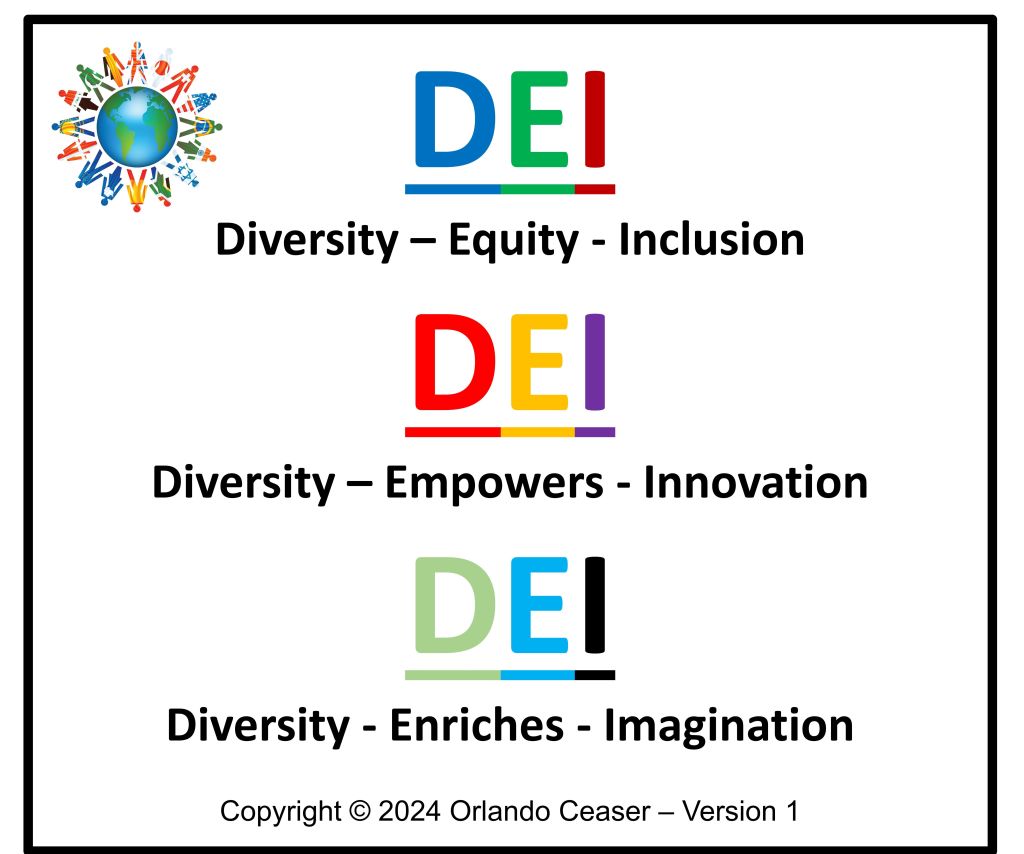
DEI stands for Diversity, Equity, and Inclusion, but there are many positive variations on these words that express the intent of the strategy and tactics for everyone.

DEI is the code of discovery that can unlock new paradigms of potential, imagination, and innovation. People think of DEI as separate from meritocracy, however, fairness would suggest that equity is essential when measuring and rewarding performance. DEI Essentials is a phrase to describe the necessary and seldom considered attributes associated with diversity, equity, and inclusion. These positive expectations and ancillary benefits are constructive. When DEI Essentials are present, there is synergy formed with the interaction of diverse and creative exchanges. They affect us on a personal and business level, enhancing decision-making, problem-solving solving and innovation. It is imperative to isolate and identify these assets to engage minds and develop better solutions.

DEI Essentials extract the best from everyone, creating a climate where dignity, respect, empathy, cooperation, and compassion are natural values. The results are a coordination of resources and ideas that lead to innovation and successful interactions. As we encourage fairness, involvement, and ingenuity, we set up an inclusive environment where people care and share, and dare to declare their greatness through strengthening relationships. We must maintain the desire to build relationships and cooperation, for they are critical to success.

“Diversity, equity, and inclusion

Must endure the chaos and confusion;

And emphasize positive potential,

And focus on DEI Essentials.”

  • Orlando Ceaser

DEI Essentials are necessary components if we want to achieve the ultimate state of effectiveness. They contain bedrock values and are the cornerstone of a thriving enterprise. They allow us to continuously push the envelope to greater frontiers. It is built on open representation, equal access to opportunity, and stimulating contributions to ensure people bring their best talent and ideas to the table. We are tapping into reservoirs of potential and possibilities.

Diversity Essentials

Diversity Essentials are characteristics that manifest our uniqueness, variety, distinctiveness, and perspectives. We developed our character through education, culture, exposure, experiences, and expertise. Diversity Essentials comprises the ways we are different, including the visible and invisible, seen and unseen. It captures the different generations and their interests. Baby Boomers are eliciting the talent and genius of Generation X, Millennials, and Gen-Z. It is an invitation to all people and ideas.

When we look at a definition of diversity, everyone should see themselves in it. We may be altruistic to a certain extent, but we need to see ourselves featured to feel as if we belong; for inclusion is a natural desire.

More of the distinctions and descriptions that describe how we are or how we feel are as follows.

Ability status, age, background, citizenship status, class, culture, development stage, educational level, ethnicity, extroversion, family status, function, gender, generation, immigration status, introversion, language, leadership styles, learning styles, life experiences, life styles, love languages, mindsets, national origin, organizational levels, other, outsider, personality types, physical attributes, political affiliation, race, regional origin, religious beliefs, sexual orientation, socio-economic status, spirituality, thinking and working styles.

Diversity Essentials are strategic business decisions that ensure that company personnel and representation reflect the customer base, community, and availability of talent. They are spontaneous revelations that believe in Win/Win situations. Diversity is more than race and gender. It is not a monster or the boogeyman to cause fear and loathing. It wants us to cultivate our abilities for the widespread improvement of projects, people, teams, countries, and the planet. Where it is practiced, organizations thrive financially in a robust culture of cooperation and innovation. Joel Barker, a Futurist who popularized paradigms and paradigm shifts, said, “Societies and organizations that most creatively incorporate diversity will reap the rewards of innovation, growth, wealth, and progress.” He also said many innovations are attributed to the outsider because they bring diverse perspectives to an opportunity.

Diversity Essentials recognizes our special nature and characteristics. We benefit extensively from the fortuitous value of working together and learning from each other.

Diversity Essentials harmonize these traits in an environment of acceptance and belonging, which allows each individual to be free, fulfilled, and fruitful.

Equity Essentials

Equity Essentials cultivates respect for fairness and the potential to be treated fairly to reach our potential to express our greatness with unfettered access to opportunity. There is an expectation of excellence. Meritocracy is a key component because the organization cannot function successfully unless it is staffed appropriately with hard-working, highly skilled employees.

Equity Essentials must be established and verifiable to potential and current employees, as well as investors. Equity Essentials assures us that we are attractive to top talent. People are attracted to places where sound, enforceable policies are in place. They wanted to be treated fairly in a setting of equal opportunity. Employee reaction should be validated in company surveys and individual conversations.  People do not feel they have an equal opportunity where favoritism and nepotism run rampant without leadership emphasizing fairness. It is one thing to have written policies against favoritism and nepotism, but if they are not enforced, they are meaningless.

Equity Essentials provides feedback on micro-inequities, bias, acceptance of generations, and increasing engagement levels. They educate us and improve our awareness of anomalies that are barriers to high performance. Integrity is an integral part of our operations, and we must elevate and celebrate core values that reflect who we are and want to become.

Inclusion Essentials

Inclusion Essentials are premeditated acts to involve others. We are pieces to puzzles and may contain missing perspectives and ideas for concepts, programs, and problems. We may have what is needed for the evolution, development, and growth of our peers or mankind in general. We cannot afford to isolate individuals who may hold the keys to our success.

Inclusion Essentials may manifest as practices, rules, and regulations that establish a climate of access and full participation. People want to be accepted in an environment of authenticity where they genuinely belong. When people know that they are valued and aligned with high expectations, in a caring group, they will not want to disappoint us. When we hold them accountable and solicit their contributions, they will stand up and stand out. There is joy in being part of something larger than each individual. They will bask in the association of being connected to fulfilling and worthwhile work.

DEI Essentials flourish, as it nourishes inquiry, constructive relationships that lead to better coordination, problem solving, and reduced conflict.

DEI Essentials promote a level playing field where individual talent and effort are encouraged and rewarded. People willingly release energy and discretionary effort as they engage in excellence and are committed to a cause greater than themselves.

Copyright © 2025 Watchwell Communications, Inc.

The Circle of Sensibility

Illustrate the movement from suspicious to synergy as we open and collaborate with others.

Human beings have an interesting way of responding when they encounter differences. Our reaction to the difference may range from civility to hostility. We’ve heard the story of women clutching their purses, and other physical manifestations of fear, irritation, or discomfort. These reactions may follow a pattern generated by unconscious bias.

Initially, we are suspicious of the presence of someone who fits our biases, stereotypes, negative stories, or prejudices. We may watch them intently and through facial expressions and other body language signals, let them know that we do not trust them.

Secondly, in the workplace, we are skeptical about collaborating comfortably with a new person in our department. We question their competence and the quality of their performance. We are reluctant to believe anything positive about them.

Thirdly, we may open our eyes and our minds and decide to be reasonable. We should approach the person in a sensible manner. This state of sensibility enables us to display wisdom, possibility, and the notion to give them a chance.

Fourthly, we become susceptible to opportunities to do something constructive. We realize that it may benefit everyone involved and set the stage for something uniquely beautiful. The more we learn about our coworkers the more we appreciate that we have more similarities in common. Our differences may be an opportunity to gain experience more about different segments of the population. We become richer, mutually, from the experience.

Fifthly, the collaboration will allow us to have successful interactions which are beneficial to change our mindset, which may cause us to discard the old ineffective preconception we harbored for so many years. Our relationship blossoms.

Lastly, we realize the full capacity of our potential to exceed expectations and thrive from the power and creativity of our new relationship. The synergy may release the talents in each of us, multiply our impact, and make us exceed our objectives. Locked in the preliminary stages of the Circle of Sensibility will hinder our achievement of greatness.

The Circle of Sensibility is a positive depiction of what we can do when we throw away the performance-limiting baggage of old mindsets and antiquated ideas. When we replace them with a worldview that allows us to capitalize on the diversity of our collective potential, we can make the world a better place. We can grow individually and collectively and fulfill the purpose that gives our life meaning.

Copyright © 2023 Orlando Ceaser

OrlandoCeaser.com

WatchwellCommunications.com

Managing negative people who undermine you? Block the impact of the Hindre™

The Hindre™ is a person or group committed to blunt your growth and development. They take it personally when you are driving and advancing in your schooling, career, and relationships. The Hindre™ takes its name from its ability to hinder your progress and work against your positive performance with negative roadblocks. They may be silent and work in secrecy. They may work in the background or out in the open, undermining you at every turn. The Hindre™ may also be referred to as the Ninja of Negativity.

The Hindre™ may be a family member, alleged friend, stranger, supervisor, or coworker. They are dedicated to suppressing your success and compromising your confidence and competence. The Hindre™ is the employee who sabotages the work of the team. They do not put their own weight on projects and may be responsible for other members leaving the company. They take the fun out of work. The Hindre™ may be the boss who does not give proper feedback and is constantly working against you.

The Hindre™ will befriend you and plant seeds of doubt through words, to shake your confidence. They will say things like, do you really think you can do that? I don’t think that is the right field for you. They may be brazen enough to ridicule by saying such things as you will never amount to anything, you are not good. They may go you by use of force and name-calling, to put you in your place, they prepared and designed for you.

The Hindre™ could be personal. The tendencies may be embedded deep in you. You may not believe deserve success and think you are unworthy. The years of persistent misinformation, ridicule, name-calling, and badgering convinced you that you are less than everyone.

We must work to identify the existence and presence of the Hindre™. We must apply the international symbol to indicate that the Hindre™ is not allowed. Their presence is unwanted and unwarranted. Their jealousy and envy, fueled by competition and insecurity, may explain their resistance and disapproval of your performance. However, it may be more insidious, such as prejudice, bigotry, and hatred.

The Hindre™ may be a negative person, a silent enemy, or a malicious perpetrator. Look in the mirror and search your soul. Are you a Hindre™? Do you know a Hindre™? How will you respond when you identify someone as a Hindre™. Be careful in their presence and align yourself with people who support you and work for your goodness and success. Be kind and caring to all people, work to connect, cooperate, and coordinate positive behavior, for the sake of progress. Do not let the Hindre™ impair your growth, as you develop a positive pursuit of love and excellence.

Copyright © 2022 Orlando Ceaser

DEI & Rudolph the Red-Nosed Reindeer – “Uniqueness is not a weakness”

Gene Autry was a military hero, who became an actor and singer. He sang the Christmas classic, “Rudolph the red-nosed reindeer.” It is a delightful song, enjoyed by young and old. However, this cheerful song delivers a powerful message about encountering and handling differences. Let us examine Rudolph the red-nosed reindeer and its meaningful conversations about diversity, equity, inclusion, belonging, and accepting others.

The song begins with a reference to the reindeer popularized in Clement Clarke Moore’s, “The night before Christmas”, also known as “A visit from St. Nicholas.” It begins with a roll call of Santa Claus’ reindeer that of course omits the name of Rudolph. As you recall, Rudolph was different from the other reindeer because of the luminescent quality of his nose. His nose was so shiny that it had either reflective qualities or it glowed like a light. This was enough to make him the object of ridicule and ostracism by the other reindeer.

This lack of acceptance is seen when children and adults are confronted with someone who is different from them. Our initial response is to make fun of the person and then isolate them because of their characteristics, traits, heredity, or idiosyncrasies. We may recall when we were young and begged for acceptance and approval. Even to this day, there is something about us that makes us stand out from the crowd. We feel self-conscious and wish that our difference could go away. If possible, we will change our stories and appearance so others will like us. When we are new and different, we carry a tremendous unnecessary burden. We view our “uniqueness as a weakness.“

At work or in school, simply being the new person, the new kid on the block, the person who is unknown, becomes a source of teasing or isolation. We often wondered,” if they would only get to know me, they would see that I’m just like them. I am a good person. “Rudolph was a reindeer, so he surely had a similar appearance, except for his nasal peculiarity. But suppose he was of a different color, from a different region of the country, or had a different ability. We usually ask the different parties to fit in, when the real focus should be on including and accepting them into the group.

Bullying is also a response shown toward those who are different. The song does not indicate that Rudolph was bullied, but we can only assume that preventing him from “playing in any reindeer games” was not accomplished in the most delicate manner.

The song does not tell us what Santa Claus was doing during the hazing or if he even knew about it. But, as a good leader, he engineered a very strategic response. He knew the talent and value of all his reindeer. He evaluated the weather system for his next journey and realized he was going to encounter many blizzards. He knew the problem could be solved by the reindeer, but he needed to show his acceptance of Rudolph the talented reindeer. The leader has vision and can often see what others cannot.

Santa Claus knew the skills and abilities of each reindeer. He knew that the appropriate circumstance would allow for each skill to be revealed. He knew Rudolph had a special gift and could provide navigation assistance on those wintry nights when delivery of toys to children around the world, would be difficult. Snowstorms would provide opportunities where others, including the reindeer, could benefit from the gift of Rudolph, the red-nosed reindeer.

We can give Santa credit for waiting for the appropriate time to unveil his strategy. He could have given the reindeer the opportunity to work it out amongst themselves, as so many people do in similar situations. We would say such things as,” kids are just being kids, learning to navigate tricky situations will only make the recipient stronger and teach them valuable life skills. We say that which does not kill them will make them stronger, to paraphrase Friedrich Nietzsche the philosopher. The reindeer performed similar initiation rites to others in the group that had other distinctions from their peers. They saw their treatment of Rudolph as being harmless and natural.

The defining moment came,” one foggy Christmas Eve, Santa came to say: Rudolph with your nose so bright, won’t you guide my sleigh tonight?” Many managers, leaders, and parents look for the opportune moment to use the skills of their people; the right moment to show the world and the individual their true value. However, it would be prudent to consistently look for ways to utilize the talents of their people. They should know the coordinates of their subordinates, so they can meet them where they are.

We can only assume that in the fictitious conversation, Santa’s encouraged Rudolph and told him about the value of his difference. He made him feel that he was something special and should never feel that he was not important and did not have a place. I’m sure he made him feel like an essential member of the team. He validated his worth by asking him to lead the team by moving up to the front of the line.

You remember the successful conclusion to the song. “Then all the reindeer loved him, as they shouted out with glee, Rudolph the red-nosed reindeer, you’ll go down in history!” We know that in life, responses to differences may not always lead to a happy ending. Sometimes the individuals have lingering insecurity, damage to their self-esteem, and underlying resentment from the initial exclusion. But, when the difference that is ridiculed or denied is used for the benefit of the group, the organization, institution, family, or community becomes more vital. Everyone learns a valuable lesson about diversity, equity, inclusion, belonging, and acceptance. We are hopeful that when the person is accepted, they don’t become complicit and act in the same manner when they encounter other people who are different.

Suppose we remember the Rudolph days of our lives and commit ourselves to preventing them from happening to others. In that case, we will maximize their future contributions to our teams, families, organizations, and communities. We will perform a noble act when leading by example with the lessons learned from Rudolph the red-nosed reindeer.

Unlock Your Leadership Greatness and other leadership resources can be found at OrlandoCeaser.com or amazon.com.

Copyright © 2013 Orlando Ceaser

Cameo Leadership™- The Power of Positive Presence

Alfred Hitchcock, the noted film director, was known for making a cameo appearances in his movies. A game among many moviegoers was to watch the films and locate the scenes where Mr. Hitchcock made his guest appearance. Celebrities use this technique, to gain publicity, boost interest in a movie, and increase sales. Stan Lee of Marvel Comics fame adapted this philosophy to playfully insert himself in Marvel movies to excite his fan base.

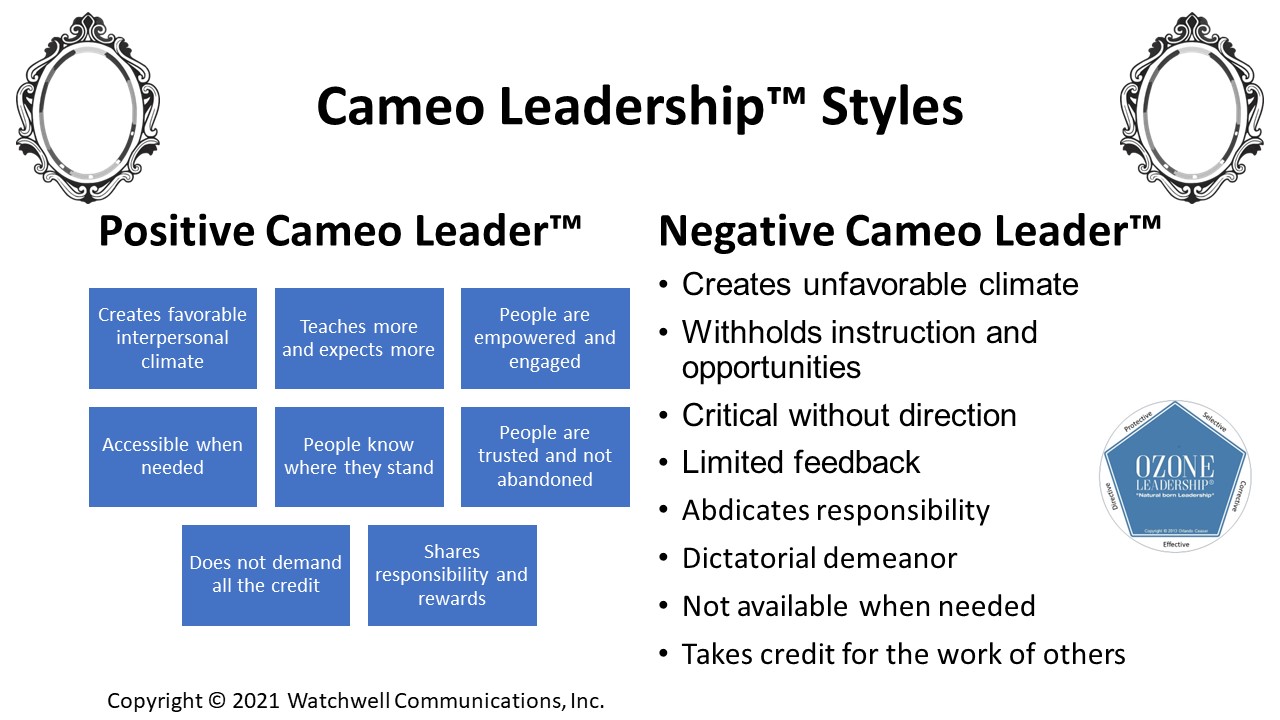
The concept of cameo appearances can also be applied to leaders. The idea of brief appearances fits the style of many leaders. Cameo Leadership could be defined as a positive or negative leadership style, characterized by a leader influencing direct reports through a series of brief exposures. The style is condoned or condemned by subordinates, based on their value to employee development.

The Cameo Leader™ may fall into two categories, negative and positive. The Negative Cameo Leader is like an absentee landlord. They abdicate their responsibility, and you can’t find them when you need them. The Negative Cameo Leader shows up for a moment without warning. Their interactions lack positive values and developmental opportunities. They arrive on the scene, ready to take center stage, absorbing all the attention and accolades available. They poison the environment in a dictatorial and authoritarian manner. They relish being the boss, as they give orders before practicing their disappearing act.

In the Negative Cameo, the NC Leader will give out an assignment without instructions or supervision. When positive recognition is dispensed upon their department, they will accept the praise and bask in the limelight, and refuse to share the glory. Employees are frustrated because they are deprived of the encouragement and developmental opportunities needed for their growth. Careers suffer because the Negative Cameo Leader is not familiar with their employees, their work ethic, or their work product. They cannot vouch for their direct reports’ performances for they do not have an intimate knowledge of their career aspirations.

The Negative Cameo Leader does not take an interest in the work of their employees or in their lives outside of work. Therefore, they do not deserve or receive loyalty from their people. The Negative Cameo Leader can become a micromanager when they pop up on the scene, drop a few demoralizing comments, and disappear. What they label as individual freedom is a dereliction of duty.

Seagull leadership is where the manager flies overhead, swoops down, and dumps on their people before moving on. This is the hallmark trait of the Negative Cameo Leader.

The Positive Cameo Leader is admired because they are with their people in the beginning during the planning phase. They share the vision and provide the resources and support to do their jobs. They give them responsibility and hold them accountable for the completion of their assignments. They value and trust their employees’ skills, abilities, and judgment. They are encouraging and believe in their people and provide independence because they trust their ability to do the job and forgive them when they make mistakes. People know where they stand with the Positive Cameo Leader, for they have an open-door policy and dispense feedback generously.

In the Situational Leadership model by Paul Hersey and Ken Blanchard, the leader would delegate responsibilities based on the development level of the employee. The peak performer would receive independence and less direction and support because they have earned it.

The Positive Cameo Leader will visit periodically to see if their people need anything. The job and the responsibilities belong to the employee. The PC Leader creates a culture of collaboration and ownership. They ensure that people think and act like an owner, for they will be held accountable for results. They are not unnecessarily visible; however, they are accessible through a variety of methods.

The Positive Cameo Leader ensures that those who do the work, receive the credit, and the accolades. They look for ways to set their people up for success through encouragement. Positive Cameo Leadership when practiced requires the leader to unselfishly accept their role in working for their people. They are willing to act and pay the price as they practice what they preach.

Cameo Leadership can have a negative or positive perception based on how employees respond to this leadership style. If it is negative, it is corrosive and is a barrier to career development. The Rosenthal effect created by Dr. Robert Rosenthal of Harvard University is the phenomenon in which experimenters treat subjects differently based on their expectations which has a positive or negative influence on subject performance. The Rosenthal effect is evaluated in four categories. They are climate, input, output, and feedback.

Cameo Leadership may be present at various stages of an organization, team, or individual’s development. For example, Positive Cameo Leadership is ideal for an individual or team that is highly skilled and does not require much supervision. A negative cameo is not desirable in most situations.

Cameo Leadership™ impacts the workplace environment. The leader’s expectations of their people determine the climate. Favorable or unfavorable expectations will create a positive or negative interpersonal climate for each individual. Secondly, leadership input, in the form of information and opportunities, is based on positive and negative expectations. Leaders teach more to those whom they expect more and conversely. Thirdly, the output is defined by the level of questions accepted or encouraged by their subordinates. We give them more opportunities to express their questions. This is also based on expectations. Lastly, the Positive Cameo Leader gives feedback that builds or diminishes self-esteem and performance and will praise or criticize for mistakes, in accordance with their level of expectations. The objective is to be a Positive Cameo Leader and minimize Negative Cameo Leadership tendencies.

Copyright ©2021 Orlando Ceaser

Leadership B.L.I.S.S.™ (Bold Leadership Is Street Smart)

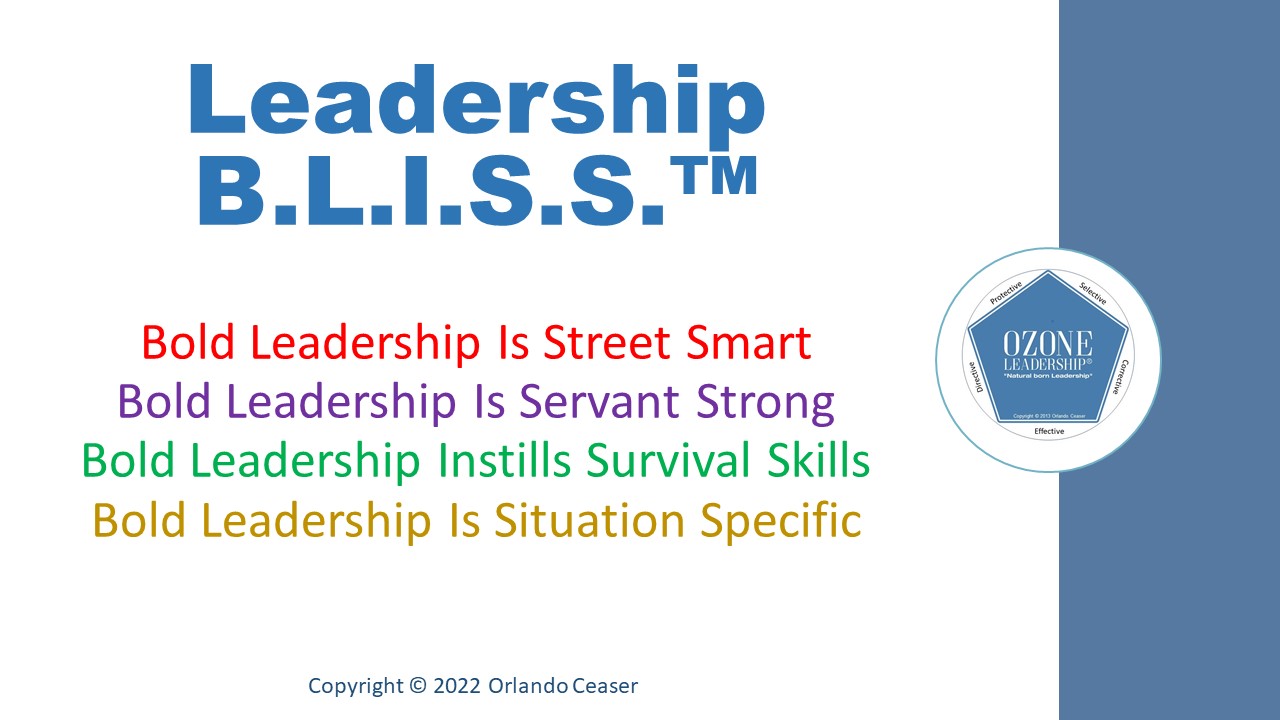
When we think of bliss, we think of joy and happiness. Bliss is a feeling, a positive state of mind; a pinnacle of emotion. Bliss may be invigorating and satisfying. In this article, we will use bliss, as an acronym. B.L.I.S.S. will evoke a sense of power and boldness when it is linked to leadership.

  1. Bold Leadership Is Street Smart.
  2. Bold Leadership Is Servant Strong.
  3. Bold Leadership Instills Survival Skills
  4. Bold Leadership Is Situation Specific

Street Smart

Bold Leadership is Street Smart. It cultivates workplace wisdom and marketplace moxie. Bold Leadership appreciates diversity, equity, and inclusion and treats people with dignity and respect. Respect is the currency that influences the cooperation and coordination necessary to avoid danger and anticipate business downturns.

The Oxford Language Dictionary defines street smarts as “the experience and knowledge necessary to deal with the potential difficulties of life in an urban environment.” The practical application of this is being savvy enough to make the tough decision. A person demonstrating street smarts knows how to operate calmly under tough circumstances. They know how to conduct themselves in a crisis. They may have the expertise and instincts to avoid a crisis. Street smart individuals can navigate a hostile environment.

A person who is street smart has developed a heightened sense of awareness of their environment. They know diverse people and their tendencies.  They recognize cues and clues and respond in the appropriate manner through their words, body language, and actions. They are confident, but not too confident and move as if they belong in the area. They do not display an air of timidity. Their strength is just enough, not to seem confrontational. They know what to say and what not to say, where to go and where not to go; they flow as if they belong.

Bold Leadership is Street Smart. Certain aspects of street smarts can be taught and presented in a framework to help people increase their awareness. Through the powers of observation and simulations, we instruct our customer-facing employees to be friendly, and professional and to understand their surroundings. They dressed appropriately and did not bring too much attention to themselves. They cultivated relationships.  People befriended them and had their backs. They would not take unnecessary risks and be constantly following Principle Number 3 from my book Unlock Your Leadership Greatness. Principle Number 3 is becoming A Student of the Game, which means continuously learning information about their field and related areas, which includes learning about diverse clients and various circumstances.

Bold Leadership is street smart when it hires and develops toughness, resilience, and street credibility. It knows how to relate to people and pays its due to learn and understand people, backgrounds, and motivations.

Servant Strong

Bold Leadership Is Servant Strong; for it realizes its purpose is to serve others. Bold Leaders see employees holistically. Each person is an individual. I feel that “The leader must know the coordinates of each subordinate, so they can meet them where they are.” They want employees to bring their entire selves to work, engaged and participating fully. Being servant strong means empathy is an important element for engagement.

Servant Leadership is a term popularized by Robert K Greenleaf in his essay, The Servant as Leader. This concept focuses on the individual. The leader concentrates on meeting the needs of their followers. The leader’s mindset is, that if we serve or take care of the people, the people will take care of the business. Traditional leadership models are leader-focused. They were hierarchical and everyone in the organization worked for the people on top. In servant leadership, the leader works for everyone. This causes a different mindset and a shift in behavior. The Bold Leader asks questions, such as What can I do for you? Is there anything else that you need? And What else is required for you to be successful?

Survival Skills

Bold Leadership Instills Survival Skills; for it is developmental by nature. There are sets of skills and abilities that must be mastered if someone is to be successful. There are minimum standards that must be learned and graduate-level on-the-job training experiences that ensure long-term success.

Bold Leadership Instills Survival Skills; by ensuring that people are fundamentally sound and by setting high standards. Feedback is provided routinely to chart their progress. By setting high expectations, people develop into confident, courageous, and competent performers.

The survival skills make them feel safe and place them in a protective frame of mind. Unlock the Secrets of Ozone Leadership® is a book utilizing the protective attribute of the ozone layer to strengthen survival skills. Bold Leadership ensures safety is a key component of their lives.

Situation Specific

Bold Leadership Is Situation Specific; refers to its ability to shift to a higher gear when more is expected. Regardless of the situation, bold leadership can adjust to a crisis and deliver what is required for their people to develop. Paul Hershey and Ken Blanchard developed and described the concept of Situational Leadership. The idea was to work smarter and not harder and to provide leadership based on the employee’s development level. Less development required more direction; more development required less direction. There was a constant delivery of support and direction based on the changing development level of the individual. Work smarter and not harder. I would add the phrase, “because you don’t want to be a martyr.

It is imperative to add B.L.I.S.S. to our leadership. This will enable us to become street smart, strong servants, instilled with survival skills, and leadership that is specific to the situation. Inherent in any leadership philosophy and methodology is a list of do’s and don’ts that we pass along to others for safety, protection, productivity, and growth. When we obtain Leadership B.L.I.S.S.™, we must train it and envelop and develop it as a competency. Leadership B.L.I.S.S.™ (Bold Leadership Is Street Smart) is a critical leadership state with many success factors to benefit our constituents.

Copyright © 2022 Orlando Ceaser

Be More Interesting – BMI

Improve relationships, recruiting, culture, retention, and productivity

Be More Interesting (BMI)

Acronyms are nifty little devices that help us memorize concepts. Acronyms are excellent to create a mantra for repetition.

People look detached and disengaged in the presence of someone whom they feel is bland and uninteresting. They may be in a relationship with someone who is dull and appeared to be sucking the life out of them. The spark is gone, and an infusion of excitement is necessary.

My college roommate told a story of asking a question of a professor who was not very dynamic. At the end of an exceptionally long, drawn-out, boring explanation, the instructor turned around to find my roommate sound asleep and snoring. The class found this to be hysterical. I found it historical, standing the test of time.

Picture this; the first date through a dating app, two people sitting at a table and staring away from each other. They are floundering in meaningless conversation, losing interest by the minute. The situation would be much better if the parties were interesting and increases the likelihood of being interested.

The workplace may need revision to increase engagement and participation. Additionally, Recruiters can recall interviews where candidates answered questions with a lackluster demeanor. They were not able to sell themselves in a persuasive manner. They may have been suitable for hire, but their personality blocked their chances.

We remember speakers and teachers who were not able to hold our attention, which caused our minds to wander. We could save ourselves the trouble, and create livelier discussions if we could make ourselves and others more interesting. Therefore, we need people to BMI. I am not speaking about “body mass index” or the Broadcast Music Corporation; I mean to Be More Interesting.

Relationships

Relationships would be more fun, interactive, exciting, and engaging if people were more interesting. Personal development can lead to a life that is more fulfilling and enjoyable. Time is well spent and used wisely when we interact with people who have great content in their conversations. Imagine having a conversation with someone who consistently provided content that is intriguing, and humorous with a substantial amount of depth and clarity. I’m not necessarily saying that they are more intellectual, but they have depth and breadth of knowledge. Interesting could be cultivated by the following methods:

  • Read more, extensively traveled and educational exposure and life experiences.
  • A well-developed “HIT List” – refers to Hobbies Interests & Talents
  • Emotional intelligence and conversation skills emanating from self-awareness and people skills
  • A sense of humor that is not condescending, but has a hint of self-deprecation
  • A curious thirst for knowledge, as they continuously learn new things
  • Optimistic in their worldview and a positive approach to life and people
  • Empathetic and humble, while taking an interest in others

Work

Work would be more enjoyable if it were more interesting. It would be a place we would look forward to going to each day. If the work and the people in it were more interesting, productivity and culture would be amazing, especially if the interesting people were allowed to fully express themselves. Gallup’s research has linked engagement to having a best friend work. They also said that people do not leave companies but need managers. Imagine a company where managers had the requisite skills of being more interesting and more interested in the people. We could revolutionize the workplace.

Personally, we should do a self-evaluation to determine how interesting are we to other people. We could ask that question of our nearest and dearest friends and associates. But we can also ask them what could we do to increase our BMI. Take notes and try to put their suggestions into practice. Also, we could ask employees about the interesting elements in the workplace, i.e., leadership, work content, workflow, and coworkers.

Interest should not necessarily be equated to popularity and an extroverted personality. We are speaking of depth and our ability to tie your exposures, experiences, and expertise in a manner that others may find compelling.

You could also add adjectives to describe interesting. They may be;

  • Authentic, transparent, empathetic, humorous, caring, trustworthy, safe, creative, adventurous, supportive, goal-oriented, with a zest for life
  • Willing to help others succeed, generous and well-rounded
  • Loyal and less likely to leave their jobs, thus enhancing retention

When we are more interesting, our relationships flourish and our connections at work can be more vital, and productive. Being more interesting would enable us to be more creative, with less stress, and retain more information. If we adopted the mindset of BMI, we could transform ourselves, the workplace, and the people we connect with daily.

Copyright © 2022 Orlando Ceaser

Managerial Monsters in Haunted Workplaces

Pandemic reflections about scary supervisors and managerial monsters in haunted workplaces were a dreadful way to spend time. The Covid 19 pandemic has shone the spotlight on jobs, managers, and workplaces, as we reassess our values and careers. Many people decided not to return to their previous workplaces. This is evident by record resignations.

There are many reasons for the work shortage. The Gallup survey told us that people don’t leave companies, they leave managers. However, the workplaces may not be an enticing place to return to. Haunted workplaces and managerial monsters may both be a problem. However, we will concentrate on the managers in this article.

The traits of these individuals influence their leadership practices. They resort to fiendish tactics or insensitive methods to get results. Where there is a monster, there is fear. Where there is fear, there must be an antidote or a strategy to eventually relieve people from the threat of the monster and the power it has over them in the workplace.

There were six favorite monsters or categories that dominated the movies in my childhood; Wolfman, Dracula, the Mummy, Frankenstein, and the Bride of Frankenstein, and various reptiles or insects mutated by their exposure to radiation. For this segment we will concentrate on the top five; Wolfman, Dracula, Frankenstein, the Bride of Frankenstein, and The Mummy.

My favorite character was the Wolfman. He was a frustrated man who was bitten by a werewolf and had to spend the rest of his life howling at the full moon. He wanted to be different, but Lawrence Talbot was overpowered by the curse. The Wolfman manager is driven by the curse of ambition or trapped in the expectations of the culture. Have you seen the Wolfman Manager in your organization? They were nice but tormented by their role. They are subject to the curse of what represents success in the organization. They are mimicking a role for survival.

Secondly, there was Dracula, the vampire. He was charismatic, smooth-talking, and mesmerizing. He spoke with a distinctive accent. People liked his charm, appearance, and professional demeanor. But Dracula was still a bloodsucker planning to render his victims hopeless and under his control. Dracula lacked empathy and emotional intelligence. His intent was to drain others until they were no longer of use to him. You may have seen a vampire walking around your company with that same arrogant, cold, uncaring look. The look that says they are interested in you for what you can do for them. The Vampire Managers walk around feeling as if they would be there forever and no one would discover their secrets. You may wonder if somewhere, there is a coffin containing their native soil, buried in an undisclosed office.

Thirdly, Frankenstein was a collection of body parts, sewn together to create a living breathing inhuman being. Frankenstein’s monster in our story may be our own creation. We have given them unlimited power over us. We let them get away with behavior and practices that are against the company policy.

The Frankenstein Manager appears in organizations as the protégé of their mentor or sponsor. Eventually, the protégé will turn on its creator, causing destruction in its wake.

Fourthly, the Bride of Frankenstein was an interesting monster because she was a woman with top billing. Most marquee monsters were male. This female monster was known for her ability to be dangerously independent and competitive. Her aggressive personality proved she was just as frightening as the men. Additionally, you can find a female personality that applies to each of the monsters listed.

Lastly, the Mummy was cursed to guard the tomb or temple of his beloved. He was slow of foot but was relentless and powerful. This is a creature driven by an overpowering love and allegiance for the object of their affection, which is power. This person within your organization has an undying love for the status quo and the good old days. They would destroy anyone who tried to harm or change it. They will blindly institute unethical policies and cover them up, especially if an investigation is pending or inevitable. This individual will persistently pursue anyone who has anything negative to say about the company or anyone they personally admire within the organization. They will practice a technique known as delayed retaliation, a slow-moving process, to seek revenge against their enemies.

Each generation has its own monsters; whether they are zombies, Aliens, the Predator, Jason of Friday the 13th, or Freddy Krueger from Nightmare on Elm Street. These Monsters have tendencies that can describe leaders in organizations around the world.

Copyright © 2015 Orlando Ceaser

The Crowd Pleaser Syndrome™ – Attention for Acceptance

The Crowd Pleaser Syndrome™

As early as I can remember, I had a craving for attention; a sweet tooth for popularity. Even when I was silent, I would look at people and want them to know me and notice me. I wanted attention, acceptance, and approval. They were my straight A’s. I wanted to play to a crowd or a small group. This Crowd Pleaser Syndrome™ (CPS) was my affliction, which fed my ego and drove me to success and notoriety. However, it also exposed insecurities and vulnerabilities.

I discovered that I was not alone, there were others like me. We needed the mentors and people who understood what we were going through. We did not have support groups to help us understand and cope with this beautiful character trait. Additionally, there were public and private assaults against our reputations for a variety of reasons.

An early manifestation of the CPS was an instance in grammar school, where I misbehaved and angered my teacher. This was during the era when teachers and corporal punishment were synonymous. The teacher called me to the front of the room for a spanking. I had the attention of everyone in the classroom. She asked me to bend over and face the class. She gave me a swift smack on my backside and sent me back to my seat. She was satisfied knowing she had dispensed justice and I felt great, knowing I gained the recognition I needed.

The Crowd Pleaser Syndrome™ is present and prevalent. It shows up at work, as individuals please their peers and supervisors. There is a tendency to deliver good news to the boss in the form of withholding negative information or results. People do not fully disclose information to analysts and the public because of the negative stock implications. Employees may be too aggressive and take unnecessary risks to look good personally. The Crowd Pleaser Syndrome™ may infuse us with the desire to win at all costs.

Crowd pleasers realize at an early age, their ability to entertain others. They may have engaging personalities and athletic and the musical prowess. Here are more Crowd Pleaser Syndrome™ characteristics.

Crowd Pleaser Syndrome™

  • Confident risk takers
  • Highly active in social and professional gatherings (parties and meetings)
  • Work hard to stand out from the crowd
  • Seek acceptance on Maslow’s Hierarchy Needs (belonging)
  • Thrive on competitive activities
  • Develop attention-getting behaviors, strategies, and tactics

Unhealthy Challenges

  • Workaholism and lacking balance by focusing only on the area giving them stimulation
  • Unethical conduct may suppress the competition and put others at risk
  • Failure to share the limelight, especially in developing others, and giving credit on group assignments
  • People tried to sabotage their careers
  • They meet the needs of others and deny themselves
  • Put others first to their personal detriment

Popularity is a stimulant which can have positive and negative effects. The Crowd Pleaser Syndrome™, when managed properly, can have a profound effect on performance, relationships, group culture, and the development of individual strengths. CPS individuals can entertain, educate, enrich, and inspire us to achieve the greatness inherent in each of us to make this a better world.

Copyright © 2021 Orlando Ceaser

Website: OrlandoCeaser.com

Watchwellinc.com