The Hindre™ – A Secret Force of Exclusion

the_hindre (1)

The Hindre™ is a person whose purpose is to keep you down, drain your confidence, stunt your growth, hold you back, and prevent you from moving forward. They will hinder you from realizing your potential and living up to your expectations. They are stationed in households and organizations to thwart progress and stymie success by discouraging siblings and offspring from achieving their dreams. The Hindre™ will disillusion people who have the ability and talent to make a positive difference. (The illustration of the Hindre™ is provided by United Press syndicated cartoonist Charles Boyce, creator of “Compu-toon”).

We encounter this nemesis of negativity at various stages of our lives. This individual is responsible for creating a hostile environment of exclusion that says we are not invited, we are not good enough and we are not wanted. The Hindre™ are in businesses and other organizations prepared to sabotage individuals viewed as a threat. They are active when difference enters an organization, so that the status quo is maintained. They are people who place fear in your heart by making you believe you are inadequate and do not have the skills to succeed, unless given special accommodations.

A first encounter with the Hindre™ is during your youth. Exposure is at school or in the home. They may lash out against you in the form of a bully, to hurt your feelings. The experience may have left you angry, embarrassed or ashamed. As you grow in age and maturity they show up in school, relationships, family, and activities and on the job. They are sometimes subtle or bold, undercover or out in the open, covert or overt in their actions. However, they may seem to support you, while discouraging you from taking a risk and disparaging you behind your back to diminish what others think of you.

The Hindre™ show up when people and ideas are the weakest and most vulnerable. In school when you are forming your dreams and goals for the future, they bring their brand of sarcasm, laughter, cynicism and ridicule to shake your confidence, break your spirit and damage self-esteem.

At work they appear in many forms. They may seem harmless, objective and well meaning. But they use their credibility to tear down your ideas and cast suspicion and doubt on your performance. If you are highly regarded, they may use language behind your back such as, “you would think with their education and experience they would know better or perform at a higher rate.” These secret attacks are pervasive, persuasive and slowly reduce your standings in the eyes of peers and supervisors.

Talent will bring the Hindre™ to the surface. Talent activates their discouragement mechanism to hinder high performance. If you are silent and under performing they are dormant and content. But when you flex your creative muscles and express your skills, abilities and talent, they are pressed into action.

Exclusion at Work

In business the Hindre™ lurks in the hallways, meeting rooms and work stations. They are dormant until someone threatens the status quo with new ideas, especially if these new ideas come from the wrong people. The Hindre™ always looks for reasons why ideas will not work and how the ideas of others may work better. They allegedly have the interests of business at heart, when they shift focus and direct their critique to the flaws in your perspectives.

The Hindre™ is sometimes driven by unconscious and conscious biases and prejudices. They restrict access to employment opportunities, neighborhoods, certain groups, membership to exclusive clubs for women and resources to complete a project or proposal.

The work of the Hindre™ has cost companies and countries billions of dollars annually in lost engagement and productivity, revenue and innovation. New ideas are suppressed. People are not fulfilled. Opportunities are passed or missed as the company is deprived of the full richness of its talent pool. On a larger scale entire neighborhoods and countries are deprived of entrepreneurs, leaders and positive role models. The Hindre™ is the ultimate Devil’s Advocate, running unrestrained throughout our lives.

In meetings they shadow your comments. They come to life when their target begins to speak. When others speak they are relatively quiet, but when you talk, they are on the edge of their seats, ready to launch a counter offensive to pounce on your ideas. Many times, they will submarine your ideas as irrelevant and inappropriate, only to repackage as their own at a later date.  Therefore, you should keep track of your ideas, so that when they resurface you can claim credit for them.

When you are aware of the existence of the Hindre™, they are very predictable. Your mindset will to prepare excessively to ensure that your comments are well thought out, yet open for constructive challenge. You can use the presence of the Hindre™ to make you stronger.

The Hindre™ is known for discrediting groups of people and diminishing their accomplishments by saying that they are in over their head, they only got here through a special program and alluding that they may not be qualified.

In Talent Management and succession planning meetings the Hindre™ is present. They shoot down candidates with little objective information, but with a plethora of subjective innuendos. They have done their homework and will twist the facts or limit the admission of positive information that could benefit talent to the organization. The Hindre™ want to restrict your movement and limit and deny access to people, assignments and information that will make you successful.

What can you do?

We must develop the vision to spot them in a crowd and to know that they exist even though we are not sure of their location. Being hidden may give them power if they can catch you by surprise. Sometimes exposure and the knowledge that you know who they are can rob them of their strength. You can develop techniques to question their comments or answer them in a thoughtful intelligent manner. When you are skilled you can cast doubt on their motives, which can be risky, without the audience support. If rendered ineffective, they may go away, go underground and try to discourage others or think of an alternative way to stunt your development.

You must build confidence and surround yourself with people who are supportive, mentors, coaches, true friends and trusted allies. If you do not place this fundamental fortress of protection in place, they will cause you to doubt yourself, especially if no one is coming to your assistance. You must develop effective allies who have your back and will alert you to attacks from unsuspected Hindre™. Occasionally, someone may ask two questions which you should take seriously.

  1. How well do you know a particular person?
  2. What does this person have against you?

This may be a warning advising you to be careful around a particular person. Listen carefully to these comments as they are trying to tell you something significant about the Hindre™ in your midst.

Not every critical person or critique is from a Hindre™. You must subject the comments to a qualifying test. If they are instructive and productive, you would accept them. If their comments mean well and will make you better, you should welcome them. Try to determine the intent and motives of the person, the value and benefits of the comments and the potential consequences of action and inaction.

The Hindre™ may be powerful. We need to resist, but we may not be strong enough individually to withstand their fury. We need advocates and allies to jump to our defense. We need to cultivate teams of believers who will stand next to us when we are challenged inappropriately.

The Hindre™ is active, damaging dreams, poisoning relationships, restricting productivity and stifling the growth of communities, countries and continents. The Hindre™ undermine the joy we could experience without the persistent nay saying, negative nemesis that seeks to deprive us of our greatness. We must be aware of their existence, their presence in our environment and their mission to undermine our effectiveness. They are among the secret forces of inclusion in our environment. Therefore, we must develop tools to nullify their impact and cultivate allies to support us and fortify our positions.

Copyright © 2009 Orlando Ceaser


Loyalty – To be or not to be?

Just_a_Game_b

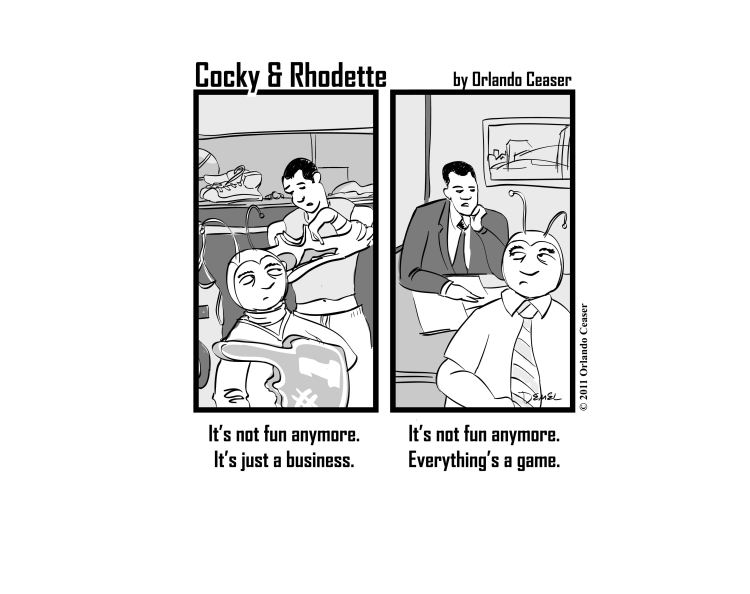
Loyalty is an awkward discussion topic within organizations. The relationship with our jobs is complicated. Layoffs, reorganizations, mergers and acquisitions, plant/store closings, and outsourcing jobs overseas have a negative impact on employers/employee relations and more row. Managers in some organizations think, “Why should I be loyal to my employees, after all this is business.” Company survival trumps loyalty is their current mindset. Employees wonder if they should stick around.

Additionally, employees who were loyal to their companies find themselves out of work and feel betrayed and used by their former employers.

Loyalty can be defined as allegiance to something or someone. Loyalty is earned and its compliance is given by consent. We are speaking of loyalty in terms of fidelity to your company. We may also view loyalty on several different levels: loyal to your manager, coworkers and team

Loyalty is an intriguing concept. We know what it is and the circumstances where it should be exercised. It is emotional and enhances the value of a relationship. Relationships have expectations. If these expectations are not met or are threatened, loyalty is affected. When loyalty is coerced or forced, people will stay on the job until the right opportunity arrives to ease their conscience as they leave the organization.

We are loyal when someone or something is worthy of our trust. However, when there is a breach of trust, loyalty is retracted.

Loyalty Demonstration

Loyalty must be discussed in the context of equality and reciprocity. After all, reciprocity is a part of the transactional currency of loyalty. The company is providing something to the individual and the individual performs the work commensurate with the salary and the environment. Loyalty involves fairness and keeping your promises. The employee’s level of engagement reflects their level of appreciation for the services rendered. If the employee is treated fairly, allegedly, they will work hard, speak highly and positively about the company and remain a part of the organization. Loyalty is given as long as both parties fulfill their part of the obligation.

A leader who is loyal to their people may fight hard to justify retaining good people at the expense of others. An organization/leader that has a reputation of doing everything to minimize layoffs and retain employees can influence the number of loyal employees who choose to stay and speak highly of the company. Some companies may take less profit, in the short term, and minimize turnover in their organization.

What do you do to develop loyalty within your people? Some may argue that loyalty is not something that you develop, but like trust, is something that is earned. What steps can you implement that will save your business and earn loyalty from your employees? Do you show that you truly value their contributions? Do you adopt strategies that protect your people during the hard times until profit improves? Do you honor your promises and meet their expectations? Discuss the big picture to keep employees apprised of company challenges and performance, where appropriate.

Seeds of defection

Organizations will frequently make decisions and state that they were made in the best interests of the company. Budgets are cut; people are reassigned or displaced in order to improve the bottom line. Some leaders will not search for an alternative view that would spare jobs and careers. Leadership will quickly reduce headcount. This plants the seeds of defection, as people realize they are only a number, a statistic, headcount and a line item on a budget.

A selfish organization risk creating a selfish, culture where people stay or jump based on their individual needs being met. Therefore, everyone is treated as expendable. People respond by acting as mercenaries or hired guns. This removes the stability that people like to experience.

If a company reduces staff, so they can bring them back later, employees become stressed. They are constantly performing emotional gymnastics in a toxic environment. Conversely, if the company goes out of its way to inform and retain people and they know it, they may go out of their way to stay or deliver higher levels of engagement, retention and overall performance, to protect the company and their jobs.

Loyalty used to be defined in the context of fidelity, as it related to staying with an organization long-term. However, there’ve been countless instances where people passed up job offers from other organizations, only to be terminated by their own company. Individuals are angry at themselves for being loyal to a company and then the company does not show the same kind of loyalty to them. When did these stories circulate around an organization, people vow to never let that happen to them if they can help it.

Mindset in Today’s market

What kind of mindset should you have in today’s precarious job market? Should you keep your head down and not worry and everything will be alright and work itself out? Should you be open-minded to the flirtations from other companies promising a better deal? Should you put the word out that you are interested and seeking a different long term relationship? When people approach work with the mindset of the, “it’s just a job,” loyalty can be compromised.

Some people strategically interview internally and externally to keep their interviewing skills sharp. Their rationale is that it keeps them sharp for jobs inside and outside of the company. Other employees interview for ego and the self worth to see if they still have the skills desired by another organization. Others want to test their market value to benchmark for raises.

Loyalty Risks

People are hired who have demonstrated the propensity to jump frequently from job to job. Their track record is firmly stated on the resume. They are hired hands or have a mercenary mentality. They have an unspoken understanding with management that they are there to fulfill an assignment or until they can’t get something better. This may ultimately become a disadvantage.

I was impressed by a young man who fits the above the description. We met between sales calls and he asked if my company was hiring? He was very impressive; He went on to say that he was always looking for a better job. He made a very elaborate presentation of his thought process of always looking out for something better. As a hiring manager, I pondered the risk of recommending or hiring someone like him who was always looking to leave for greener pastures. Loyalty with him would be misplaced and could be detrimental to the survival of the new organization.

Loyalty is a learned trait. It is generally observed and imitated. Individuals learn from an environment where loyalty is practiced. They learn the components and the guiding principles and foundation regarding its use. Both parties in the employer/employee relationship are evaluating the value of the arrangement. Both groups are under enormous pressure to behave in a manner that is considerate of each other.

If a company lays off employees as a last resort, it may be the nature of the business that is the business required it. Employees may not like it, but ultimately will understand.

If an employee receives an outstanding offer from another company that could benefit them and their families, it may be the right decision to take the job. In some industries, it is the nature of the business to change jobs frequently to build a resume of different experiences. In each situation, the ideal objective is to be respectful of each other and perform in the best interests of all parties involved.

Loyalty also mandates that you honor your decisions, whether they are to work for the company, leave the company, hire or release employees; act in a manner that shows you are respectful and deliver the best you can in the relationship. You can always show loyalty by working as hard as you can, as long as you are on the job. An organization may have to reduce staff, as a last option to remain viable as a company. An individual may be faced with the tough decision to leave a job that has good to them; in today’s turbulent times we should respond to these difficult situations with dignity and respect in all roles and for all employees. Loyalty must continue to be an important value for us. However, loyalty is strained and tested; we must combine it with trust to build stronger organizations and relationships that benefits all participants.

Copyright © 2016 Orlando Ceaser