DEI Essentials

Profitable Possibilities

DEI Essentials 
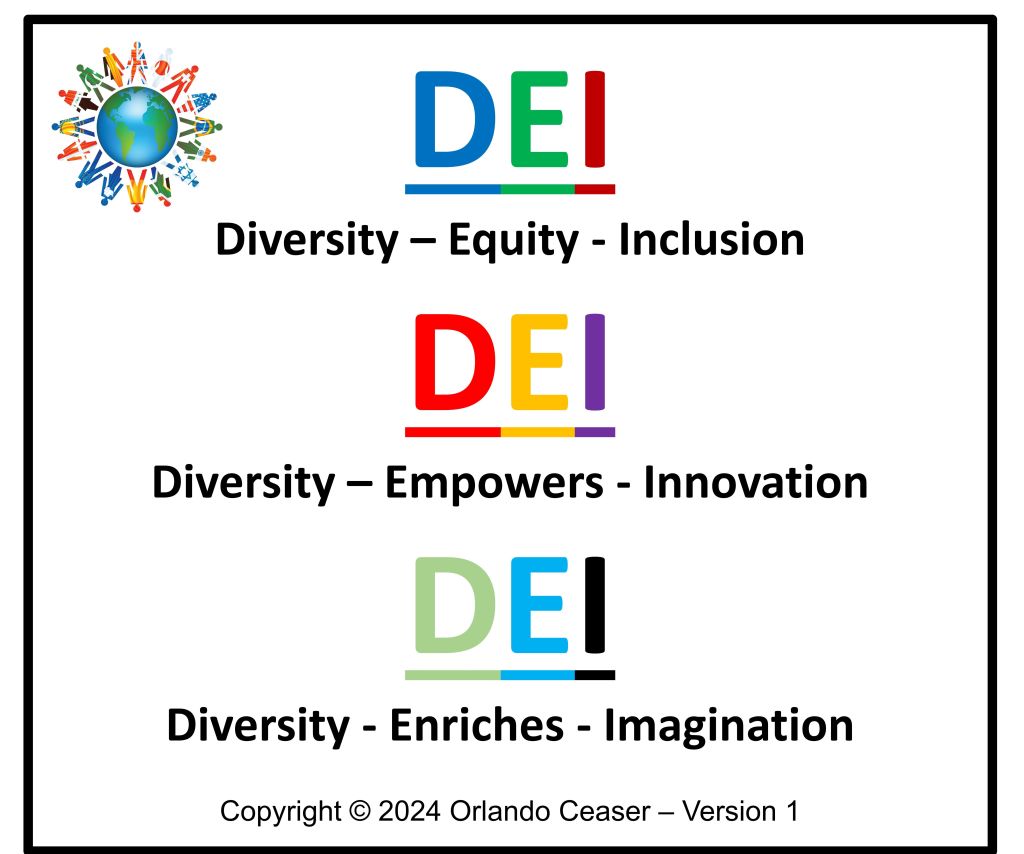
DEI stands for Diversity, Equity, and Inclusion, but there are many positive variations on these words that express the intent of the strategy and tactics for everyone.

DEI is the code of discovery that can unlock new paradigms of potential, imagination, and innovation. People think of DEI as separate from meritocracy, however, fairness would suggest that equity is essential when measuring and rewarding performance. DEI Essentials is a phrase to describe the necessary and seldom considered attributes associated with diversity, equity, and inclusion. These positive expectations and ancillary benefits are constructive. When DEI Essentials are present, there is synergy formed with the interaction of diverse and creative exchanges. They affect us on a personal and business level, enhancing decision-making, problem-solving solving and innovation. It is imperative to isolate and identify these assets to engage minds and develop better solutions.

DEI Essentials extract the best from everyone, creating a climate where dignity, respect, empathy, cooperation, and compassion are natural values. The results are a coordination of resources and ideas that lead to innovation and successful interactions. As we encourage fairness, involvement, and ingenuity, we set up an inclusive environment where people care and share, and dare to declare their greatness through strengthening relationships. We must maintain the desire to build relationships and cooperation, for they are critical to success.

“Diversity, equity, and inclusion

Must endure the chaos and confusion;

And emphasize positive potential,

And focus on DEI Essentials.”

  • Orlando Ceaser

DEI Essentials are necessary components if we want to achieve the ultimate state of effectiveness. They contain bedrock values and are the cornerstone of a thriving enterprise. They allow us to continuously push the envelope to greater frontiers. It is built on open representation, equal access to opportunity, and stimulating contributions to ensure people bring their best talent and ideas to the table. We are tapping into reservoirs of potential and possibilities.

Diversity Essentials

Diversity Essentials are characteristics that manifest our uniqueness, variety, distinctiveness, and perspectives. We developed our character through education, culture, exposure, experiences, and expertise. Diversity Essentials comprises the ways we are different, including the visible and invisible, seen and unseen. It captures the different generations and their interests. Baby Boomers are eliciting the talent and genius of Generation X, Millennials, and Gen-Z. It is an invitation to all people and ideas.

When we look at a definition of diversity, everyone should see themselves in it. We may be altruistic to a certain extent, but we need to see ourselves featured to feel as if we belong; for inclusion is a natural desire.

More of the distinctions and descriptions that describe how we are or how we feel are as follows.

Ability status, age, background, citizenship status, class, culture, development stage, educational level, ethnicity, extroversion, family status, function, gender, generation, immigration status, introversion, language, leadership styles, learning styles, life experiences, life styles, love languages, mindsets, national origin, organizational levels, other, outsider, personality types, physical attributes, political affiliation, race, regional origin, religious beliefs, sexual orientation, socio-economic status, spirituality, thinking and working styles.

Diversity Essentials are strategic business decisions that ensure that company personnel and representation reflect the customer base, community, and availability of talent. They are spontaneous revelations that believe in Win/Win situations. Diversity is more than race and gender. It is not a monster or the boogeyman to cause fear and loathing. It wants us to cultivate our abilities for the widespread improvement of projects, people, teams, countries, and the planet. Where it is practiced, organizations thrive financially in a robust culture of cooperation and innovation. Joel Barker, a Futurist who popularized paradigms and paradigm shifts, said, “Societies and organizations that most creatively incorporate diversity will reap the rewards of innovation, growth, wealth, and progress.” He also said many innovations are attributed to the outsider because they bring diverse perspectives to an opportunity.

Diversity Essentials recognizes our special nature and characteristics. We benefit extensively from the fortuitous value of working together and learning from each other.

Diversity Essentials harmonize these traits in an environment of acceptance and belonging, which allows each individual to be free, fulfilled, and fruitful.

Equity Essentials

Equity Essentials cultivates respect for fairness and the potential to be treated fairly to reach our potential to express our greatness with unfettered access to opportunity. There is an expectation of excellence. Meritocracy is a key component because the organization cannot function successfully unless it is staffed appropriately with hard-working, highly skilled employees.

Equity Essentials must be established and verifiable to potential and current employees, as well as investors. Equity Essentials assures us that we are attractive to top talent. People are attracted to places where sound, enforceable policies are in place. They wanted to be treated fairly in a setting of equal opportunity. Employee reaction should be validated in company surveys and individual conversations.  People do not feel they have an equal opportunity where favoritism and nepotism run rampant without leadership emphasizing fairness. It is one thing to have written policies against favoritism and nepotism, but if they are not enforced, they are meaningless.

Equity Essentials provides feedback on micro-inequities, bias, acceptance of generations, and increasing engagement levels. They educate us and improve our awareness of anomalies that are barriers to high performance. Integrity is an integral part of our operations, and we must elevate and celebrate core values that reflect who we are and want to become.

Inclusion Essentials

Inclusion Essentials are premeditated acts to involve others. We are pieces to puzzles and may contain missing perspectives and ideas for concepts, programs, and problems. We may have what is needed for the evolution, development, and growth of our peers or mankind in general. We cannot afford to isolate individuals who may hold the keys to our success.

Inclusion Essentials may manifest as practices, rules, and regulations that establish a climate of access and full participation. People want to be accepted in an environment of authenticity where they genuinely belong. When people know that they are valued and aligned with high expectations, in a caring group, they will not want to disappoint us. When we hold them accountable and solicit their contributions, they will stand up and stand out. There is joy in being part of something larger than each individual. They will bask in the association of being connected to fulfilling and worthwhile work.

DEI Essentials flourish, as it nourishes inquiry, constructive relationships that lead to better coordination, problem solving, and reduced conflict.

DEI Essentials promote a level playing field where individual talent and effort are encouraged and rewarded. People willingly release energy and discretionary effort as they engage in excellence and are committed to a cause greater than themselves.

Copyright © 2025 Watchwell Communications, Inc.
DEI vs VEI – “Variety is the Spice of Life, Imagination, and Innovation”

DEI is a strategy to alter the climate in the workplace, build company culture, and capitalize on different talents and perspectives. It reflects customers’ makeup and ensures that many groups are represented. DEI is also necessary to ensure that organizations have a workforce that meets their staffing needs. However, despite its intent and documented positive results, DEI is controversial. Many believe that when DEI is implemented correctly, it is effective and has company and employee benefits.

The word diversity is primarily linked to affirmative action and reverse discrimination. Diversity is more than race and gender, but some people fail to see this. DEI applies to many valuable attributes and creates an environment where innovation can enhance teamwork and improve company culture. Equity and inclusion should be human rights. A successfully implemented DEI strategy in your culture is a win-win proposition. Additionally, it helps employers staff organizations today and in the future.

The variety among members of our species is visible and invisible. We have idiosyncrasies, peculiarities, and eccentricities that make us stand out from our peers. People should realize that their uniqueness is not a weakness, but a viable asset. DEI allows this to happen.

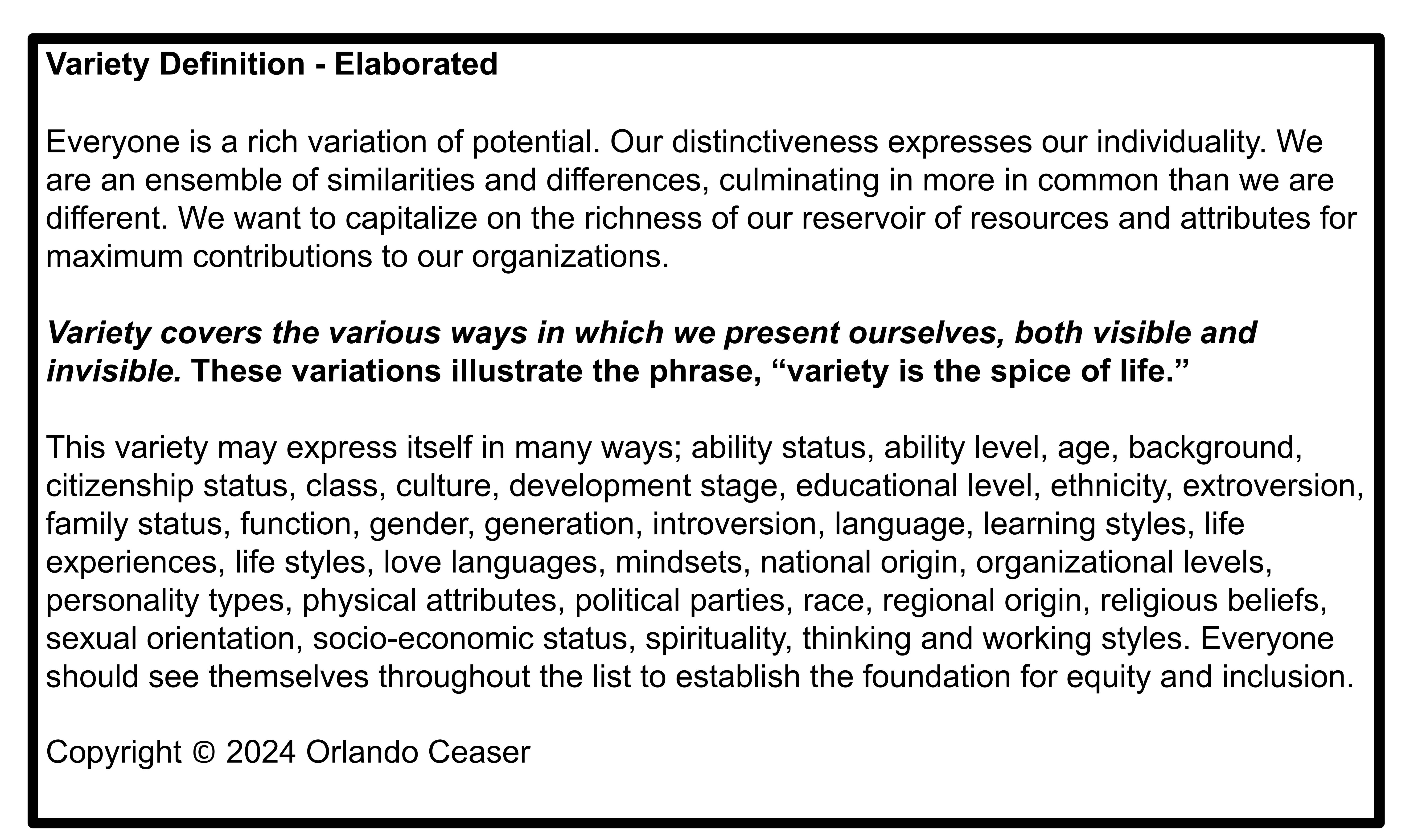
Consider the following kaleidoscope of values that highlights our differences. Everyone should see themselves in multiple words in the definition. When this is observed, it is not seen as a special program only for particular groups of individuals. Additionally, one does not feel left out and excluded.

Despite challenges to DEI, many organizations have remained steadfast in their commitment because they have seen the business transforming power of DEI. However, others have removed their support, due to pressure and negative impact on business. For example, consider the situation with Bud Light sales when a boycott was engineered after a social media post featuring a transgender actor. Bud Light went from number two to number three in sales and they had to shuffle company executives to distance themselves from the controversy.

Eliminating DEI programs prevents people from experiencing and benefitting from the fullness of DEI. Resistance to history, unconscious bias, micro-aggression, micro-inequities, and other diversity training are lost opportunities to better understand each other.

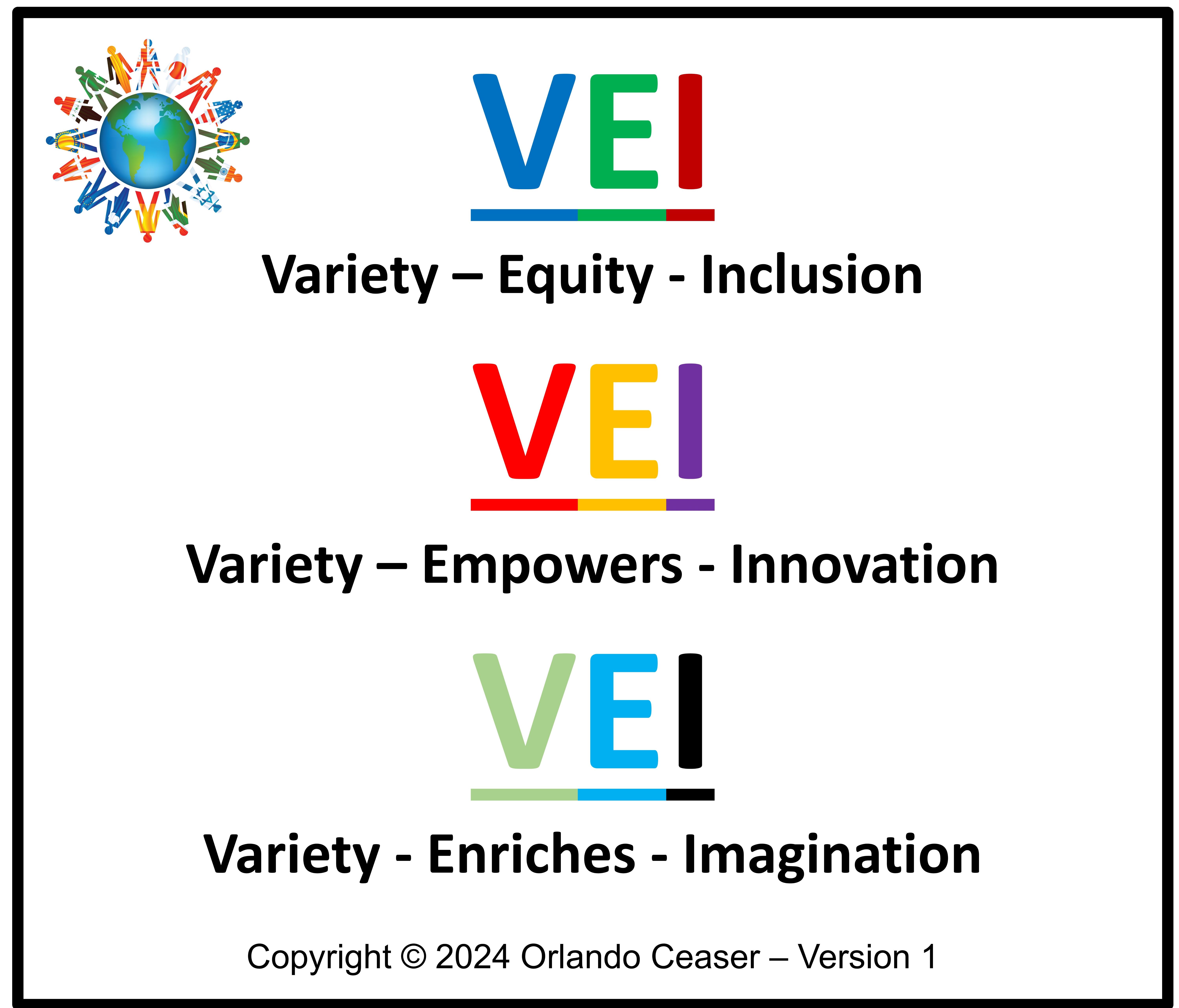
I propose the ‘V’ word, as a replacement for individuals confounded by the ‘D’ word. The principles present in DEI are valuable to all employees. We want to create an accepting, fair, inclusive, and belonging climate. Ultimately DEI can influence imagination and innovation. Variety should be used to accentuate our similarities and differences for growth and development.

Variety in the acronym may minimize controversy. I reworked the chart using variety as a neutral word for diversity while maintaining the highlights.

VEI addresses the advantages of our distinctiveness. We can enhance value by creating a positive company culture, where individuals and teams perform at a higher level.

Everyone has distinct qualities that make us unique. Variety as a replacement word may allow people to come to the table and use their various and sundry skills to bring out the best in everyone for the good of everyone in the enterprise. My premise is that substituting ‘Variety” for “Diversity” will help us achieve benefits for all employees.

Copyright © 2024 Watchwell Communications, Inc.

The Circle of Sensibility

Illustrate the movement from suspicious to synergy as we open and collaborate with others.

Human beings have an interesting way of responding when they encounter differences. Our reaction to the difference may range from civility to hostility. We’ve heard the story of women clutching their purses, and other physical manifestations of fear, irritation, or discomfort. These reactions may follow a pattern generated by unconscious bias.

Initially, we are suspicious of the presence of someone who fits our biases, stereotypes, negative stories, or prejudices. We may watch them intently and through facial expressions and other body language signals, let them know that we do not trust them.

Secondly, in the workplace, we are skeptical about collaborating comfortably with a new person in our department. We question their competence and the quality of their performance. We are reluctant to believe anything positive about them.

Thirdly, we may open our eyes and our minds and decide to be reasonable. We should approach the person in a sensible manner. This state of sensibility enables us to display wisdom, possibility, and the notion to give them a chance.

Fourthly, we become susceptible to opportunities to do something constructive. We realize that it may benefit everyone involved and set the stage for something uniquely beautiful. The more we learn about our coworkers the more we appreciate that we have more similarities in common. Our differences may be an opportunity to gain experience more about different segments of the population. We become richer, mutually, from the experience.

Fifthly, the collaboration will allow us to have successful interactions which are beneficial to change our mindset, which may cause us to discard the old ineffective preconception we harbored for so many years. Our relationship blossoms.

Lastly, we realize the full capacity of our potential to exceed expectations and thrive from the power and creativity of our new relationship. The synergy may release the talents in each of us, multiply our impact, and make us exceed our objectives. Locked in the preliminary stages of the Circle of Sensibility will hinder our achievement of greatness.

The Circle of Sensibility is a positive depiction of what we can do when we throw away the performance-limiting baggage of old mindsets and antiquated ideas. When we replace them with a worldview that allows us to capitalize on the diversity of our collective potential, we can make the world a better place. We can grow individually and collectively and fulfill the purpose that gives our life meaning.

Copyright © 2023 Orlando Ceaser

OrlandoCeaser.com

WatchwellCommunications.com

Managing negative people who undermine you? Block the impact of the Hindre™

The Hindre™ is a person or group committed to blunt your growth and development. They take it personally when you are driving and advancing in your schooling, career, and relationships. The Hindre™ takes its name from its ability to hinder your progress and work against your positive performance with negative roadblocks. They may be silent and work in secrecy. They may work in the background or out in the open, undermining you at every turn. The Hindre™ may also be referred to as the Ninja of Negativity.

The Hindre™ may be a family member, alleged friend, stranger, supervisor, or coworker. They are dedicated to suppressing your success and compromising your confidence and competence. The Hindre™ is the employee who sabotages the work of the team. They do not put their own weight on projects and may be responsible for other members leaving the company. They take the fun out of work. The Hindre™ may be the boss who does not give proper feedback and is constantly working against you.

The Hindre™ will befriend you and plant seeds of doubt through words, to shake your confidence. They will say things like, do you really think you can do that? I don’t think that is the right field for you. They may be brazen enough to ridicule by saying such things as you will never amount to anything, you are not good. They may go you by use of force and name-calling, to put you in your place, they prepared and designed for you.

The Hindre™ could be personal. The tendencies may be embedded deep in you. You may not believe deserve success and think you are unworthy. The years of persistent misinformation, ridicule, name-calling, and badgering convinced you that you are less than everyone.

We must work to identify the existence and presence of the Hindre™. We must apply the international symbol to indicate that the Hindre™ is not allowed. Their presence is unwanted and unwarranted. Their jealousy and envy, fueled by competition and insecurity, may explain their resistance and disapproval of your performance. However, it may be more insidious, such as prejudice, bigotry, and hatred.

The Hindre™ may be a negative person, a silent enemy, or a malicious perpetrator. Look in the mirror and search your soul. Are you a Hindre™? Do you know a Hindre™? How will you respond when you identify someone as a Hindre™. Be careful in their presence and align yourself with people who support you and work for your goodness and success. Be kind and caring to all people, work to connect, cooperate, and coordinate positive behavior, for the sake of progress. Do not let the Hindre™ impair your growth, as you develop a positive pursuit of love and excellence.

Copyright © 2022 Orlando Ceaser

Be More Interesting – BMI

Improve relationships, recruiting, culture, retention, and productivity

Be More Interesting (BMI)

Acronyms are nifty little devices that help us memorize concepts. Acronyms are excellent to create a mantra for repetition.

People look detached and disengaged in the presence of someone whom they feel is bland and uninteresting. They may be in a relationship with someone who is dull and appeared to be sucking the life out of them. The spark is gone, and an infusion of excitement is necessary.

My college roommate told a story of asking a question of a professor who was not very dynamic. At the end of an exceptionally long, drawn-out, boring explanation, the instructor turned around to find my roommate sound asleep and snoring. The class found this to be hysterical. I found it historical, standing the test of time.

Picture this; the first date through a dating app, two people sitting at a table and staring away from each other. They are floundering in meaningless conversation, losing interest by the minute. The situation would be much better if the parties were interesting and increases the likelihood of being interested.

The workplace may need revision to increase engagement and participation. Additionally, Recruiters can recall interviews where candidates answered questions with a lackluster demeanor. They were not able to sell themselves in a persuasive manner. They may have been suitable for hire, but their personality blocked their chances.

We remember speakers and teachers who were not able to hold our attention, which caused our minds to wander. We could save ourselves the trouble, and create livelier discussions if we could make ourselves and others more interesting. Therefore, we need people to BMI. I am not speaking about “body mass index” or the Broadcast Music Corporation; I mean to Be More Interesting.

Relationships

Relationships would be more fun, interactive, exciting, and engaging if people were more interesting. Personal development can lead to a life that is more fulfilling and enjoyable. Time is well spent and used wisely when we interact with people who have great content in their conversations. Imagine having a conversation with someone who consistently provided content that is intriguing, and humorous with a substantial amount of depth and clarity. I’m not necessarily saying that they are more intellectual, but they have depth and breadth of knowledge. Interesting could be cultivated by the following methods:

  • Read more, extensively traveled and educational exposure and life experiences.
  • A well-developed “HIT List” – refers to Hobbies Interests & Talents
  • Emotional intelligence and conversation skills emanating from self-awareness and people skills
  • A sense of humor that is not condescending, but has a hint of self-deprecation
  • A curious thirst for knowledge, as they continuously learn new things
  • Optimistic in their worldview and a positive approach to life and people
  • Empathetic and humble, while taking an interest in others

Work

Work would be more enjoyable if it were more interesting. It would be a place we would look forward to going to each day. If the work and the people in it were more interesting, productivity and culture would be amazing, especially if the interesting people were allowed to fully express themselves. Gallup’s research has linked engagement to having a best friend work. They also said that people do not leave companies but need managers. Imagine a company where managers had the requisite skills of being more interesting and more interested in the people. We could revolutionize the workplace.

Personally, we should do a self-evaluation to determine how interesting are we to other people. We could ask that question of our nearest and dearest friends and associates. But we can also ask them what could we do to increase our BMI. Take notes and try to put their suggestions into practice. Also, we could ask employees about the interesting elements in the workplace, i.e., leadership, work content, workflow, and coworkers.

Interest should not necessarily be equated to popularity and an extroverted personality. We are speaking of depth and our ability to tie your exposures, experiences, and expertise in a manner that others may find compelling.

You could also add adjectives to describe interesting. They may be;

  • Authentic, transparent, empathetic, humorous, caring, trustworthy, safe, creative, adventurous, supportive, goal-oriented, with a zest for life
  • Willing to help others succeed, generous and well-rounded
  • Loyal and less likely to leave their jobs, thus enhancing retention

When we are more interesting, our relationships flourish and our connections at work can be more vital, and productive. Being more interesting would enable us to be more creative, with less stress, and retain more information. If we adopted the mindset of BMI, we could transform ourselves, the workplace, and the people we connect with daily.

Copyright © 2022 Orlando Ceaser

The 4th Monkey – “May The 4th Be with You”

Integrity and Character – Values for the Ages

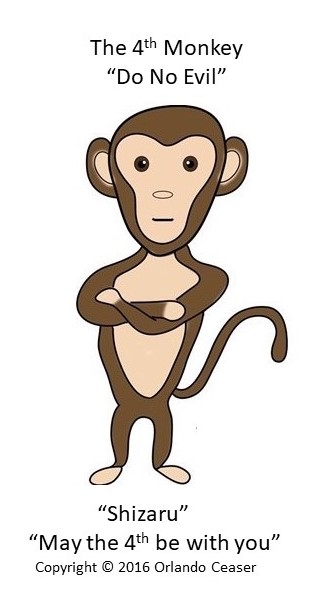
The 4th Monkey – Do No Evil

Our current climate exposes the need for character development and truth. Integrity is highly regarded in our daily affairs, yet we don’t emphasize it as often as we should. We grew up thinking about values, truth, sportsmanship, ethics, and etiquette. Now we focus on winning at all and any cost. Conscience is seldom referenced and seldom discussed to govern our actions.  We must focus on universal values and principles to teach us to work together to build connection and teamwork. My most popular blog post, The 4th Monkey is being re-issued to concentrate on behavior to improve our interpersonal skills. The universal application of these age-old concepts is a tremendous value that should build connection and our ability to work together in harmony toward a worthy ideal.

We grew up with the story of the three monkeys. I imagine we share the same interpretation of what they represent. We were exposed to pictures or statues. One monkey had his hands over his eyes, the second had hands over his ears, and the third monkey’s hands were over his mouth. They were See No Evil (Mizaru), Hear No Evil (Kikazura), and Speak No Evil (Iwazura). There were actions and behaviors demanded of us based on the three monkeys, but nothing was said about the fourth monkey. The fourth monkey is Do No Evil (Shizaru).

The stories of the four monkeys were popular in Japan in the 17th century. Their origin is between 2 and 4 BC in China. The Storyologer website (www.storyologer.com) has this account of Mahatma Gandhi who carried around a small statue of the three monkeys.  “Gandhi had a statue of three monkeys in three different postures. One was shutting his mouth with his hands; the other was shutting his ears similarly and the third monkey had put his hands over his eyes. A visitor to his house became curious and questioned Gandhi about the various postures of the monkeys. Gandhi politely replied, “The one shutting his mouth tells us that we should not speak ill of anybody. The one shutting his ears tells us that we should not hear the ill of anybody. And the one shutting his eyes tells us that we should not see the ills of anybody. If we do so, we will have all goodness, and nothing but goodness.” 

Travelers often find local markets with carved depictions or artwork featuring the three monkeys. However, the fourth monkey is rarely seen. The 4th monkey, when pictured, is usually shown folding his arms (the body language of being closed) or covering his crotch to signify inactivity.

The different interpretations of the four monkeys are fascinating. In the Buddhist tradition, it meant don’t spend your time preoccupied with evil thoughts. In the West, it relates to not facing up to our moral responsibility. But in my household, the monkeys were presented to us as a model of proper behavior. Our parents wanted us to identify with the images, to supplement our moral code.

See no evil (Mizaru)

We were told to pay attention to people and location(s). The idea was that if we were in the right location, we would minimize seeing trouble develop before our eyes. This was applicable in school and at work. We were instructed against being at the wrong place at the wrong time or the wrong place right. We were also told not to look for bad things in people or in certain situations. There are people who see bad things when they don’t exist, which could explain the manifestations of bias, stereotypes, and profiling. We were not taught to be naïve but to be careful and respectful.

Hear no evil (Kikazaru)

We were told to shield ourselves from bad language and bad intentions. We should stay away from people who spoke ill of others and gossiped. If we were not in the wrong place we could minimize hearing things that we should not hear. We were also instructed not to listen to foul or vulgar language. If we heard people’s language, especially regarding someone’s evil intentions, we could use the evil information to do good or to help others, that would be permissible.

Speak no evil (Iwazura)

Speak no evil was used to discourage gossiping or speaking ill will about someone. We were told to watch our language and to speak kind words. “If you can’t say anything good about someone, don’t say anything” was a part of this same philosophy. Adults told us that spreading bad news or malicious information could come back to haunt us. We should also, apply this same advice to the workplace.

There is a misconception about the concept. This misconception has led people to adopt a code of silence in the workplace and in politics when a person is not pulling their own weight or has committed offenses. We would rather silently complain or resign, before talking about an employee who was not working. We would not want to be labeled a snitch or a stool pigeon. In the streets, people would say, “snitches get stitches.” To speak evil of someone means telling a lie, bearing false witness, or defaming their reputation. However, it is our responsibility to find a way to report injustice, illegal behavior, and practices that undermine people and the organization. Our intention should be to speak the truth in love without malice or premeditated negative objectives.

One way to break the code of silence is by offering incentives to whistleblowers. These individuals are people who step forward and report unlawful activities in an organization. They are paid a 10% bounty if the measure goes to court and fines are levied against the lawbreakers. In neighborhoods where people know the perpetrators of violence, but fail to come forward, there are no such incentives. Residents may be afraid of retribution, as the rationale for their silence. We must also realize that justice requires telling the truth and this should not be regarded as speaking evil of someone.

Do no evil (Shizaru)

The fourth monkey’s actions are truly related to the others. The workplace and politics are common places for the four monkeys to be used as an operating system. Employee bullying and intimidation, sexual-harassment claims, the presence of racial discrimination, unconscious bias, and sexually charged language and actions exists in many organizations. Where improprieties and liberties are taken with people’s rights in the form of disrespectful words and actions, there are laws in place to prevent and punish these actions. Employees, who adopt a see no evil, hear no evil, speak no evil mindset are not helping to develop a positive company culture or a respectful workplace

Do no evil is a perfect monkey to enforce the values of character and integrity. He reminds us of proper behavior and etiquette. Our choices have consequences and the more we can emphasize a positive corporate culture and a respectful workplace the more effective our organizations will become. There are conduct and behavior norms that must be identified, emphasized, and enforced vigorously. Character will minimize stress in the workplace and reduce the number of lawsuits and discipline related to improper behavior.

The Do No Evil mindset would influence our participation in the political process. Our dialogue in conversations around those who are different from us or have different opinions would be positively affected. If we operated each day thinking in terms of Do No Evil, we would be more empathetic in understanding of each other. We would put ourselves in the shoes of our neighbors and seek to understand their point of, listen to their words, and lay the foundation for greater chemistry instead of conflict.

How can we create an environment in our workplaces, families, and communities, where people are held accountable for their own unlawful actions and the private citizens who come forward can feel safe and protected? If The 4th Monkey was modeled, we would have less of a cause to talk about Mizaru (see no evil) and Kikazuru (hear no evil).

Do no evil and speak no evil should be magnified and connected to many of our guiding principles of behavior. The Golden Rule and its equivalent in many cultures advise us to treat people the way we want to be treated. The Platinum Rule asks us to treat people the way they want to be treated. The 10 Commandments implore us not to do a series of acts that could be seen as evil, such as murder, stealing, etc. you are instructed to love your neighbor as yourself. If we began from a position of love, it is easier to think in terms of speak and do no evil.

We must clearly outline expectations of behavior and the judgment related to them to improve the climate in our organizations, homes, and places where people meet. The correct action is essential to achieving healthy results in our relationships.

The imagery and practices espoused by The 4th Monkey hold the key to making this possible. I am hopeful that by emphasizing the fourth monkey, we can improve our behaviors, connections, interactions, and relationships with everyone.

Copyright © 2016 Orlando Ceaser

The Crowd Pleaser Syndrome™ – Attention for Acceptance

The Crowd Pleaser Syndrome™

As early as I can remember, I had a craving for attention; a sweet tooth for popularity. Even when I was silent, I would look at people and want them to know me and notice me. I wanted attention, acceptance, and approval. They were my straight A’s. I wanted to play to a crowd or a small group. This Crowd Pleaser Syndrome™ (CPS) was my affliction, which fed my ego and drove me to success and notoriety. However, it also exposed insecurities and vulnerabilities.

I discovered that I was not alone, there were others like me. We needed the mentors and people who understood what we were going through. We did not have support groups to help us understand and cope with this beautiful character trait. Additionally, there were public and private assaults against our reputations for a variety of reasons.

An early manifestation of the CPS was an instance in grammar school, where I misbehaved and angered my teacher. This was during the era when teachers and corporal punishment were synonymous. The teacher called me to the front of the room for a spanking. I had the attention of everyone in the classroom. She asked me to bend over and face the class. She gave me a swift smack on my backside and sent me back to my seat. She was satisfied knowing she had dispensed justice and I felt great, knowing I gained the recognition I needed.

The Crowd Pleaser Syndrome™ is present and prevalent. It shows up at work, as individuals please their peers and supervisors. There is a tendency to deliver good news to the boss in the form of withholding negative information or results. People do not fully disclose information to analysts and the public because of the negative stock implications. Employees may be too aggressive and take unnecessary risks to look good personally. The Crowd Pleaser Syndrome™ may infuse us with the desire to win at all costs.

Crowd pleasers realize at an early age, their ability to entertain others. They may have engaging personalities and athletic and the musical prowess. Here are more Crowd Pleaser Syndrome™ characteristics.

Crowd Pleaser Syndrome™

  • Confident risk takers
  • Highly active in social and professional gatherings (parties and meetings)
  • Work hard to stand out from the crowd
  • Seek acceptance on Maslow’s Hierarchy Needs (belonging)
  • Thrive on competitive activities
  • Develop attention-getting behaviors, strategies, and tactics

Unhealthy Challenges

  • Workaholism and lacking balance by focusing only on the area giving them stimulation
  • Unethical conduct may suppress the competition and put others at risk
  • Failure to share the limelight, especially in developing others, and giving credit on group assignments
  • People tried to sabotage their careers
  • They meet the needs of others and deny themselves
  • Put others first to their personal detriment

Popularity is a stimulant which can have positive and negative effects. The Crowd Pleaser Syndrome™, when managed properly, can have a profound effect on performance, relationships, group culture, and the development of individual strengths. CPS individuals can entertain, educate, enrich, and inspire us to achieve the greatness inherent in each of us to make this a better world.

Copyright © 2021 Orlando Ceaser

Website: OrlandoCeaser.com

Watchwellinc.com

Managing your personal power supply

The Spin class was about to begin. Gayle, the instructor, stated, “I lost power yesterday.” She said she was in her home when suddenly, a loud noise was heard and her electricity went off. We stretched, continued a light conversation and launched into a rigorous routine. I wondered during the class, “How many times, as individuals, have we lost power in our lives? Did we give it away or was it taken from us? Are there certain situations or individuals who cause us to lose power? Who are they and why does this happen? What are the early warning signs before there is a loss of power?

The loss of power is readily detectable. You have that feeling of loss of confidence, which is demonstrated by your body language, vocabulary and actions. Many times the loss of power at home or at work may come as a surprise. However, just as in nature there is a flash of lightning or thunderclaps before a storm, you can rely on certain indicators as precursors to a storm. You can anticipate someone’s presence, behaviors, as a good sign that a storm and potential power loss is on the way.

We should be aware of the signs of losing power and fortify your defenses. This will require us to increase our competence, confidence and network of individuals who will cooperate with us in our efforts to enhance our power position. There are times when we lose power and look around us and everyone seems to have theirs. What can we do to maintain or regain our power during a power outage? Power outages may be due to:

  1. Burnout
  2. Lack of confidence
  3. Power drainers
  4. Power mongers

Burnout

We can lose power by expending too much energy. We may fail to prioritize and try to do too many things at once. Processing too many projects at one time will lead to an increase in stress. Lack of sleep and irritability may negatively affect your disposition. You may become moody and easy to anger. Our lives are running at many revolutions per minute (rpm’s). We create to do lists (TDL’s) to keep track of our obligations. To do lists are getting longer and serve as a repository of unlimited tasks of varying priorities. We may fail to rank the items or every item seems to be important, which will lead to none of them being important. If we don’t put a filter on the funnel, we will be overwhelmed. This state of overload will lead to burnout, a breakdown and a loss of power. You must realize that some items on your list may not be covered or should be delegated or deleted.

Lack of confidence

Sometimes lack of confidence can lead to a loss of power. You may be faced with the possibility that you are not as good as you think you are and are afraid that others will discover your shortcomings. A way to address this fear is to conduct a self assessment of your skills and abilities. Be honest with yourself. You should relentlessly study your craft until we are an expert in your field. This may require study and validation which will give you the necessary credentials to ward off any challenges. If you lack confidence or courage you may doubt your abilities and lose the power of conviction needed to be successful.

Power drainers

Some people exist as leaches in the workplace, at home and wherever you engage in relationships. They will drain your power through constant complaining. Negative thoughts and the complaints will drain your energy supply. Their negative disposition and complaint oriented disposition puts everyone in a bad mood. They are not satisfied with anything and they never bring a solution to the myriad of problems they detect. When they enter the room, you can feel the life being sucked out of the place. Engagement levels seem to go down and the level of interaction and cooperation is reduced. The focus is on the speed of ending the meeting and getting back to work away from this malcontent.

The power drainers are time wasters. They do not respect time. They will barge into your office or workspace and tell you the latest gossip and shortcomings of the organization. Many power drainers have a running conflict with their peers and want you to come in as a peacemaker, which is time consuming and emotionally exhausting.

Power mongers

Power mongers are perpetrators who like to hoard power and use it over people based on their level of influence or authority. They will take the power away from you in a meeting. If you have the floor in a meeting they will ask the questions to shift the emphasis to them. I attended a meeting where one participant had more handouts on my subject than I did and spent the meeting time explaining their handouts which took away my power and control of the meeting. The better preparation and communication skills may address some of the issues of the power mongers.

The manager who asks you to do something because they said it does everything to shut down questions from the meeting attendees. Power mongers also work by using intimidation to get results. They will level threats at people who do not complete assignment correctly. A power monger will embarrass people in front of their peers. They may do this deliberately to show who’s the boss? A new manager at a paper recycling plant announced to his employees that he wanted them to fear him. He went on to exercise this management style as an egocentric power monger.

A power monger believes that information is power and takes this concept to the extreme. They delegate information sparingly. A manager had access to updates from the home office that would have been useful to one of his subordinates making a presentation. Rather than call him off to the side before the meeting and provide the updates, he strategically interrupted during the meeting with the latest news from headquarters. You may need help in dealing with a power monger, who negatively uses power. This can be done by working with mentors, advocates and power brokers. These individuals have the wisdom, insight and influence to assist you in relating to the power mongers.

Power brokers

Powerbrokers are individuals who use power effectively to get results. These individuals should be utilized and studied in order to gain their assistance. You want to use their techniques to minimize personal power outages. These individuals can be identified and cultivated at work, networking groups, referrals from their contacts and through personal introductions.

Work with powerbrokers to increase your confidence; improve your influence skills and knowledge of your area of interest and expertise. Conduct a personal assessment; improve your communication skills and your knowledge of your subject. Your objective is to isolate the individuals and circumstances that drain your power and counteract their affect on you. This will enable you to be stronger and effective in harnessing your power supply and minimizing instances where you lose power.

Copyright © 2016 Orlando Ceaser

Performance fixing in the workplace – Lost productivity and restricted growth

C&R 9-3 0007

Athletes and their sports periodically are plagued by scandal. Athletes may be asked to lose a match, fight, or game by delivering less than their best effort. The tennis world was recently rocked by allegations of match fixing where players allegedly accepted payment for losing or throwing a match. Novak Djokovic, the reigning number one men’s player in the world, said he was offered $200,000 through his previous handlers in 2007 to lose a match.

Boxing has had its share of scandals. Unscrupulous fighters have been known to take a dive, throw a fight or lose a fight on purpose. Controversies have surfaced with football, basketball and baseball.

This tactic of solicitation; altering the outcome of a performance is also prevalent in other aspects of our lives. Performance fixing is not customarily a term used to describe substandard performance at work. We do not accuse employees of collusion, throwing a project or taking a dive regarding their objectives. However, there may be similarities with sports.

Friends or coworkers may ask you to deliberately act in ways that could negatively affect results. They may expect you to limit your participation or productivity, hold back by not delivering your best effort and engage in activities with consequences that will affect your grade, goal achievement, contributions or career.

It is an integrity issues when someone delivers an unearned and unsanctioned discount or illegally influences the score. But failing to bring your best effort is also unfairly influencing results by delivering below expectations.

People may have a variety of reasons for convincing others to take a dive. They may want you to make a supervisor look bad, fail or simply to compromise results for a number of reasons.

As a sales representative my competitors tried to discourage me from working hard and going beyond the call of duty. Ultimately, when I was promoted to management, they told me they thought I was smarter than to take a role in leadership. Their code of ethics was to do just enough to get by, not rock the boat or bring too much attention to the status quo of their comfortable world. They had tried for several years to get me to perform at a level that did not upset their established level of mediocrity. They were in effect asking me to fix the outcome of my selling activities by reducing my effectiveness.

Take a moment to reflect on your life and your performance in school, relationships or in your career. Have there been instances where people have discouraged you from taking a course of action; pursuing an MBA, volunteering for a project, advancing your education or participating in a manner that would improve the outlook for your career? They may not have offered money, but there was an expectation that you would conform to their request and maintain a friendship or relationship. Did they influence you to withhold your best performance or restrict your participation? How did you respond to their subtle influences to maintain the status quo? You probably did not see it as performance fixing.

Can you think of instances where you were reluctant to excel and talked yourself out of delivering your best performance? You may have convinced yourself that inertia, standing still, the status quo was more desirable than going after a promotion or shaming your peers. You may have told yourself the aggravation of more responsibility would be too much work and not worth the small financial payout and alienation from your peers. You may have held back, telling yourself that management would not be receptive to your efforts to improve your opportunities. The result was stabilization and stagnation.  Therefore, you took an internal dive and restricted the release of your talent and failed to maximize on the opportunities available.

Companies have lost productivity and revenue due to people shaving productivity across the organization. Individuals intentionally or unconsciously participated in a conspiracy to hold back on excellence. The payout was not also in money. They may have received resources or items of nominal value. It was for either pleasure or pain.

Pleasure could involve the camaraderie and benefits of connection in a powerful networking relationship. Being affiliated with people who are well known or who praise them makes them feel special. They may want the pleasure of associating with someone they wish to emulate, who makes them feel special.

The compensation could be the avoidance of pain. People are deprived of the discomfort of being shunned by their friends and the humiliation of failing to land a job because they took a risk. If they don’t pursue the job then they don’t have to make mistakes or suffer the failure not reaching it.

Withholding effort and talent is not considered a criminal event. People don’t think of themselves as being complicit in an illegal activity. But, they are assisting other people in activities that hurt themselves, other people or the company. Under the cover of darkness they are essentially breaking into a residence of excellence and stealing from the organization. They are taking a payoff to engage in activities that restrict growth and development.

Professional tennis was struck hard by the accusations of impropriety. The governing bodies of tennis are investigating their handling of this potential blemish on their profession and the parties involved. Other athletic associations, through the years have investigated and disciplined all parties found to be guilty of affecting the integrity of their sport. What must we do to ensure that performance fixing is minimized or eliminated from within our areas of responsibility?

You may consider it unfair to view lack of excellence and substandard engagement, as an integrity issue. But people are hired and expected to bring their best effort to the workplace every day. I had a manager who always asked me,” is this your best thinking?”  We must ensure that we bring our best thinking and best action to the workplace in our interactions with others. The dollar value on waste and on the opportunity costs of lost or poorly implemented ideas.

Copyright © 2016 Orlando Ceaser

5 Self Restraining Tendencies (SRT’s) That Can Hurt You

We are human and therefore, have idiosyncrasies, nuances and eccentricities that come with our personalities. Many of these unique characteristics position us for survival and success. But some of these peculiarities are counterproductive and are detrimental to our growth. I will call them self restraining tendencies or SRT’s. They are not necessarily life-threatening, but they may serve as impediments to development.

SRT’s are indigenous to human beings. They may be formed by life experiences and thoughts and subsequently create insecurities. They may be pseudo-defense mechanisms to allegedly protect us. SRT’s may be categorized as bad habits that may hold us back, restrict growth or work against us. How do we know we have them? Self assessments and times of reflection can increase self awareness and reveal SRT’s, as we examine our lives and impact on others. Additionally, we may receive the gift of honesty from a friend through candid comments. Constant feedback from co-workers, parents and peers can also be useful by adding to our enlightenment. But, we must be objective, receptive and appreciative of their candor.

5 Self Restraining Tendencies (SRT’s)

  1. Procrastination
  2. Poor communication skills
  3. Negativity mindset
  4. Toxic people skills
  5. Lack of Integrity

1. Procrastination

It is interesting to learn that many people are struggling with procrastination. The act of postponing things until later is not intellectually difficult for people to understand. They know that something should be done immediately and to postpone will have consequences. But, nevertheless, they still will delay until later, that which should be done today.

We recognize that we may not feel like doing something right now or we have awarded a greater priority to something else. If we continue to kick the can down the road or delay the inevitable, we will continue to waste time and effort and increase the amount of stress in our lives.

Lisa was interviewing for a job as a pharmaceutical sales representative. She felt very comfortable with the interview. The interviewer asked her about her number one shortcoming. She responded, “I am a procrastinator. I get things done, but sometimes it takes me a while to get started.” Procrastination was her Self Restraining Tendency, but the interview may not be the right place to disclose this particular self restraining tendency.

2.  Poor communication skills

Communicating is something we do every day. It is the currency by which we interact with people in order to state our ideas, convey instructions and build relationships. Those among us, who communicate effectively, actually have an advantage at school, in our careers and in relationships. If we are hampered by poor communication skills, our effectiveness is restricted. This self restraining tendency, like the others featured in this article, must be identified and corrected.

Poor communication skills could be non verbal or verbal to include written, body language and group presentations. Ask yourself, “Am I plagued by poor communication skills? Are there aspects of my communication ability that are hindering my progress?” Conduct a self-assessment. Diagnose your communication ability to see if there is a deficiency. You may seek to solicit feedback from respected sources and trusted friends and colleagues to see if they can identify areas that require improvement. When the SRT is disclosed, a change management process should be initiated. However, rather than go through multiple steps to change we should go directly from denial to acceptance and put a plan in place to correct the SRT.

3. Negativity Mindset

People who have a negativity mindset are not necessarily the individuals who look at the pros and cons of every situation. I am speaking of the people who like to rain on the parade. When the entire group has decided to move in a positive direction, they are the naysayers who constantly focus on what is or could go wrong. They provide excuses rather than explanations. They seldom do anything but complain without the slightest contribution to positive constructive participation to change anything. 

4. Toxic people skills

The toxic people SRT is different from the poor communication skills mentioned earlier. Individuals prone to this tendency will use power to humiliate and intimidate in order to gain the upper hand or to create an environment of fear.

My son worked for an organization where the new boss actually said, “When I walk into a room I want people to fear me.” He wanted people to be intimidated by his presence. This attitude is supported by language and interactions that cause stress, a lack of trust, poor engagement and ultimately subpar performance. Individuals with toxic people skills may speak about people behind their backs, pit coworkers against each other and generate an atmosphere of tension.

People with toxic people skills may be cursed with the propensity to enter every interaction with a transaction mindset. They are constantly thinking what is in it for them, how can they beat the other person by any means necessary and how it can only help them succeed. This is prevalent in relationships where they only socialize or interact with people who can help them advance their position, today. 

5. Lack of Integrity

People with a lack of integrity are flawed in their relational and work performance. They utilize a winning at all cost or any cost approach to work and relationships. People with this tendency view the rules as an inconvenience, something for weak minded people, to be broken and circumvented whenever possible. Breaking rules is seen as a badge of honor, a necessary evil to give themselves the ultimate advantage toward victory.

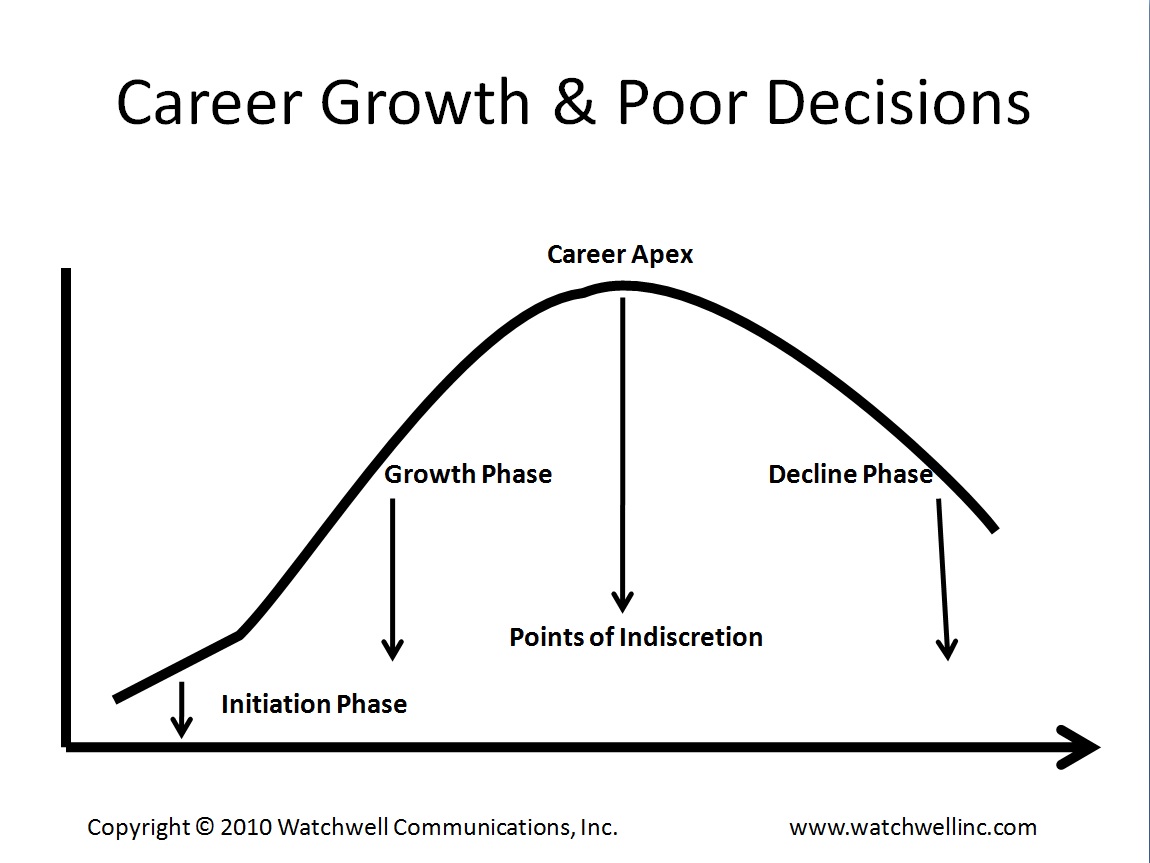
Invariably, this SRT will cause the downfall of their career and reputation. Oftentimes, the integrity flaw does not manifest itself until well into a person’s career. Please find below a chart illustrating a natural career growth curve and the various points of indiscretion where a lack of integrity can doom a person’s career.

careergrowth

If a lack of integrity shows itself at the end of someone’s career, a lot of their positive contributions can be discounted and shrouded in suspicion, nullifying their reputation. If a lack of integrity revealed itself early in someone’s career, they may never have the opportunity to make significant positive contributions or to realize the potential present in their talents and abilities.

Ideally, we should establish self restraining orders or SROs for those character traits which are limiting our joy and effectiveness. The five self restraining tendencies listed or others should be addressed if they are a problem for you. They have the capacity to limit your effectiveness and keep you away from realizing your full potential in every segment of your life.

Copyright © 2016 Orlando Ceaser