Unlock Your Leadership Greatness

Preface—Keys to Leadership Greatness

To unlock your leadership greatness, you must start from the premise that greatness exists within you. Greatness is an infinite potential to reflect a significant purpose. It is not arrogance of superiority, but rather a hunger to live a life of meaning. As humans, we are intrinsically drawn to excellence and, when we are separated from it, we crave to re-establish contact. Access and exposure to this reservoir of experiences and expertise will enable you to lead yourself and others to a better future.

Leadership is an integral part of our lives and is instrumental in achieving results that represent success. Experts discuss the need to include diversity and inclusion as a part of training, rather than as a standalone program. Effective leadership, incorporating individual distinctions, will enable you to instinctively make decisions that include everyone. You will capitalize on the talents, ideas, and contributions of the team as well as every individual to improve innovation and decision-making.

The climate you have has a profound effect on your results. Some experts believe 30% of your financial results (profits and revenue) can be directly related to organizational climate. Climate can impact employee engagement levels, which also influence results.

The climate/culture you create can be seen through the acronym OASIS. OASIS = Open and Share Ideas Safely. The climate must be a place where people are in a safe place to state how they feel and how they can help you and the company excel and meet personal objectives and the needs of clients.

It was Friday of my first week as the Senior Director of Diversity and Work/Life Effectiveness, after nearly thirty years of sales, marketing, and training experience. I was called to a meeting of our Research & Development Department. It was an actual meeting with people participating across the world as a video conference and a teleconference. At one point in their discussion of the eight questions from the Employee Survey related to diversity, one of the directors turned to me. “Orlando, since you are the worldwide expert of diversity, what do you think we should do?”

“Thank you very much,” I responded. “Since I am the worldwide expert as of Monday, let me speak to you from my depth of experience. One of the questions asks, ‘Are you afraid to state what’s on your mind without fear of reprisal?’ The last survey result gave an average response of 64%, this year’s survey came in at 66%. I will not talk to you about the statistical significance of going from 64% to 66%, but what I will tell you is that one-third of your people are afraid to state what is on their minds. We recently lost four drugs in late-stage development, after a tremendous financial investment. Somebody knew they had problems. Either they were too afraid to state what was on their minds, or they spoke their minds and they were ignored. We will need the next great drug to be successful. Who’s to say that the success of that next great drug does not reside in the minds of the one-third who are too afraid to speak?” As a leader, you must get the best out of your people, and one way is to encourage candid discussions and establish an environment that rewards and encourages this philosophy. Remember you are all on the same team and want the same level of success.

There is a leadership continuum showing the correlation between values, beliefs, and results. Values influence personal expectations and the expectations you and the organization have for your direct reports. There is a certain behavior we infuse within our culture. Those who comply are seen as successful, and the outliers are reformed or replaced. Fifty to seventy percent of the variance in organizational climate can be attributed to differences in leadership style.

There is a burning desire, a hunger that exists within you; a turbulence stirring inside indicative of a need to be satisfied. This yearning to live a life of purpose asks you to find and fulfill your reason to achieve a goal. So, you are programmed to make an impact, not merely a faint impression, but a bold imprint. To be successful, there are keys or success factors at your disposal.

There is an open debate on which keys are the most beneficial to unlock the vault. However, this vault of potential energy will transform your life. It will not require voice recognition software, retinal scans, reading a thumbprint, or facial analysis to get inside and use its contents. In one of my favorite childhood stories, the hero would always say, “Open Sesame” to open the side of the mountain that was filled with unlimited treasure. In this book, you will review ten keys to unlock your leadership greatness. These practical strategies and their tactics are designed to give you Action-Oriented Knowledge (AOK).

The ten keys evolved from over three decades of experience in observing and developing Impact Players. The term Impact Players is common in professional sports and is applicable to academic, business, and community performance. Impact Players are the game changers, the difference makers, the catalysts who change the direction of the game and the performance of their peers and the competition. By their very presence, they accelerate and elevate performance to a higher level. People are wired to become Impact Players. The traits of these high achievers are similar to the traits we wish to unlock in each of us to reach our maximum effectiveness. Tapping into this power will enable you to unlock your leadership greatness.

To unlock leadership greatness, discard and disregard the debate of whether great leaders are born or made. Walk away from conversations that argue whether nature or nurture shapes the greatness of a leader. William Shakespeare said, “Be not afraid of greatness; some are born great, some achieve greatness, and others have greatness thrust upon them.” Martin Luther King, Jr. said, “Everyone can be great, because everyone can serve.” The ten keys to unlock your leadership greatness embody these quotations.

We define our infinite potential as our inherent leadership greatness. You will utilize your skills to focus on the benefits, remove the barriers, and experience the breakthroughs or “Aha’s,” as you discover the treasury of enriched potential within you. Jules Verne, in his book Journey to the Center of the Earth,” imagined wonders and adventures” on an expedition going beneath the Earth’s surface. You will encounter such a stimulating journey as you delve into unlocking your leadership greatness.
DEI vs VEI – “Variety is the Spice of Life, Imagination, and Innovation”

DEI is a strategy to alter the climate in the workplace, build company culture, and capitalize on different talents and perspectives. It reflects customers’ makeup and ensures that many groups are represented. DEI is also necessary to ensure that organizations have a workforce that meets their staffing needs. However, despite its intent and documented positive results, DEI is controversial. Many believe that when DEI is implemented correctly, it is effective and has company and employee benefits.

The word diversity is primarily linked to affirmative action and reverse discrimination. Diversity is more than race and gender, but some people fail to see this. DEI applies to many valuable attributes and creates an environment where innovation can enhance teamwork and improve company culture. Equity and inclusion should be human rights. A successfully implemented DEI strategy in your culture is a win-win proposition. Additionally, it helps employers staff organizations today and in the future.

The variety among members of our species is visible and invisible. We have idiosyncrasies, peculiarities, and eccentricities that make us stand out from our peers. People should realize that their uniqueness is not a weakness, but a viable asset. DEI allows this to happen.

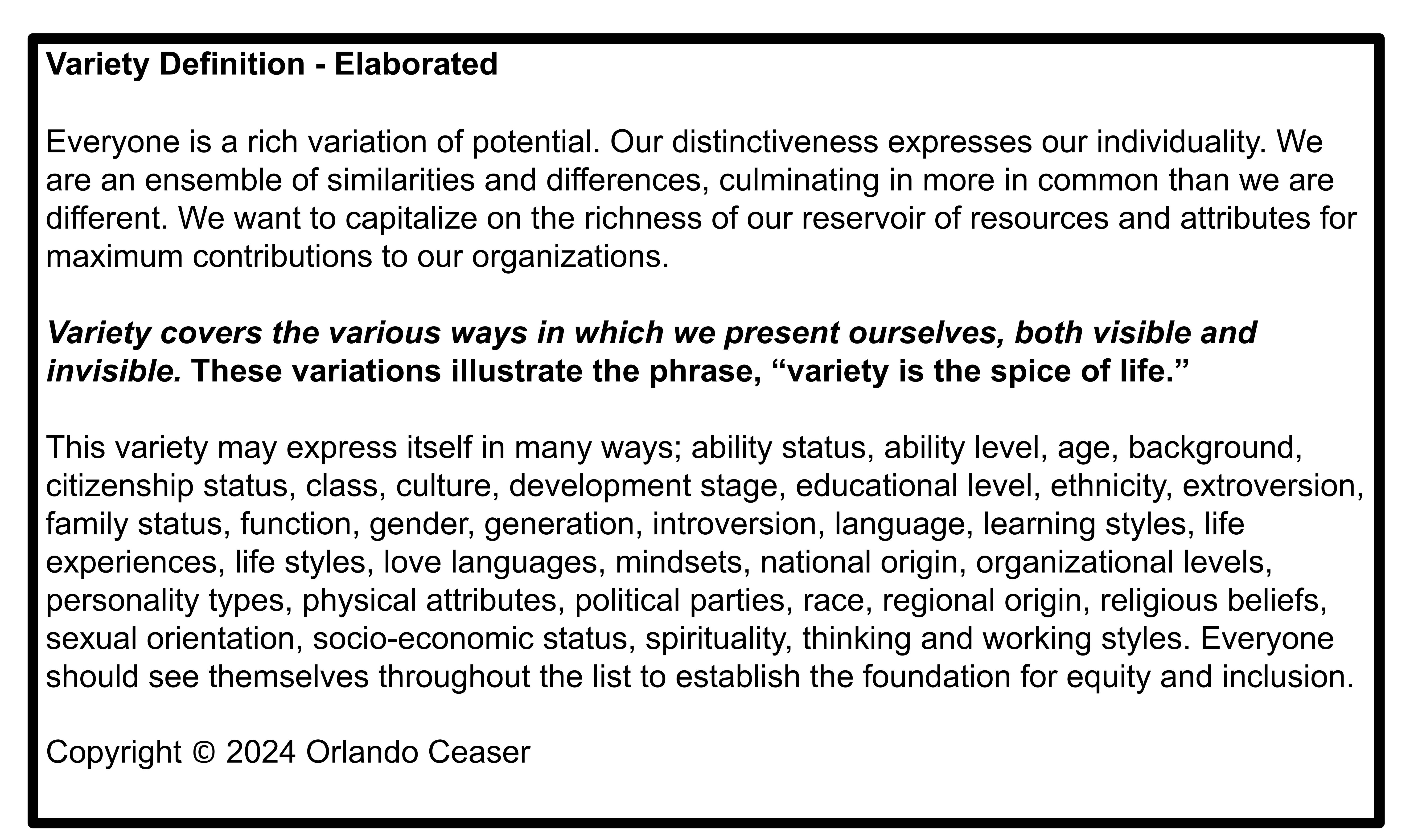
Consider the following kaleidoscope of values that highlights our differences. Everyone should see themselves in multiple words in the definition. When this is observed, it is not seen as a special program only for particular groups of individuals. Additionally, one does not feel left out and excluded.

Despite challenges to DEI, many organizations have remained steadfast in their commitment because they have seen the business transforming power of DEI. However, others have removed their support, due to pressure and negative impact on business. For example, consider the situation with Bud Light sales when a boycott was engineered after a social media post featuring a transgender actor. Bud Light went from number two to number three in sales and they had to shuffle company executives to distance themselves from the controversy.

Eliminating DEI programs prevents people from experiencing and benefitting from the fullness of DEI. Resistance to history, unconscious bias, micro-aggression, micro-inequities, and other diversity training are lost opportunities to better understand each other.

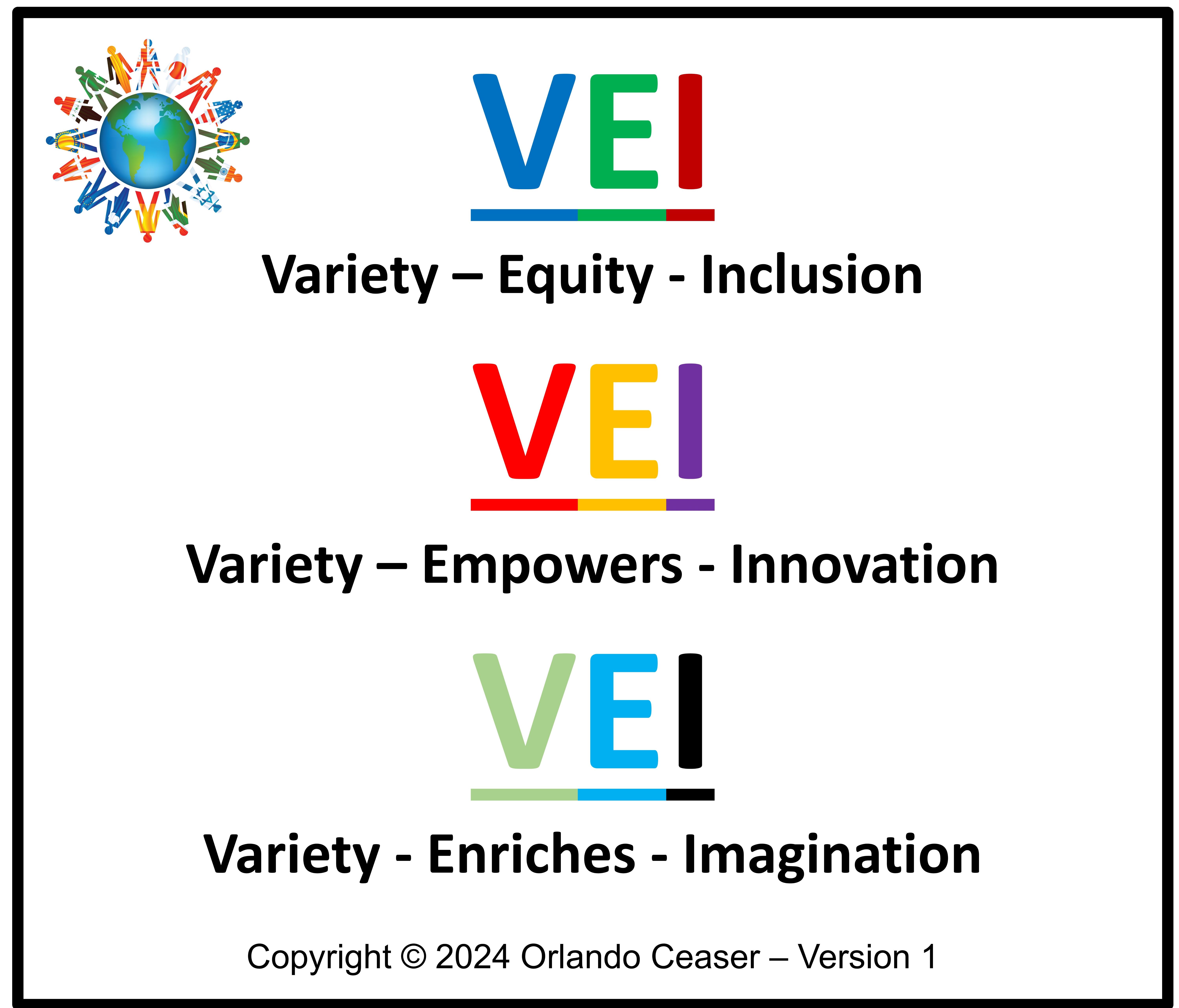
I propose the ‘V’ word, as a replacement for individuals confounded by the ‘D’ word. The principles present in DEI are valuable to all employees. We want to create an accepting, fair, inclusive, and belonging climate. Ultimately DEI can influence imagination and innovation. Variety should be used to accentuate our similarities and differences for growth and development.

Variety in the acronym may minimize controversy. I reworked the chart using variety as a neutral word for diversity while maintaining the highlights.

VEI addresses the advantages of our distinctiveness. We can enhance value by creating a positive company culture, where individuals and teams perform at a higher level.

Everyone has distinct qualities that make us unique. Variety as a replacement word may allow people to come to the table and use their various and sundry skills to bring out the best in everyone for the good of everyone in the enterprise. My premise is that substituting ‘Variety” for “Diversity” will help us achieve benefits for all employees.

Copyright © 2024 Watchwell Communications, Inc.

The Literal Leader – 6 Steps to Authenticity

The Literal Leader – 6 Steps to Authenticity

I received a literal arts education from a liberal arts university. My coursework was well-rounded and included biology, chemistry, physics, and mathematics. I was schooled in the scientific method, with an emphasis on evidence-based decision-making. My communications classes taught me that clear messaging is important, and the value of unambiguous thought and speech. This mindset put me on the road of life to adopt a “what you see is what you get” leadership style. Literal leadership promotes straightforward and predictable behavior.

Literal leadership is not based on interpretation, translation, or guessing the leader’s intent or expectations. There are at least six guiding principles for authentic communication, leadership, and team effectiveness. They are as follows;

  1. Clarity
  2. Charity
  3. Regularity
  4. Parity
  5. Hilarity
  6. Solidarity

Literal leadership categories set the stage for transparency, authenticity, trust, and credibility.

Clarity

The Literal Leader provides clarity of vision, expectations, mission, goals, and feedback. They have a reputation for telling it as it is. They know that they stand for truth and development. They think about their words and search for a clear message. If they can think of two meanings to a request/command, they will rewrite or rethink it to search for one unambiguous message.

The Literal Leader also provides as much information as possible, to increase their followers’ understanding of their decision-making process. It would be malpractice to shield your team from information that could stimulate their growth and broaden their understanding. People know where they stand, even if it’s in quicksand. There is no speculation about expectations, with the Literal Leader.

Charity

The Literal Leader is kind, giving, and forgiving. They use empathy as part of their repertoire of requisite skills. They are servant leaders. They emulate the generosity that flows from a service-oriented mentality. Leading by example and being a positive role model is evidence of their servant leadership mentality. The Literal Leader is sharing, caring, and thriving by using their exposure, experience, and expertise to benefit others. It is within their very own to assist others in their development.

Regularity

The Literal Leader is the hallmark of consistency. When you need guidance, you can count on them to be dependable and predictable. Teams feel comfortable around them. There is only necessary drama. The Literal Leader has their back and will support them in everyday activities and planning their careers. The Literal Leader can be counted on to deliver according to their words and promises. They are predictable and will act on cue to retain the results consistent with your expectations. People can predict their actions and behavior, which makes them feel safe.

Parity

Parity in a high-performing team is the goal of a Literal Leader. Parity is where everyone exudes excellence and the average is synonymous with greatness. Bill Hybels, a famous author, and church leader, used to say that the speed of the leader determines the speed of the team. The Literal Leader knows that when everyone achieves an all-star level of development and execution, everybody wins.

The Literal Leader believes in celebrating difference through diversity, equity, and inclusion. They make people feel they belong. This also creates an environment for maximum productivity. They support equity and equality in the workplace. Parity speaks to treating people fairly with access to opportunity. They must exhibit competence, regardless of their gender and other distinctions. The Literal Leader knows the dangers of favoritism, nepotism, special treatment, and other behaviors denigrating morale and teamwork. Therefore, parity is linked with treaty personalities with equal respect to satisfy their needs.

Hilarity

There is a misunderstanding that it is inappropriate to have fun at work. Humor, in certain settings, is frowned upon as unprofessional. A manager told a story about his boss, who made the following statement; ‘judging from the laughter in the room when I arrived, I am convinced that the atmosphere was not professional.” He did not see the connection between laughter and leadership.

The Literal Leader knows that work can be stressful but finds ways to make it fun. They will mingle levity and pace, to create a healthy rhythm in the workplace. The Literal Leader can make work meaningful and enjoyable. People enjoy their jobs because they are in the right job that allows them to develop their skills and helps them consistently use their gifts. The environment is there for them. The Literal Leader knows the coordinates of their subordinates, so they can meet them where they are. They know that if it’s not fun it’s not fair. And if it is not fair it’s up to individuals to provide input and suggestions to make a change. Many employees work together and play together. A Gallup survey showed that one of the variables for engagement and retention was to have a best friend at work. A best friend is someone you can laugh with and provide levity to lighten the workload. They can be developed and found in the workplace.

The Literal Leader may be seen as a tough-minded leader with lofty standards. They may be described as firm, but fair, but they know how to have fun. The Literal Leader may approve team activities during and after work to allow people to get to know each other and to lighten the work atmosphere.

Solidarity

Solidarity is the glue that keeps the team together; where everyone works together for the sake of the group. It results from talented people, who receive feedback that reinforces their value to the organization and the team. People ask themselves the following question; Are my actions in alignment with the goals of my assigned responsibilities? They work as a team, with common interests, which grows commitment to a greater cause. This has a spillover effect as everyone wants everyone to succeed. It reminds me of the Three Musketeers and their chant of “all for one and one for all.”

Many colleges pride themselves in offering you a liberal arts education, not realizing that there is a literal arts component. Their coursework and environment create a foundation for the growth of Literal Leadership. Students inculcate these values not realizing that it is teaching them to think with clarity, charity, regularity, parity, hilarity, and solidarity. They are consciously and unconsciously on their way to developing the leadership profile of a Literal Leader.

Copyright © 2023 Orlando Ceaser

Unlock Your Leadership Greatness

Preface—Keys to Leadership Greatness

To unlock your leadership greatness, you must start from the premise that greatness exists within you. Greatness has an infinite potential to reflect a significant purpose. It is not the arrogance of superiority, but rather a hunger to live a life of meaning. As humans, we are intrinsically drawn to excellence and, when separated from it, we crave to re-establish contact. Access and exposure to this reservoir of experiences and expertise will enable you to lead yourself and others to a better future.

Leadership is an integral part of our lives and is instrumental in achieving results that represent success. Experts discuss the need to include diversity and inclusion as a part of training, rather than as a standalone program. Effective leadership, incorporating individual distinctions, will enable you instinctively to make decisions that include everyone. You will capitalize on the talents, ideas, and contributions of the team as well as every individual to improve innovation and decision-making.

Climate Influence

The climate you have has a profound effect on your results. Some experts believe 30% of your financial results (profits and revenue) can be directly related to organizational climate. Climate can impact employee engagement levels, which also influence results.

The climate/culture you create can be seen through the acronym OASIS. OASIS = Open and Share Ideas Safely. The climate must be a place where people are safe to state how they feel and how they can help you and the company excel and meet clients’ personal objectives and needs.

It was the Friday of my first week as the Senior Director of Diversity and Work/Life Effectiveness, after nearly thirty years of sales, marketing, and training experience. I was called to a meeting of our Research & Development Department. It was an actual meeting with people participating from across the world as a video conference and a teleconference. At one point in their discussion of the eight questions from the Employee Survey related to diversity, one of the directors turned to me. “Orlando, since you are the worldwide expert on diversity, what do you think we should do?”

“Thank you very much,” I responded. “Since I am the worldwide expert as of Monday, let me speak to you from my department of experience. One of the questions asks, ‘Are you afraid to state what’s on your mind without fear of reprisal?’ The last survey result gave an average response of 64%, this year’s survey came in at 66%. I will not talk to you about the statistical significance of going from 64% to 66%, but what I will tell you is that one-third of your people are afraid to state what is on their minds.

We recently lost four drugs in late-stage development, after a tremendous financial investment. Somebody knew they had problems. Either they were too afraid to state what was on their minds or they spoke their minds and were ignored. We will need the next great drug to be successful. Who’s to say that the success of that next great drug does not reside in the minds of the one-third who are too afraid to speak?” As a leader, you must get the best out of your people and one way is to encourage candid discussions and establish an environment that rewards and encourages this philosophy. Remember you are all on the same team and want the same level of success.

There is a leadership continuum showing the correlation between values, beliefs, and results. Values influence personal expectations and the expectations you and the organization have for your direct reports. There is a certain behavior we infuse within our culture. Those who comply are seen as successful and the outliers are reformed or replaced. Fifty to seventy percent of the variance in organizational climate can be attributed to differences in leadership style.

There is a burning desire, a hunger that exists within you; a turbulence stirring inside indicative of a need to be satisfied. This yearning to live a life of purpose asks you to find and fulfill your reason to achieve a goal. So, you are programmed to make an impact, not merely a faint impression, but a bold imprint. To be successful, there are keys or success factors at your disposal.

There is an open debate on which keys are the most beneficial to unlock the vault. However, this vault of potential energy will transform your life. It will not require voice recognition software, retinal scans, reading a thumbprint, or facial analysis to get inside and use its contents. In one of my favorite childhood stories, the hero would always say, “Open Sesame” to open the side of the mountain that was filled with unlimited treasure. In this book, you will review ten keys to unlock your leadership greatness. These practical strategies and their tactics are designed to give you Action-Oriented Knowledge (AOK).

The Evolution of the 10 Keys

The ten keys evolved from over three decades of experience in observing and developing Impact Players. The term Impact Players is common in professional sports and is applicable to academic, business and community performance. Impact Players are the game changers, the difference makers, the catalysts who change the direction of the game and the performance of their peers and the competition. By their very presence, they accelerate and elevate performance to a higher level. People are wired to become Impact Players. The traits of these high achievers are similar to the traits we wish to unlock in each of us to reach our maximum effectiveness. Tapping into this power will enable you to unlock your leadership greatness.

To unlock leadership greatness, discard and disregard the debate of whether great leaders are born or made. Walk away from conversations that argue whether nature or nurture shapes the greatness of a leader. William Shakespeare said, “Be not afraid of greatness; some are born great, some achieve greatness, and others have greatness thrust upon them.” Martin Luther King, Jr. said, “Everyone can be great, because everyone can serve.” The ten keys to unlock your leadership greatness embody these quotations.

We define our infinite potential as our inherent leadership greatness. You will utilize your skills to focus on the benefits, remove the barriers, and experience the breakthroughs or “Aha’s,” as you discover the treasury of enriched potential within you. Jules Verne, in his book Journey to the Center of the Earth,” imagined wonders and adventures” on an expedition going beneath the Earth’s surface. You will encounter such a stimulating journey, as you delve into unlocking your leadership greatness.

The 4th Monkey – “May The 4th Be with You”

Integrity and Character – Values for the Ages

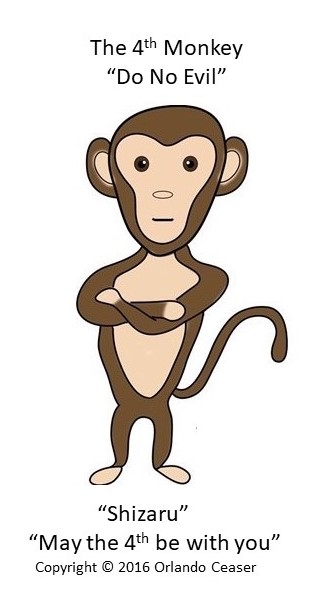
The 4th Monkey – Do No Evil

Our current climate exposes the need for character development and truth. Integrity is highly regarded in our daily affairs, yet we don’t emphasize it as often as we should. We grew up thinking about values, truth, sportsmanship, ethics, and etiquette. Now we focus on winning at all and any cost. Conscience is seldom referenced and seldom discussed to govern our actions.  We must focus on universal values and principles to teach us to work together to build connection and teamwork. My most popular blog post, The 4th Monkey is being re-issued to concentrate on behavior to improve our interpersonal skills. The universal application of these age-old concepts is a tremendous value that should build connection and our ability to work together in harmony toward a worthy ideal.

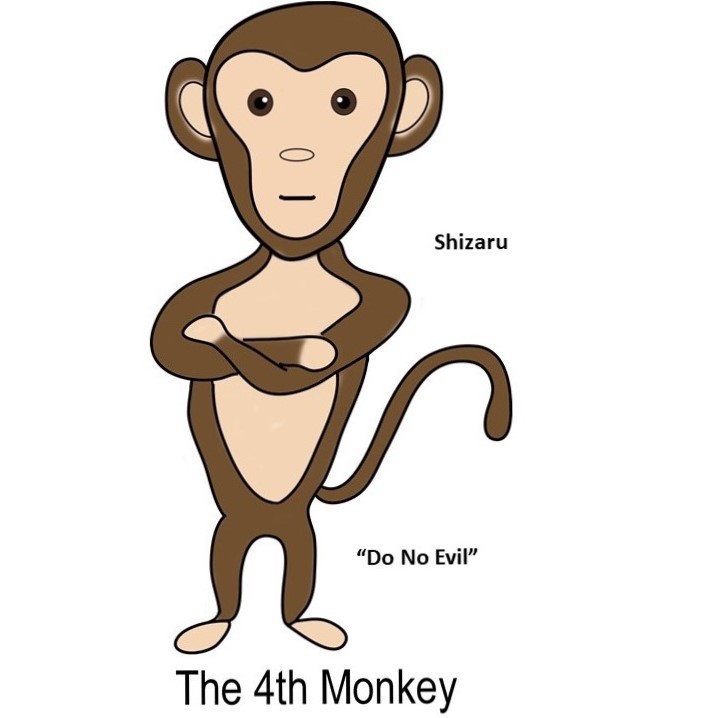
We grew up with the story of the three monkeys. I imagine we share the same interpretation of what they represent. We were exposed to pictures or statues. One monkey had his hands over his eyes, the second had hands over his ears, and the third monkey’s hands were over his mouth. They were See No Evil (Mizaru), Hear No Evil (Kikazura), and Speak No Evil (Iwazura). There were actions and behaviors demanded of us based on the three monkeys, but nothing was said about the fourth monkey. The fourth monkey is Do No Evil (Shizaru).

The stories of the four monkeys were popular in Japan in the 17th century. Their origin is between 2 and 4 BC in China. The Storyologer website (www.storyologer.com) has this account of Mahatma Gandhi who carried around a small statue of the three monkeys.  “Gandhi had a statue of three monkeys in three different postures. One was shutting his mouth with his hands; the other was shutting his ears similarly and the third monkey had put his hands over his eyes. A visitor to his house became curious and questioned Gandhi about the various postures of the monkeys. Gandhi politely replied, “The one shutting his mouth tells us that we should not speak ill of anybody. The one shutting his ears tells us that we should not hear the ill of anybody. And the one shutting his eyes tells us that we should not see the ills of anybody. If we do so, we will have all goodness, and nothing but goodness.” 

Travelers often find local markets with carved depictions or artwork featuring the three monkeys. However, the fourth monkey is rarely seen. The 4th monkey, when pictured, is usually shown folding his arms (the body language of being closed) or covering his crotch to signify inactivity.

The different interpretations of the four monkeys are fascinating. In the Buddhist tradition, it meant don’t spend your time preoccupied with evil thoughts. In the West, it relates to not facing up to our moral responsibility. But in my household, the monkeys were presented to us as a model of proper behavior. Our parents wanted us to identify with the images, to supplement our moral code.

See no evil (Mizaru)

We were told to pay attention to people and location(s). The idea was that if we were in the right location, we would minimize seeing trouble develop before our eyes. This was applicable in school and at work. We were instructed against being at the wrong place at the wrong time or the wrong place right. We were also told not to look for bad things in people or in certain situations. There are people who see bad things when they don’t exist, which could explain the manifestations of bias, stereotypes, and profiling. We were not taught to be naïve but to be careful and respectful.

Hear no evil (Kikazaru)

We were told to shield ourselves from bad language and bad intentions. We should stay away from people who spoke ill of others and gossiped. If we were not in the wrong place we could minimize hearing things that we should not hear. We were also instructed not to listen to foul or vulgar language. If we heard people’s language, especially regarding someone’s evil intentions, we could use the evil information to do good or to help others, that would be permissible.

Speak no evil (Iwazura)

Speak no evil was used to discourage gossiping or speaking ill will about someone. We were told to watch our language and to speak kind words. “If you can’t say anything good about someone, don’t say anything” was a part of this same philosophy. Adults told us that spreading bad news or malicious information could come back to haunt us. We should also, apply this same advice to the workplace.

There is a misconception about the concept. This misconception has led people to adopt a code of silence in the workplace and in politics when a person is not pulling their own weight or has committed offenses. We would rather silently complain or resign, before talking about an employee who was not working. We would not want to be labeled a snitch or a stool pigeon. In the streets, people would say, “snitches get stitches.” To speak evil of someone means telling a lie, bearing false witness, or defaming their reputation. However, it is our responsibility to find a way to report injustice, illegal behavior, and practices that undermine people and the organization. Our intention should be to speak the truth in love without malice or premeditated negative objectives.

One way to break the code of silence is by offering incentives to whistleblowers. These individuals are people who step forward and report unlawful activities in an organization. They are paid a 10% bounty if the measure goes to court and fines are levied against the lawbreakers. In neighborhoods where people know the perpetrators of violence, but fail to come forward, there are no such incentives. Residents may be afraid of retribution, as the rationale for their silence. We must also realize that justice requires telling the truth and this should not be regarded as speaking evil of someone.

Do no evil (Shizaru)

The fourth monkey’s actions are truly related to the others. The workplace and politics are common places for the four monkeys to be used as an operating system. Employee bullying and intimidation, sexual-harassment claims, the presence of racial discrimination, unconscious bias, and sexually charged language and actions exists in many organizations. Where improprieties and liberties are taken with people’s rights in the form of disrespectful words and actions, there are laws in place to prevent and punish these actions. Employees, who adopt a see no evil, hear no evil, speak no evil mindset are not helping to develop a positive company culture or a respectful workplace

Do no evil is a perfect monkey to enforce the values of character and integrity. He reminds us of proper behavior and etiquette. Our choices have consequences and the more we can emphasize a positive corporate culture and a respectful workplace the more effective our organizations will become. There are conduct and behavior norms that must be identified, emphasized, and enforced vigorously. Character will minimize stress in the workplace and reduce the number of lawsuits and discipline related to improper behavior.

The Do No Evil mindset would influence our participation in the political process. Our dialogue in conversations around those who are different from us or have different opinions would be positively affected. If we operated each day thinking in terms of Do No Evil, we would be more empathetic in understanding of each other. We would put ourselves in the shoes of our neighbors and seek to understand their point of, listen to their words, and lay the foundation for greater chemistry instead of conflict.

How can we create an environment in our workplaces, families, and communities, where people are held accountable for their own unlawful actions and the private citizens who come forward can feel safe and protected? If The 4th Monkey was modeled, we would have less of a cause to talk about Mizaru (see no evil) and Kikazuru (hear no evil).

Do no evil and speak no evil should be magnified and connected to many of our guiding principles of behavior. The Golden Rule and its equivalent in many cultures advise us to treat people the way we want to be treated. The Platinum Rule asks us to treat people the way they want to be treated. The 10 Commandments implore us not to do a series of acts that could be seen as evil, such as murder, stealing, etc. you are instructed to love your neighbor as yourself. If we began from a position of love, it is easier to think in terms of speak and do no evil.

We must clearly outline expectations of behavior and the judgment related to them to improve the climate in our organizations, homes, and places where people meet. The correct action is essential to achieving healthy results in our relationships.

The imagery and practices espoused by The 4th Monkey hold the key to making this possible. I am hopeful that by emphasizing the fourth monkey, we can improve our behaviors, connections, interactions, and relationships with everyone.

Copyright © 2016 Orlando Ceaser

MSU (Making Stuff Up) – Credibility and Creativity

MSU C (2)

I began speaking about the concept of MSU in 1986 when training sales representatives as a Regional Operations Manager. A few representatives, when faced with a difficult question, tried to bluff their way through their answers to tough questions. Their responses contained misinformation and outright lies. A few of them demonstrated unbelievable creativity under pressure to make up fantastic stories but distorted the facts. I was rather angry because we took the truth very seriously. We boasted to have one of the best trained sales forces in the industry. You had to achieve 90% to pass our product examinations. We stated the company policy around misinformation. Their credibility and the company’s reputation was on the line, therefore MSU was forbidden. We would not tolerate MSU (Making Shit Up). I apologized for the language, but it was a profoundly serious matter. Additionally, we told them that it made them look stupid because the doctors probably forgot more about medicine then they would ever know.

I must admit that some of the responses were rather creative. We applauded creativity but not in the dissemination of product information and following company policies and procedures.

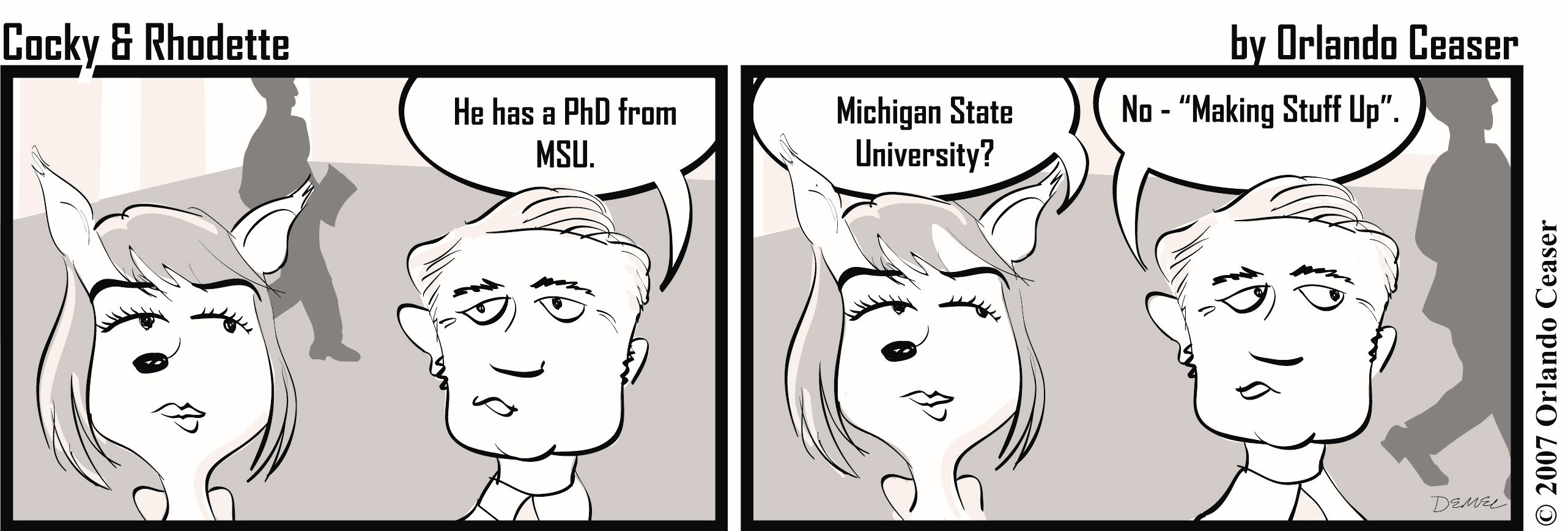
MSU was such a catchy concept that we included it in our regular training vocabulary. We would openly talk about Making Stuff Up and the dangers of resorting to that practice in answering physician questions. MSU had value as it related to creativity and other areas. When I introduced the concept of MSU I would state that it did not stand just for Michigan State University.

Years later we were training physicians on presentation skills. I decided to drop in on one of the sessions. I noticed that on one slide were the letters MSU. This piqued my curiosity and I sat for the session. The presenter opened the session by saying he wanted to talk to them about MSU and it did not just stand for Michigan State University. It stood for Making Stuff Up. I was impressed but, I sat there speechless. I did not recall reading about MSU before that fateful day in 1986 in our sales training seminar.

15 years later I was in my office as an Area Sales Director. One of our trainers (Field Development Leaders) gave me a book. The book was titled MSU (Making Something Up). And 10 years later in Zambia, South Africa, one of our pastors conducted a workshop on MSU, Making Stuff Up; obviously, it was a well-established concept.

MSU is therefore a viable practice. It is a catalyst for creativity and a warning. We must use it wisely because authenticity and transparency are required to enhance your credibility. As a leader, is important to be aware of MSU and how adopting this mindset can be used to make decisions, answer questions, solve problems and enrich our world through creative thinking and innovation.

Copyright © 2020 Orlando Ceaser

Websites: OrlandoCeaser.com

watchwellinc.com

A Call to Decency & Integrity (D&I)

The 4th Monkey (3)

Decency is not a trade he frequently discuss. Yet, people know what it is when they see it. We would agree that people who are decent are trustworthy, with strong character traits, such as integrity. They are respected and held in high esteem. Decency is an acquired state. It is a function of diligence, conditioning, and a propensity to do the right thing. It is combination of characteristics, attitudes, and positive personal values, which causes people to gravitate to the as a magnet.

You may not have it as a goal, nonetheless it is a byproduct of being a good person. Decency is a positive side effect of good behavior. The individuals possess high moral standards and a solid reputation and track record.

Google defines decency as “behavior that conforms to accepted standards of morality or respectability.” It is often used in the context of someone being modest.

Decency surfaced on my first interview trip as a district sales manager. I was sent to help a district manager fill vacant sales of territories. The company had a structured interview program based on behavioral questions. We looked for competencies or behaviors necessary to do the job. Past performance / behavior was a predictor of future performance. Whereas there were no questions related to decency, it was evident, among the candidates.

One candidate rose to the top of my list. He had the requisite potential to be an outstanding sales rep. This was during a time when we were hiring recent college graduates for sales positions. There was one sales territory that was hard to fill. My favorite candidate evoked the word decency. He had the requisite skills, but I kept thinking, he is a thoroughly decent individual.

Decency translated into a culmination of many positive character traits. His overall demeanor was supported by quantifiable, specific behavior related outcomes.

Our interviewing questions covered such areas as presentation skills, product knowledge, administrative abilities, persuasion, teamwork, tenacity, resilience, creativity, and organizational skills.

Sandwiched between his answers were examples of

  • Fairness, equality, and good judgment
  • A hard-working personality
  • Faith centered living
  • Integrity and moral behavior with clients and competitors

Decency is an attribute, we relish in people who lead us, serve us, and befriend us. They have integrity which is characterized by the 4th Monkey (Shizaru) which is “Do No Evil”. Decency is not something we feel we can teach, but believe it was necessary for longevity and success in the long term. It may be a function of upbringing, conditioning, modeling behavior, practice, and reinforcement. Decency is often described as; you know it when you see it, or you can feel its presence in your gut.

In a highly competitive marketplace, decency can be a tiebreaker in hiring employees and building relationships and collaborations. We should determine whether candidates can play well in the sandbox, are good listeners and strong team players. They could essentially play well with others, driven by a sense of fairness and purpose, emotional intelligence, likability, and a desire to excel and achieve their inner greatness.

When we visually survey our workers and coworkers, if we find they have a sense of decency we could probably see the following.

  1. Authenticity
  2. Integrity
  3. Honesty
  4. Strong work ethic, based on productivity, quality and execution
  5. Treats people fairly, with dignity and respect
  6. Moral character as reflected in the stories they tell
  7. A sense of fair play

Answer the following question. Are you a decent human being? How do you know this to be true? Asked the coworker, relative or friend if they would consider you a decent person. Ask for examples.

The decent human being is the team player that people like to work with and want on their teams. Strong character individuals are sought after in every interaction that is important to us. It is advantageous to associate with decent people and hire, develop and promote in our organizations.

Copyright © 2020 Orlando Ceaser


The Core of More™ – Be Awesome from the Inside Out

MORE (2)

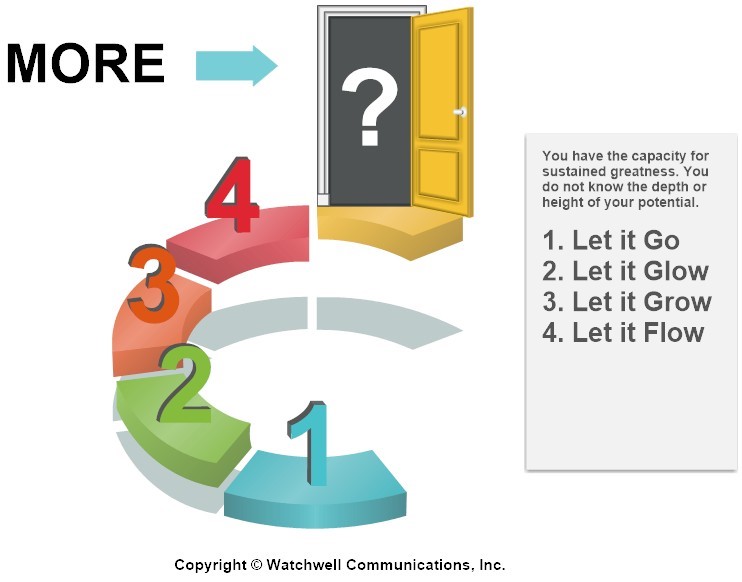
There are crucial components to your development that must be examined to accelerate your progress. There is a core set of skills, values or principles which can be debated, but factually, these key ingredients build on your present state. You have more depth and more in the core of your being you can imagine.

Let’s place four elements in this Core of More™. These elements confirm there is more in your core than you can imagine, yet you periodically ignore one or more components. They are Let it Go, Let it Glow, Let it Grow and Let it Flow. These ingredients will enable you to gain rather than regress and achieve success, that is surplus, but not necessarily excess.

Let it Go

Before you start and during your journey, there are nouns that you must displace. There are people, places or things that are excessive weight that must be discarded. There are situations, memories and perspectives you must release.  As a hot air balloonist will tell you, if they want to increase their altitude, sandbags must be cast overboard, or they will impede their ascension.

There are personal situations that try to hold you back and hold you down. In earlier articles I refer to them as the Hindre™ a person or force of negativity that attempts to hinder or restrict your progress.

Hindre


They must be released if you are to soar to the rightful heights of your potential. You may know these impediments. You must be open to receive information on people who are plotting against you. Additionally, you must change old mindsets and adorn new ways as you grab on to new beginnings.

You must let go of destructive habits, attitudes, the wrong crowd, the wrong thinking and other roadblocks that may block your progress.

Let it Glow

Your light, however you define it, must be allowed to shine. Your talent, skills, abilities, capacity and resources must be a beacon of hope, a living positive example. Your light must be an indicator of your presence, purpose and performance. As we sang in Sunday School, “This little light of mine, I’m going to let it shine. Let it shine, let it shine, let it shine.” When it shines, it has a glow, a luminescence that grabs people attention, pinpoints your location and potentially influences behavior.

Let it Grow

Skill level and impact will expand and enlarge your contributions. Influence grows as your abilities are refined and increased. You must devote time, effort, energy and insight received from teachers, mentors and coaches to improve knowledge and the quality of your work.

You will become a continuous learner and communicator, passionate about getting better in the priority areas of your life. Your light will get larger and brighter and more will take notice of you and more will be expected of you, as more are influenced by your presence. Your abundance will become a windfall to others, as you realize you are slated to get better, so others can benefit from your brilliance. You can state your growth as, “I’m proving myself by improving myself.”

Let it Flow

As it glows and grows, it will flow in the execution of your skill set and in helping other people. Work will become easier and more natural. Executing your tasks will appear effortless, mainly because you are in your sweet spot and you are streaming in success. It is captured in an acronym SMILE (So Make It Look Easy). An athlete will comment that they let the game come to them or the game slows down for them, as they improve their craft.

When you Let it Flow, your stream of influence will remove logjams that exist in your path. Your actions are fluid as a well-trained athlete, gliding through the race; a musician who makes playing the instrument look easy; a world class professional speaker in their comfort zone, delivering a powerful message, a leaf sailing on the water. You are caught up in the flow.

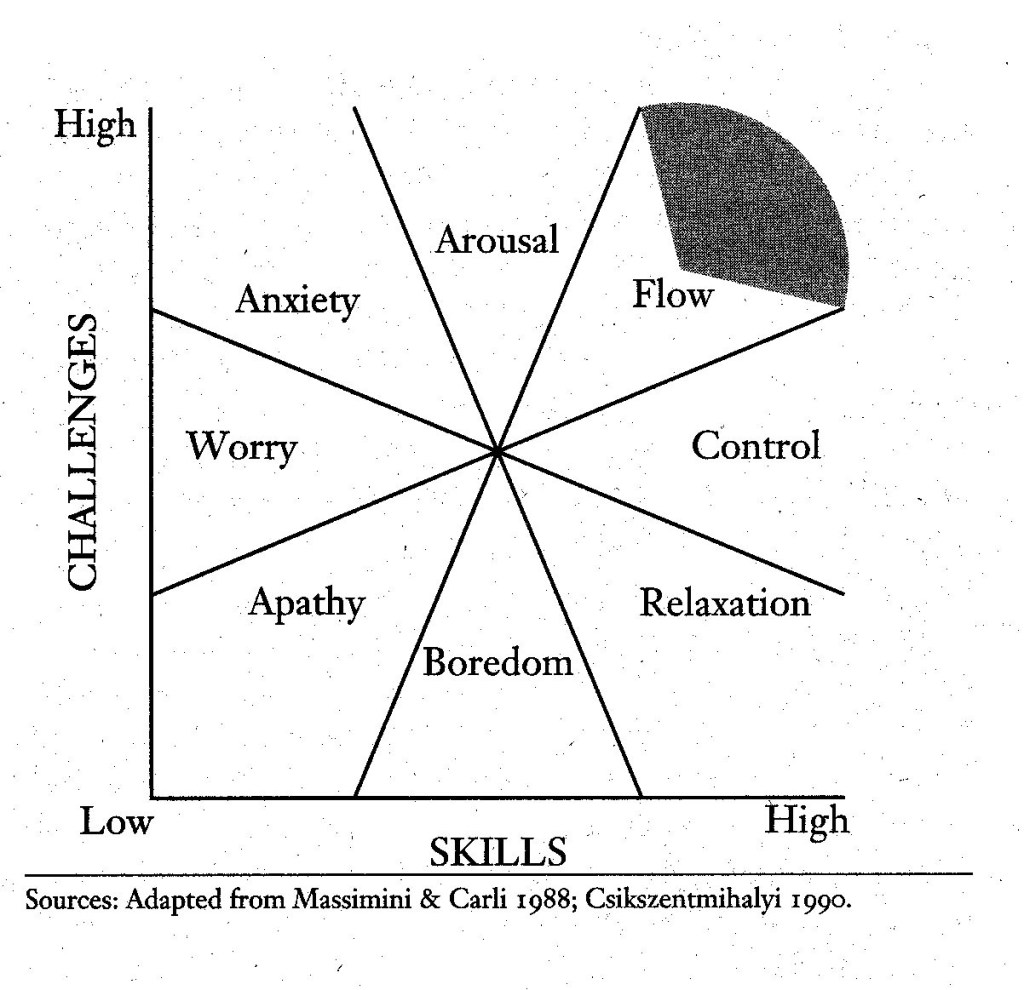
Professor Mihaly Csikszentmihalyi , has a concept of Flow which is defined as follows, “In positive psychology, as the zone, is the mental state of operation in which a person performing an activity is fully immersed in a feeling of energized focus, full involvement, and enjoyment in the process of the activity”1. It is a state where skills are consistent with the challenges presented to you. In the state of flow, you lose track of time and you are consumed in passion2. Simon Sinek says, “Working hard for something we don’t care about is called stress; working hard for something we love is called passion.”3 When you Let it Flow, your passion shows and when added to perseverance, you are exhibiting Grit4.

Flow Document (1)

Let it go, Let it glow, Let it grow, and Let it flow are part of the Core of More™. Apply these principles to help you achieve success in the professional and personal realms of your life.

Copyright © 2018 Orlando Ceaser

  1. https://en.wikipedia.org/wiki/Flow_(psychology)
  2. Csikszentmihalyi, Mihaly (1998). Finding Flow: The Psychology of Engagement With Everyday Life
  3. wordpress.com/2014/08/24/working.
  4. Duckworth, Angela (2016). GRIT: The Power of Passion and Perseverance


Resilience and Another Starfish Story

starfish

Resilience is a way of describing your bounce back ability (BCA). A trait that is wired into our mental framework to give us the tenacity to govern our behavior. It is a portrayal of our stamina and stability and the survival instinct within us. We are formed, fortified and framed with the mindset to resist tough times. We are not saying that we are challenge proof, but challenging resistant, enabling us to bounce in the presence of hard times and hard surfaces.

Let me tell you another Starfish Story. This is different from the traditional starfish story. This story takes place in the ocean. Our hero or heroine is an injured starfish, that is wounded in the ocean. The injury either by accident or sustained damage from the encounter with a predator or a vessel in the water.

During this mishap the starfish was badly damaged and lost one of its points. The starfish has five arms, as we know from the pictures we’ve seen or the animals in an aquarium. However, they may have any number ranging from five arms, to over 50, but I digress. You may have been lucky enough to see these fascinating creatures, sometimes referred to as sea stars, and the they are not really fish.

Our starfish suffers what would be considered a devastating injury to most animals. Imagine this wounded animal moving around in the water eligible to die from the mutilation. However, the starfish has a quality that allows it to rejuvenate or regrow its arms. It is as if the starfish’s body, metabolism or inner programming remembers its original structure and works to replace it. This fascinating attribute allows it to live for 35 years.

Humans do not yet have this ability to physically rejuvenate, however mentally we are resilient. We may face a devastating appointment which takes away our drive and self-esteem. We may make a mistake which appears to be career ending. We may have our reputation tarnished to the extent we feel we may never recover. But like the starfish, we can rejuvenate, regenerate, replenish and reestablish ourselves with proper a mindset.

We can re-institute a positive, reassuring and confident state of mind. When we were infants and toddlers, there were qualities we had, such as curiosity, adventure, stamina, persistence and endurance. We could focus on something with relentless intensity and if we fell trying to get it, we had the resilience, the bounce back ability, after a moment of pouting to get back on our feet and resume our pursuit of the goal.

Later in life, many of us periodically, have these traits badly damaged and removed from our repertoire or body of skills. We may go through life psychologically impaired when we have the inmate ability to do something about it. We need to rejuvenate and regenerate the mental demonstration of renewed strength and resilience.  We need to re-grow these former strengths in order to sustain ourselves and renew our level of effectiveness.

Think back to a time when you were whole and constructed for success and survival. Remember how it felt to be fearless and confident. Remember the other starfish story and recapture what was lost or taken from you, so that you can replenish yourself and be structured to become your best. Remember the words of the philanthropist W. Clement Stone who was the proponent of PMA (positive mental attitude). He said that what the mind could conceive the and believe, it could achieve.

Think of the starfish and reach down within yourself to repair the damage and regain whatever you lost, the world is counting on you and your leadership.

Copyright © 2020 Orlando Ceaser

OrlandoCeaser.com


What is your From – To Story (FTS)?

Goals
Constantly, we are exposed to stories that grab our attention. They are tales of unbelievable struggle, growth and accomplishment. People have overcome tremendous odds the and circumstances to arrive at an unforeseen destination. They may be classified as from rags to riches, from poverty to higher education, from homelessness to home ownership or from working as a janitor to becoming the principal of a school. These stories show the power of the human spirit; the magnificence of vision, goal setting, perseverance, generosity, luck and encouragement.

Our hearts were warmed a few years ago by the story of a Ted Williams, a homeless man who was called the Man With The Golden Voice. He was given a job making commercials and later returned to radio. When you think about your life, you can also create your own personal From – To Story. Look at a point in your life, a different job or think of your current position or objective in life. Where were you? Where are you? Where do you want to go? What do you want to become? What is your purpose, your destiny or your goal?

When I was younger, I would read about individuals who stated that they were the son or daughter of a sharecropper. Their bio would state, from a sharecropper’s son they rose to the position of president of their own company; from a single parent to the position of a medical doctor; from the inner city to a position in higher education. I have known individuals who have gone from an administrative assistant position to a position in sales management. These examples are all around us.

You know who you are and where you’re From, now it’s up to you to establish, what is your destination, or more specifically, what is your To? What is the right To for you? Before you arrive at your ultimate destination, there may be a series of stops along the way, therefore, there may be multiple To’s in your forecast, in your future.

What does your dream scenario look like? What is the tagline that you would want attached to the beginning of any description of your life and accomplishments? Fill in the blanks below to give yourself some practice. Thinking about your responses may fill you with a sense of accomplishment, on how well you’ve done and how far you’ve traveled. It may also show you, how far you must go and serve as a reminder of your purpose, destination and destiny.

From ________ To ___________.

From ________ To ___________.

From ________ To ___________.

From ________ To ___________.

From ________ To ___________.

I wish you success on your journey. I look forward to the day when we can discuss where you are From and your arrival to the To that is right for you. Your, From – To Story (FTS) will be a benefit to you and enrich the lives of others.

Copyright © 2019 Orlando Ceaser