Motivation from the Heart – Propel Yourself into Action

heart

We can gain valuable information about motivation by studying the heart and how it functions to keep us alive. During my training as a pharmaceutical sales representative, I received cardiovascular instruction to prepare me to sell a drug for treating heart disease. There were two components of my cardiovascular education I use to this day. They are the characteristics of the heart and the equation for blood pressure. To truly experience motivation from the heart we must demonstrate these qualities.

The heart has 4 main characteristics. They are as follows:

  1. Automatism – the heart can generate its own impulse to initiate the heart beat
  2. Contractility – the heart has the ability to contract, which is to do work
  3. Conductivity – the heart conducts and therefore, sustain electrical impulses
  4. Compensatory mechanism – the heart can create additional arteries to help supply oxygen to areas where existing arteries are blocked

Automatism

Just as the heart has the ability to generate a signal to get started, we should have automatism built into the fabric of our personality and value system. We need to be self starters. Our biological clock must have an alarm to awaken our desire to achieve. Additionally, we should align ourselves with people who also demonstrate this trait.

People with automatism instinctively start, regardless of the changes in their environment. The heart has an SA node, the sino-atrial node which is the network of nerves that are responsible for the impulse that triggers the heart beat. Each person is hotwired with his or her own hot button. What is your SA node? Do you know the triggers, switches and hot button to turn on your ignition to drive toward greatness?

The best workers are those who are doing what they love. They are using their talents and skills in a career or area suited to their interests and passions. Individuals in the right job utilize their values, beliefs and purpose to propel them to higher levels of performance. They have the spark that provides their own ignition.

Contractility

Contractility is the second trait, which is expressed as the ability to do work. The heart when faced with increased demand or workload will beat faster. We must work smarter and harder when the challenges are higher and more difficult. We need to spend the time and effort, exhibit the stamina and energy to reach our potential and expected outcomes. We don’t need people to carry around a motivational defibrillator to frequently jump start our attitude. Some employees are great workers when things are calm, but when the tension rises they fall apart and become less productive. We will not become those individuals, because we have lofty career goals.

Individuals may require help during an intermittent crisis in morale, but the matter should be temporary and should not be needed often. A motivational pacemaker, would be a drain on time and resources.  These pacemakers and defibrillators can become habit forming and lead to entitlement and an always need to be rescued mentality. The resulting motivation is effective only if the stimulant is always present. If the external stimulant is a manager or threat of disciplinary action, the long term motivational impact is doubtful.

Conductivity

Conductivity is the third trait. It is important because we must sustain the desire and commitment needed to do the work. The heart is like a battery. It can distribute power that is stored inside. The drive must be rejuvenated over time with the stamina and repetition to achieve results. The need for continuous external stimulation is not desirable. Conductive people are enthusiastic and easily identified by their ability to transmit this energy and enthusiasm to others.

Conductive workers are usually positive role models. They are the ambassadors of the purpose, mission and goals of the group. They lead by example and can be counted on to support the goals of the organization. We must be people who cause a positive chain reaction and a current of courage and collaboration to achieve results.

Compensatory

The heart’s compensatory ability is the fourth characteristic. It is shown by its ability to create new arteries to go around the blocked areas to deliver oxygen to the region of the heart that is not getting enough blood flow. When motivation is in short supply in the workplace, this compensatory mechanism has protective properties to keep people fired up and dedicated to reach the goal.

We are expected to compensate, adjust and adapt to forces within our environment. When barriers confront us while completing responsibilities, we need to think of creative measures to work around the obstacles. Innovation and flexibility are requirements in these changing times and versatile people with compensatory abilities are in great demand.

Work versus Resistance

The other major component related to the heart is the blood pressure equation. Blood pressure exists in the Circulatory System and serves as another way of illustrating the concept of motivation. Blood pressure in the body can be displayed in a simple equation.

CO (Cardiac Output) X TPR (Total Peripheral Resistance) = Blood Pressure

Blood pressure is a function of cardiac output (CO) and total peripheral resistance (TPR). CO is the work the heart performs, when it beats. The heart works against TPR, resistance in the arteries. If the heart works harder, this will increase blood pressure. If the resistance goes up, there will be an increase in blood pressure. The resistance is like the drag that an airplane experiences in flight. It is like the head wind that causes friction that could slow down the plane.

Work X Resistance =  Success (Quality of life, performance, results, etc.)

The equation can also apply to life. If quality of life or success is the goal of motivation, we can say it is influenced by the amount of work we do in the face of the internal and external resistance in our environment. If we want to improve our quality of life or success, we have to be motivated to do more work or reduce the resistance or competition.

Resistance is an obstacle and can represent people, environment, lack of resources, competition, peers, attitudes and other circumstances. As the resistance increases, we must counteract by working harder and more efficient. If we can reduce the resistance, we minimize the barriers to our quality of life, but we must still do the work.

Leadership should recognize and reward, motivated performance and establish an environment of positivity, optimism and development. Workers must ensure that their communication arteries and career arteries aren’t clogged with bad habits, unhealthy attitudes (entitlement and negativity) and a failure to give their best performance.  We must also encourage each other to greater performance levels of excellence.

When we speak of motivation from the heart, the correlation between how the heart works and what is needed today is very strong. We must be heart smart in developing ourselves and the people around us. We should look to the heart and emulate the qualities of automatism, conductivity, contractility and compensatory mechanisms. We should also remind ourselves of the blood pressure equation and the relationship of work and resistance. We can influence success, quality of life, performance and results by affecting the quality and quantity of work we produce against the various levels of resistance.
Communication Excellence – A Competitive Advantage

We should help our young people become better communicators as a part of their educational development, while helping ourselves improve in this area. This should begin in our homes, and shift to the schools, work, community, places of worship and other organizations.

There are statistics that indicate that 85% of success will be attributed to communication skills. Correct speech builds confidence and youth won’t feel self-conscious in the presence of individuals with strong verbal skills. Leadership qualities blossom in the portfolio of a strong communicator. If communication skills are solid, youth can concentrate on the content of their conversations, articulating their dreams and the ideas they want to present. If communication skills are solid, adults can broaden their career opportunities.

Improving communication skills is a phenomenal benefit and competitive advantage. Improved speech at an early age actually making life easier for everyone. Students don’t have to think as much about choosing the right words for speaking clearly will come naturally for them. It is easier to have excellent speech and shift to colloquialisms, then to always speak in colloquialisms and try to shift to excellent speech.

People will jump to conclusions, make snap judgments and make decisions about someone based on their speech. They will rightfully or wrongfully gauge intellect, display bias about where someone were born and raised, gauge economic status, and achievement potential. Companies will hire, promote or allow employees to speak for the company in a meeting or to the media, based on their ability to communicate. These subjective and objective reactions may not be fair, but are indicative of the power of communication skills.

People are resistant to broach the subject of speech correction. This tendency has to change, so that we can radically assist our youth on their path to excellence. I don’t know if this reluctance is due to a lack of confidence, individuals discomfort and knowledge about what is correct speech or if they feel it is not important enough to address. Clearly the data suggests that communication is an area where improvement could be emotionally and financially beneficial.

There are several skill areas essential to master. They are conversations, group presentations, punctuation and written communications. As youth grow older they will get into the intricacies of verbal and non-verbal indication (body language). Mastering these areas will contribute to other parts of their intellectual endeavor such as improving math, science and reading skills. Focusing on these areas early in life will help children form habits that will make communicating easier.

More people should pay attention to individuals whose professions rely on effective speaking. If children use them as a mirror, they could elevate the quality of their communications. Youth would make their career choices and competitively pursue more promotional opportunities. Adults will grow in confidence, credibility and grow in their organizations as communication excellence contributes to their leadership abilities.

Athletes are a prime example of individuals receiving different careers options because of their competence in communicating. Effective communications through their fluid speaking ability could lead to a career in broadcasting. Here are a few examples of athletes who combined athletic excellence with effective communication skills to add another source of income and another career.

  1. Michael Jordan as a pitchman for several products
  2. Michael Strahan, a professional football player who became a sports announcer. His personality and communication skills enabled him to be a co-host on a talk show and opened the doors for numerous commercials
  3. The Rock, a famous actor, at one point in his career was a college football champion and a professional wrestler. His personality and indication skills enabled him to take on many roles due to his ability to communicate.

We should be impressed by people who immigrate to another country unable to speak the language. Many come to the United States and assume English as their second language. Many of the older generation would listen to the radio and watch television, using these as venues to practice and learn English. I admired their persistence and dedication and the quality of their speech after working tirelessly to master the language. We would use them as motivation to improve communication skills.

What is wrong with communication excellence?

Some people feel it is the duty to attack communication excellence. Youth should beware of people who ridicule them because of their dedication to speak a language in the way it was designed to be spoken. Speaking right should not be given a derogatory label. Youth should not have to fight for their freedom to pursue excellence in speech. Youth should not apologize for achievement (excellence does not deserve sympathy or ridicule). Unlocking their leadership greatness will give them the necessary perspective, drive and credibility to lead their peers to share their commitment to excellence.

Effective communication should be seen as a vehicle to achieve goals and fulfill dreams. Achieving their dreams is the objective for youth and adults. Being able to communicate at a high level will work to their advantage. It is therefore, helpful to emulate the articulation of professional communicators, i.e. teachers, actors, newscasters, television and radio personalities, lawyers, spokespersons and politicians to help improve communication skills. There is also value in joining speaking organizations such as Toastmasters International to gain real world speaking experience and coaching in a nurturing environment. Additionally, Local schools and junior colleges also have speech classes which can help students and aspiring professionals.

As adults, we should not abandon the practice of improving our speech. It is never too late to speak better. We will serve as a model for people who watch and listen to us. Diligence in communication can have a powerful effect on the job. People in leadership position will select people they feel have the power to communicate corporate messages to employees. We noted that statistics have indicated that 85% of the skills necessary to be promoted on the job are related to your communication skills. This statistic alone underscores the importance of communicating with excellence and its value as a competitive advantage.

Copyright © 2015 Orlando Ceaser

Global Warming in the Workplace

heat_cycle1

“It is getting hot in here.” Can you feel the heat? The heat is rising in workplaces around the globe. Competition is intensifying. Competition for customers, products, services and career opportunities is heating up. Heat is also known as pressure, when it flows from higher levels of management as edicts, high expectations and strongly worded challenges to the people in the hierarchical structure below. The heat also flows from peers, internal standards and the family values

The list of individuals sweltering under the blistering temperatures in organizations is increasing. Companies are falling by the wayside due to heat stroke and the casualties of progress. The business landscape is littered with the fallen logos and share prices of former titans of industry. Innovation and new methods of distribution have led to the demise of companies that could not adjust and keep up. Companies that were once household names, no longer exist. So, now the companies that are still standing, have survival paranoia hanging over their heads, as they reflect on the cost of failure.

Companies have restructured, attempting to do more with less people and resources. Survivors of downsizing are dealing with survivor’s guilt and an increased workload. When employees demonstrate that they can function with fewer co-workers, relief does not seem to be on the near horizon. Employees want to save their jobs, even if they are unfulfilled, because it is hard to find a new job in the current employment environment.

The heat at work is beginning to move into homes as tensions mount due to the lack of attention overworked individuals display on the home front. Schedules at home are equally chaotic and hectic and have become the new normal. These factors have created immense pressure on relationships. The heat is spreading like wildfire. The pressure of life and the heat of each day confirm that global warming is prevalent at home and in the workplace.

Promoting individuals to management, who are not well schooled in leadership, can negatively affect the environment. Veteran managers with too much on their plates can become impatient when they are under fire to produce. Employees who want to grow, but barely have time to catch their breath, because all of their time is task time and nothing is left for personal development. If there is no positive end in sight morale and engagement will become areas of concern. The thermostats within organizations indicate that engagement levels reflect the temperature and pressure of working in today’s climate.

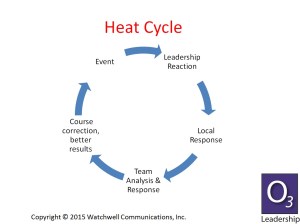
When there is a problem or discrepancy between expectations and results, leadership may react by raining down heat or turning up the heat. Merely emphasizing this lack of achievement will also be seen as bringing on the heat. Heat really means high expectations. This terminology is well accepted in companies everywhere.

Leaders will exercise their positional and personal power to get results. Ideally, the manager may not let unproductive heat go through unfiltered to their people. They may stand in the gap and become the ozone layer for their people. This filtering philosophy will only let the productive, constructive and inspiring heat reach their people. This heat will cause the manager to hold strategy sessions to determine the reasons for the discrepancies and propel them to devise an appropriate course correction.

Brainstorming and strategy sessions will result in recommendations for getting on the right course. In makeshift war rooms, teams are working diligently to yield revised tactics. These new marching orders are the result of analyzing the strategy and competitive response, gathering data on customer acceptance and revising resource allocations. The successful implementation of strategy changes will hopefully put the team on the right track. The new results will please leadership and the entire team.

Ironically, whenever another problem occurs, the leaders believe the heat administered the first time was the reason for the change in behavior and production. Therefore, as part of a vicious cycle or continuous loop, heat is again acomponents3dministered until expectations are reached.
The astute ozone leadership practitioner will help his team establish an early warning system, with a feedback mechanism, to serve as indicators of impending change. This metric will alert them to changes or malfunctions in the strategy at the earliest possible moment to minimize any surprises. Veteran and new employees will receive training on strategy execution and how to assess progress to minimize problems in reaching their goals. They will know the early warning signs that strategy and tactics need to be adjusted.

Global warming within the workplace has a number of origins. Some of them are due to a direct reflection of new technologies and distribution channels, as well as the competitive nature of the most industries. It is also a function of the realities of the current lifecycles of products and organizations and the internal drive and survival instinct of employees.

ozone_cover

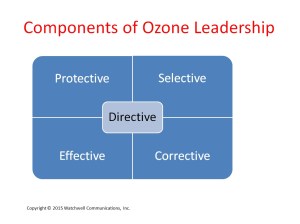
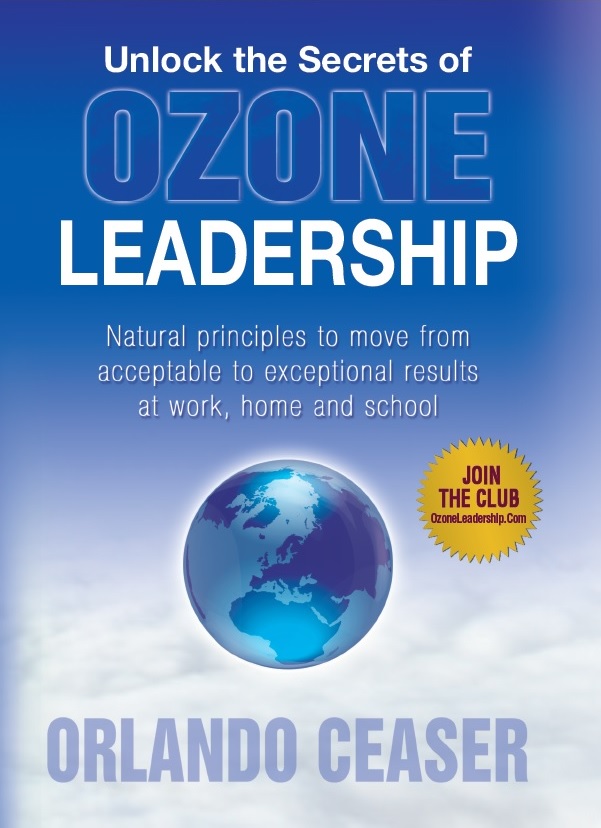
Ozone leadership can be further explored in the book Unlock the Secrets of Ozone Leadership. The book, keynote address and workshop espouse the five principles of this leadership model. The five components are directive, protective, corrective, effective and selective. When leaders have a mindset incorporating these five components they are more inclined to focus on developing people and developing the business. The implementation of these principles in the program would do its part to counteract global warming within your workplace.

Copyright © 2015 Orland Ceaser

Under New Management – A chance to decline or a chance to shine

new-mgmt

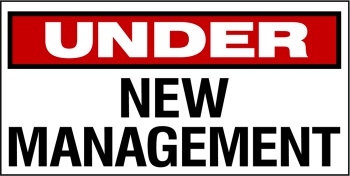
The sign has three words, “Under New Management.” We often see the sign in the window of a retail establishment. What does this sign mean to you? Does it conjure up images of change and great expectations? Are you saddened that a great institution will never be the same, gone the way of the dinosaur? Does it make you think hopeful thoughts about the future, casting aside the circumstances of the previous administration? Do you instantly wonder if new people with more money, resources, business acumen, talent and operational expertise, will make the business successful. Under New Management can bring opportunities, as well old problems and new obstacles.

Your opinion about an “Under New Management” sign is based on being connected to the previous management; as a patron or participant in their business. If you were dissatisfied with the prior regime, this sign may give you words of encouragement that things will be better. If you are on the inside, and not in the inner circle, this may mean greater opportunities for advancement. If you are on the outside, you are hopeful for a better return on investment or an increase in quality and customer service.

When new management arrives on the scene, there are new people to handle the day-to-day operations. The communications industry, especially radio, is notorious for bringing in new ownership, followed by new management. Radio personnel are often under the specter of change. When rumors start about a potential acquisition, panic leaps into the hearts and minds of everyone, except those personalities who view themselves as untouchable. These individuals, due to their notoriety, can be classified as employable, because of their ease of finding another job.

It is customary for most industries to experience change. Will that change be in products or services or the management structure, personnel or brand identity? In radio the change could be in their format? Will the station go from all news to a talk radio or country music format? What will the new manager think is the financially prudent format to recoup their investment? What changes could “Under New Management” bring to your company or industry? How could your life be changed?

“Under New Management” is a sign that could be hung after a merger and acquisition. Those in positions of power and leadership may worry the most. Many times the higher up you are in an organization the more worried you are of losing your job, status, influence, mentors and advocates. But, there are those on the outside of power, looking forward to the opportunity to shine. They want a clean slate, audiences before a new panel of judges.

Some of my greatest opportunities were, “Under New Management.” I recall making a speech before a large audience after a merger. I was approached by one of the sales representatives from Puerto Rico, excited about my message. She said,” I never knew you could speak like that! We have never heard you on the big stage before. Why haven’t you been on stage in this type of setting?” I smiled and thanked her, realizing that there was something special about the opportunities provided by being, under new management. There can be many career benefits brought on by a change in management. Ambitious personnel should strategically plan for a jump start, a new start to their careers and seize the new opportunities.

“Under New Management” could provide an environment where people can feel courageous enough to explore new areas. It could be seen as a chance to overcome mistakes made earlier in one’s career. New management may have a policy of mistake forgiveness, like the accident forgiveness features in some automobile commercials. It is true that negativity never gets amnesia in some organizations. It has a long memory for mistakes, even though the clarity of its memory may be very vague.

I spoke with the manager who applied for re-entry into her former company. She was cleared for rehire, but someone mentioned a problem they had with her almost 20 years earlier. He couldn’t remember the specifics, only that it was unpleasant. This company was under management, however there were lingering problems of old biases from the people they maintained.

New management can therefore, lead to the continuation of old stereotypes and biases from the remaining managers. It may also replace old unconscious biases with a new set of preferences and biases. But we must be optimistic and strive for the excitement and new energy to commit to build something new and magnificent. We must build an organization that allows us to make the most of the honeymoon period assigned to “Under New Management,” to impress upon everyone the desire and willingness to serve in order to achieve high expectations.

“Under New Management” is not the answer to all problems and it is incumbent upon everyone to bring their best and be hopeful that the environmental change will be a breath of fresh air. They must work to help provide fertile soil for people to grow to their fullest potential. They must work diligently to give the new managerial structure a chance to succeed and flourish.

Copyright © 2015 Orlando Ceaser

Overqualified! Is this a real concern or a convenient excuse?

Lack-of-Vision

Many companies do not give interview feedback to external candidates? But, when feedback is delivered, many of the applicants will hear these dreaded words, “You are an excellent candidate, but I am afraid you are overqualified for the position.” These words, intended to placate the candidate, often leave them frustrated and disillusioned.

There are a tremendous number of talented people in search of a new job. In many instances they are willing to work in jobs that are below their educational level, income history or experience. They want to work. They want to take care of their families, pay their bills and be productive contributors to society.

There are two attitudes about people that come into play in workplace scenarios. First, everybody likes to get added value, purchase something on sale or receive a bonus and a gift that is unexpected. They want to consider themselves lucky. This also applies to personal relationships. If a potential mate is interested in them and they are more attractive, with assets beyond their imagination, they consider themselves very fortunate. They are ecstatic when they gain something that exceeds their needs and expectations.

Second, no one likes to be tricked, used, manipulated, taken advantage of, fooled or exploited. If they hire someone and before they can give them a satisfactory return on investment, they leave the organization, people are left feeling they wasted their time and resources. If people invest time in a relationship and it is severed prematurely, they are disappointed and possibly angry.

Both of these philosophical dynamics come into play when companies are interviewing to fill vacant positions.

Overqualified people

There are facts that are known prior to the interview. Interviewers know whether or not a person’s qualifications match the needs of their assignment. If the person is overqualified, they know it before the interview. If being overqualified is a knockout factor for the assignment, the person should not be invited to the interview. It is wasting their time and company time. If they are brought to the interview, the assumption is that the organization is open-minded to consider them as a temporary or permanent fit for the job.

If they are invited to the interview and rejected, here are some of the potential real concerns and convenient excuses.

Real concerns

  • They have too much experience, but it is the wrong experience for today and for the future
  • They wanted them to perform well, but they bombed the interview
  • They did not convince the interviewer that they really wanted to work for their organization
  • They could not transfer their skills and experience to the job
  • The amount of time necessary to train them would slow down the work teams
  • They told the interviewer, in so many words, they would leave the company if something else became available With real concerns, interviewers have serious doubts about the person’s interest in the assignment. The organization knows, they are only available because a job that matches their background is not ready. They want the person to be happy and productive, but they are skeptical. They do not believe the candidate is ready for the lower paying job. They don’t want to take the risk to see if they could handle it. The interviewer wanted to be sold on the fact that they were capable of making the adjustment to the new job.

Convenient excuses

  •  The interviewer is reluctant or prohibited from giving the candidate the real reason for not selecting them
  • The overqualified line was given because it is the easiest explanation.
  • The candidate was so impressive in the interview that they were seen as a potential threat to vulnerable careers in the organization.
  • They like the candidate, but are afraid they would be frustrated and unhappy

Convenient excuses are used to hide the real reason for not giving someone a job. The excuses could indicate that someone was interviewed to meet a federal regulation to include certain individuals in a candidate pool. Company personnel have to be consistent when offering this explanation to candidates after the interview. When a candidate finds out that they were rejected as overqualified and other individuals with similar experiences were hired, they could cause problems.

Candidate – Overqualified Mindset

The candidate must understand the current predicament of the hiring manager. They are wrestling with the two dynamics discussed earlier; the struggle between obtaining extra value and the risk of being used by a desperate job seeker. They must recognize that the hiring manager has the following issues;

  • They are gauging seriousness as to whether the person really wants the job and would really stick around for a while.
  • The company feels the overqualified person is only interested in them because their real interests is not available.
  • Ask, “What do they need to hear from me, to make them comfortable enough to give me the job?”
  • They want to know that the job will be stimulating enough. They want them engaged and not disruptive to the team.
  • How can they make them feel that it is their lucky day that they are available to benefit the organization?
  • Convince them that they are hopeful that this opportunity will lead to something to benefit their career.
  • They may wonder if they are patient enough to stay with them and learn the job and contribute at a very high level.
  • Show them how they can add value to the organization, while broadening their skills
  • Demonstrate that this is a calculated move to strengthen their portfolio
  • Display belief in their ability to make it work, that they have thought it through and it is more than a desperate ploy, but an opportunity to show their humility while using their skills and work ethic to make a difference.

As discussed earlier, people like it when they can obtain greater value. If an organization can bring someone in the workforce that has skills above and beyond what is expected of the job and they are willing to accept the money offered and can hire them on a trial basis and groom them for greater things, it may be a risk worth taking. The hiring decision can be fraught with risk. Many times hiring a candidate who is not overqualified, can result in, them leaving shortly after being hired.

There isn’t a problem getting someone or being someone that is overqualified. The company, under the right circumstances, could use the person’s skills and experiences to enhance their organization. They could use their leadership to develop their peers. They could ideally be someone they would like to groom to fill other positions in the company down the road.

In this competitive work environment, people who are overqualified are constantly being hired, while others are being turned away. It is important for candidates to continue interviewing for the right job, and to be strategic and look at other positions to determine and how they can add value broaden their portfolio.

When individuals are told they were overqualified, this may mean they were unable to address the real concerns potentially posed by their resume. It could also be an indication that the interviewer took the easy way out and resorted to a convenient excuse.

Copyright © 2015 Orlando Ceaser

Leadership and the Ozone Layer – Channeling the heat

O3Logo(1)

Managers often talk about the heat generated in many organizations by their superiors. A solar fire storm comes down from on high, whenever Senior Leaders are dissatisfied with results. These measures vary within companies, but usually relate to financial outcomes.  When pressured, these leaders want immediate improvement. Their words may be indelicate with crude language and their words and demeanor may be threatening.  This intimidating method of getting higher performance has been successful in the past and is a knee jerk reaction to falling profits.

Employees of these fire wielding executives need an ozone layer, like the one that circles the Earth. Science classes from the past and the current discussions on climate change make us aware of the ozone layer. The American Heritage Science dictionary defines it as “A region of the upper atmosphere containing relatively high levels of ozone, located mostly within the stratosphere. It absorbs large amounts of solar ultraviolet radiation, preventing it from reaching the Earth’s surface.” It is essentially a protective layer that prevents the full burst of the sun’s rays from striking the Earth. The earth’s ozone layer does not filter out all of the heat, just the harmful ultra violet rays.

The ozone layer in our context can also be described as a supportive culture that protects employees from intimidation and excessive pressure from people in authority.  In my book, Unlock the Secrets of Ozone Leadership I assigned five attributes to Ozone Leadership. They are;

  • Protective
  • Selective
  • Corrective
  • Effective
  • Directive

These attributes lay the premise and the foundation for the philosophical rationale behind Ozone Leadership. Like the Earth’s ozone layer, a business ozone layer administered by an Ozone Leader working effectively, can protect the organizational culture. The results are greater productivity, higher morale, which holds everyone, including, leadership accountable.

Middle managers jobs are based on their ability to implement strategy and tactics to achieve share holder and stake holder value. In organization where senior leaders employ an intimidating management style, their managers may be required to serve as the ozone layer for their people.

Managers as effective leaders must regulate the heat to see that if falls appropriately. They know their personnel and realize that some individuals in the organization may need a hole in this ozone layer to feel the additional heat. If they are not performing properly they cannot be pampered and allowed to give less than their best. Some people may need to be shocked into working at expected levels. This must be done in the context of a respectful workplace and honoring them without bullying, intimidation or harassment. There may be a window in the ozone layer to allow them to be excised from the organization, as skillfully as a surgical strike with a laser beam.

When the solar winds cascade down the leadership chain the Middle managers feel the full brunt of the energy surge. One manager recalls being told, “If you are not tough enough to get the job done, we will replace you with someone who will.” Threats are generally a part of the vocabulary of solar expectations. Fear is believed to be a potent motivator. For years we have learned that the KITA (Kick in the Ass) approach only works temporarily and the stick part of the “carrot and stick” approach also has limited sustainability. When people can leave an organization, they will leave if their current organization abuses these methods.

The middle managers know their people are hard working and that some of the shortfall in performance is a shared responsibility. Leaders and the rank and file may have under estimated the size of the challenge. It is therefore, a shared responsibility to fix the problem. Local leaders modify the threats in the message for they realize the negative effect it has on morale and productivity. They know from recent literature that positive expectations and clear focus will allow people to think better. What are needed are calm minds to solve the problems. These leaders therefore, form a force field around their people to shield and buffer them from a direct hit. They usually channel the heat. They;

  • Gather their teams together and explain the dire situation around performance
  • Evaluate the current state to determine how they got there
  • Brain storm ideas and establish a list of things they should stop or start doing
  • Work to develop strategies and tactics to improve sales and financial performance
  • Adjust the tone of the demands from Senior leadership, while developing solutions to address the concerns of upper management

The company achieves its objectives due to the passionate, insightful work of the managers and their teams. People recognize that they dodged a solar bullet and everything is fine until the next crisis. When Senior Leadership sees the positive results; the reversal of negative trends, increased market share, they are pleased and complimentary. However, they are convinced that their firebombing directives caused the change. Senior leadership are prepared to reach for the flame thrower and use whatever draconian methods necessary to keep their organizations focused on reaching the results required to keep share holders happy. Therefore, with the next crisis they can be predicted to respond the same way, but with greater intensity. To minimize potential over reactions, it is incumbent upon the Ozone Leader to equip the team to minimize deviations from the corporate goals and objectives.

Solutions

If the practice of leaders in your organization is to respond the same way to every crisis, the objective should be to eliminate or minimize the number of crises. It is incumbent upon leaders to keep their teams always anticipating competitive and market pressures to prevent the initial crisis. Otherwise the fire drill will repeat itself and they may not be able to blunt the impact and consequences. This will require a change in mindset at all levels of the organization. All leaders, including middle managers should control the area within their jurisdiction. They should;

  • Ensure that their people exceed their stretch goals (effective)
  • Conduct simulations and “What if” drills to anticipate competitive responses
  • Ensure that employees are clear on the leader’s expectations (directive)
  • Eliminate competing priorities, being selective in what affects their time (selective)
  • Be willing to change course and admit when the leader makes a mistake (corrective)

All followers should:

  • Develop a “What else” mindset directed toward other things they should do to tackle or prevent a problem. This mindset will also help generate and evaluate alternative solutions
  • Monitor competitive activities
  • Ensure that customers are steadily assessed and surveyed to determine their level of satisfaction
  • Highly value customer service and customer surveillance as a high priority to provide the kind of market intelligence needed to make better decisions

The ozone layer mentality should be a part of the corporate culture. This will prevent the untoward effects of leadership striking the panic button and forgetting everything they learned about motivating people and driving behavior. Or it will ensure that local measures are put in place to achieve the objectives of senior leaders without torching and scorching the very people responsible for correcting the problems and creating the solutions.

Leadership needs to construct an environment of innovation and a culture that inspires people to give their best and offer solutions with fear of reprisal and ridicule. Trust and respect will go a long way toward eliminating a culture of fear and intimidation and ultimately produce the ideas and innovations needed to exceed objections.

Copyright © 2013 Orlando Ceaser

Learn more about Ozone Leadership by ordering my book The Secrets of Ozone Leadership which is available at www.orlandoceaser.com and www.amazon.com. The information is available in a hard cover, e-book and as an audio book, which is also available on iTunes.

Embarrassed in your career or Routed in pursuit of your dreams

Monitored_Life

How many times have you suffered an embarrassing defeat in your career or on the journey to achieve your dreams? Imagine your career or dreams as a sporting event. There are many similarities you can make to use this metaphor to examine your performance. Reflect objectively on a time when you did not deliver your best performance. You can then use the sporting analogy to analyze your performance and subsequent actions to get back on the right track, to outstanding results.

I was watching one of my professional sporting teams experience a severe defeat. They lost 55 to 14 to a division rival. It could be classified as a beat down, embarrassment, retiring on the job or surrendering on national television. Whatever the classification, it was hard to watch. The coach looked confused. The quarterback was stunned. Offense and defense collectively were disappointed and the fans were upset. I wanted to gain something positive from this experience, since I invested time watching the game. I searched for a correlation in the world of business and personal achievement.

I knew there would be many commentators, patrons, fans and armchair quarterbacks who would list a number of reasons for the debacle. They would want the coaches and general managers fired. They would want someone to pay for the spectacle that humiliated the city and its inhabitants. Someone had to lose their job because of this performance or the lack of performing. Have you ever been routed by the competition? Are you secretly being annihilated at this moment? Have you ever wanted to fire yourself or put someone else in your position? Are you, in some area of your life, losing out to someone more strategic, better prepared with equivalent talent? Is their game plan a superior document? Are they marching to victory with superior execution, preparation and passion? Think about this honestly.

Imagine your career and dreams as a sporting event. Wouldn’t it be wise to make first round draft choices to benefit the team? If some failed to pull their weight, you could counsel and replace them if necessary. They should be making actions to benefit the team, not focused on individual achievement and unnecessary celebrations to the detriment of the group.

There was a time when you failed to execute your strategy. You knew what to do, but failed to rely on your fundamentals and your abilities to work together as a team. You assembled a team of advisers, coaches and friends who were not skilled at their positions. They were nice enough. They did not give you candid advice when you needed to receive it. They were more concerned with staying in your good graces and benefiting from associating with you.

In the face of watching my favorite team gets spanked. I was forced to look inwardly and ask myself, where have I played a game that was not competitive and was not representative of my career goals, dreams or expectations? When did I disappoint my fans and let myself down? Where was I routed by an embarrassing act of incompetence, lack of passion and poor execution? Where did I collapse in the face of a stronger rival, due to intimidation or lack of preparation? After I face the reality that I have personally been routed by the competition, I can examine my response.

I was able to turn my season around. What did I do to make that happen? My responses to set backs are swift, instinctive and decisive. I don’t often think about them, but there is value in exposing the techniques I use. I can use this analogy and blueprint to help others. What tough choices did I make to get back on the winning track on the road to respectability? What tough decisions did I have to make pertaining to my personal habits and the individuals who influenced my behavior? Something happened. New habits were formed. Execution of the fundamentals was mandatory. I proved to myself that things could be and would be different going forward. I committed myself to excellence in preparation and execution. My past taught me to be patient with others, and I guide them recover from their own personal debacles and defeats. The objective is to instill the skills and strengthen the will and discipline to prevent it from happening again.

I go through life viewing the world from three perspectives. I want to entertain or be entertained, educate or be educated and inspire and be inspired to achieve dreams and career fulfillment. I can use setbacks such as a demoralizing performance of an athletic team to educate and inspire, even though it lacked the necessary entertainment value.

We are going through life continuing to hone our skills as a student of the game. This principle is at the center of the core messages delivered in my book Unlock Your Leadership Greatness. There are 10 principles to keep you from being embarrassed in your career or routed in your dreams. They are:

  1. Be fit for the role
  2. Be powered by a dream
  3. Be a student of the game
  4. Master the fundamentals
  5. Set high standards
  6. Always be creative
  7. Execute with passion
  8. Lead by example
  9. Make others better
  10. Serve others


Copyright © 2014 Orlando Ceaser

6 Personalities on the Path to Progress

leadercouldbewaiters1
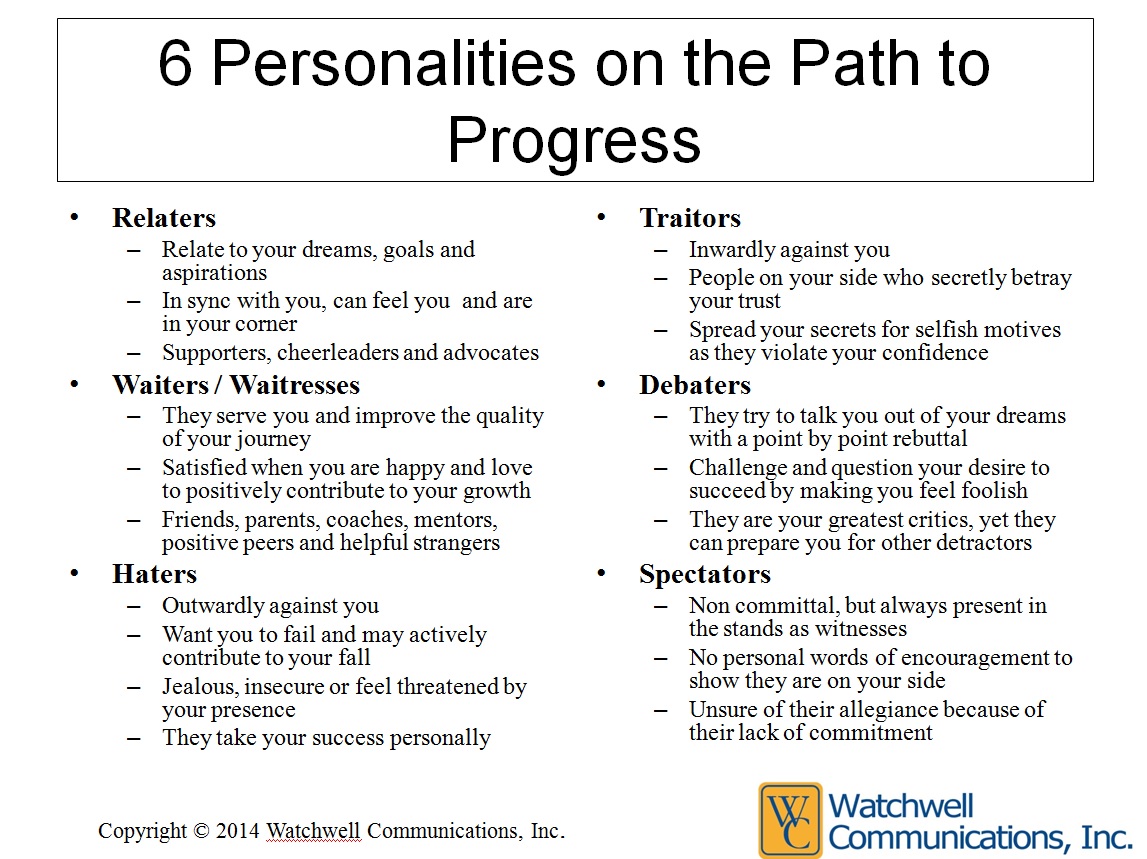
You will encounter a variety of people along the path to progress. There are a number of personalities on your journey willing to provide assistance or to be an impediment to you. Six profiles are highlighted based on personal and group observations. They are the relaters, waiters, haters, traitors, debaters and spectators. No one is exclusively one profile all the time. You may vacillate among the characteristics depending on the situation and the people involved. It is important to identify these personalities in order to enlist their assistance or to avoid their negative attacks on your well-being and your ability to achieve outstanding results.

6_personalities1

Relaters

These individuals relate to your dreams, goals and aspirations. They are in sync with your mission to succeed. There is a connection, commitment and compatibility with your dream. They relate positively to your intentions and seeking the best for you. They are on the sidelines and in the game as supporters, cheerleaders and advocates. It warms your heart to look in your corner and see relaters wanting you to make it.

Waiters / Waitresses

Waiters and waitresses have ‘. They are not individuals hired by you, but people who voluntarily serve you on your journey. They are your friend, parents, teachers, coaches, mentors and positive peers. They may be anonymous or strangers say a kind word or perform a good deed. These individuals derive satisfaction from being of service to and being a part of the delegation responsible for your achievements.

I ran the Chicago Marathon twice and the streets were lined with people with signs encouraging the runners. They screamed out the numbers of the runners and some of them provided us with water and beverages. You may recall a waiter or waitress who gave you outstanding service. They asked poignant questions in order to serve you better. They went out of their way to make your visit an enjoyable and memorable experience.

Haters

You may have come in contact with these individuals. They are outwardly against you. They may be jealous, insecure or just plain malicious in their attitude toward you. You may not have done anything against these people, but they see you and immediately resent you and your accomplishments. Haters are committed to bringing you down. They celebrate and laugh when you stumble. They have the resentment to match your contentment and find great satisfaction whenever you experience difficulties. Haters are prone to go to great lengths to place barriers in front of you and to turn people against you. They are constantly questioning your motives, while developing conspiracy theories to discredit your work.

Haters are very dangerous because of their capacity to spread malicious lies, rumors while attacking your reputation. Their outward expression of contempt may not be to your face, but many people will be exposed to their feelings.

Traitors

Traitors may get very close to you and win your confidence. You may trust them only to find out that they were false friends. They will work inwardly to unravel and discredit your progress to success. They will secretly try to undermine your efforts and tell people about your innermost secrets and weaknesses. Traitors may start out as relaters, but somewhere along the way they turn against you. Hopefully you will find out soon enough that they cannot be trusted. They are back biters and back stabbers. They may be passive aggressive, sneaky and secretive. Traitors may ruin your reputation by selling your secrets to the highest bidder.

Because traitors are believed to be your friends, their words ring with truth and credibility to an unsuspecting audience. Traitors will break your heart because of their proximity to your inner circle. They are on the inside and privy to your thoughts, feelings and actions.

Debaters

While you are committed to your journey, you will find a number of people challenging you every step of the way. They try to talk you out of success. They will question your sacrifice and try to discourage you from wasting your time. They will give you countless counter arguments and examples of others who failed through no fault of their own. They will persistently challenge the value of your dreams and the foolishness of your work ethic. Debaters will make you question your intelligence and qualifications for your objectives.

Debaters, however, can strengthen your resolve and survival skills. When you successfully counter their arguments, you will be stronger against other opponents. They actually prepare you for meaningful discourse with the conscientious objectors who are against your desire to be successful.

Spectators

In many respects your journey to succeed is a competitive event. There are spectators who are on the roadway in the field. There are other individuals who are in the stands watching the game. They do not get involved in the activities. They may cheer, but the cheers may not be for you. You may see the spectators in the stands, but you do not know their allegiance. You just know that they are present. They do not personally give you words of encouragement, as is the case with relaters and the waiters. You may not know if they are against you like the haters, debaters and the traitors.

Haters and traitors are potentially destructive. You need to find out who they are and develop strategies, structures and individuals to shield you from their insecurities. Haters and traitors attack you from different positions. Haters are outwardly against you. Traitors are inwardly against you. They gained your confidence and many times, you were unaware of their insidious nature.

Some debaters are convinced they are trying to protect you by talking you out of your dream. They may feel the dream is too dangerous and you may be hurt and they want to spare you the grief and humiliation associated with failing. However, many debaters are insecure and don’t want you to succeed because they will take it personally. If you succeed and they do not, they will see themselves as failures.

The spectators may be harmless, but they should be more than a witness along your path to progress. Spectators should get involved in the game and become relaters and waiters to support your cause. It is wonderful when spectators decide to be a part of the success of others. This service to others could be a major personal development growth opportunity on their path to becoming a leader.

These six personalities are present any time you try to accomplish something. They are the people you meet along the path to progress. The supportive personalities such as the relaters and waiters are essential to give you the moral support and technical proficiency, you need to succeed. Words of encouragement and acts of kindness from these individuals are instrumental in giving you the confidence and competence to achieve your goals.

Copyright © 20014 Orlando Ceaser

The “A” Game Chronicles – Discover and deliver it

Keeping_Up_C
How often have you heard someone say or someone is told to bring their “A” Game to the competition? They don’t say bring a game, but the capitalized “A” game. I wonder if people know what their “A” Game looks like. How often have they seen it? Would they recognize it when they saw it? I wonder if they have ever challenged themselves at such a high level that it brought out their “A” game. Then they would know what it looked like and could therefore, duplicate it upon demand. They are told to get an “A” for effort, but you need the results to back it up

Their “A” game is heavily in demand. “A” is for action or “A” is for achievement. “A” is for the highest performance. I knew managers who were never rated at the top performance tier within their organization. Yet many of these managers would distribute these ratings without hesitation. My questions were always two fold. First, “How could you?” and secondly, “Do you know what awesome looks like, since you never received the rating? The same applies to someone’s “A” Game. Do you know what it looks like and does a manager know when it has arrived and how to bring it out in the open? An accumulation of “A” games should lead to the highest performance ranking and rating within the group.

There are apparently different standards for an “A” game. I suppose it is in the eye of the beholder. What measuring device are you using for an “A” game? Your “A” Game could be a function of the following:

• Attitude – your disposition spells confidence and could cause your best performance to explode out of your potential.
• Awareness refers to self – awareness, for you are in touch with your physical and mental capabilities. Your emotional intelligence (EQ) involves knowledge of people and relationships. When combined with competitive knowledge and personal or self knowledge you create a climate for your “A” game to develop.
• Aptitude – (IQ) – intelligence referring to mental skill and thinking enhances by hours of hard work, reading and analyzing your performance and expectations.
• Alignment – consistent with goals
• Achievement focused
• Action oriented – execution, passion and initiative

What the “A” Game is not – pseudo “A” Game or false positive

• Avoidance – hiding from your best performance and abdicating to other work you should perform yourself
• Absent – missing and engaged in inaction when you are expected on the job. When people are depending on you.
• Awkward – uncoordinated, undisciplined due to a lack of practice and poor technique.
• Average – In the same level as others. Your “A” game should be a moving target. The best you have today should be better than yesterday and below the high bar, you have established for tomorrow. This gives you something to aspire to within the range of your potential.

In delivering your “A” Game on a bad day you may be slightly short and deliver an “A-“Game, which is an A minus Game. But this is a whole lot better than a negative “A” Game. For this is the polar opposite to your best performance. This is essentially an “F” Game which is not acceptable.

Everyone brings a game to the arena, but you should make sure that it is your “A” game; an awesome effort that leads to an astonishing performance.

Copyright © 2011 Orlando Ceaser

Aha moments of a different kind

The Aha moment is that period of enlightenment when you realize a profound truth. The Miriam Webster dictionary defines it as, “a moment of sudden realization, inspiration, insight, recognition or comprehension.” The concept is everywhere, ubiquitous if you will. Business conversations around the water cooler, comments made in meetings, and words printed in business literature and popular magazines focus on the aha moment.

Today’s aha moment is only one interpretation of the word that I encountered when I was growing up in the city of Chicago, Illinois. My first perception of the aha moment was not the classic definition around a moment of illumination. I was not trying to solve a problem and the solution eluded me and then out of the clear blue sky, presto! The answer appeared.

I would like to talk to you about aha moments of a different kind. Aha moments in my early days could have easily referred to the word that was shouted at me whenever I was caught. Someone jumped out of the bushes and screamed aha with the emphasis on the second syllable. It was a gotcha moment. I was busted, found out. It was a sound of discovery. My friends had cornered me in a game of hide and seek. I can hear him saying I got you.” I guess you can say my aha moment meant that I was discovered. I did not have a personal revelation, I was the personal revelation. I was the object of a surprise attack and my assailant screamed loudly to punctuate their victory.

In the first aha moment we discussed, equal weight was given to each of the syllables. The second aha moment had a greater accent on the second syllable. I am proposing a third aha moment where the stress is on the first syllable. This is the aha that was used when people laughed at me or ridiculed me. I can still hear the strident sound on the first syllable as they yelled out, “aha!” I heard this mocking sound several times during my childhood. Many times I was the new kid on the block and there was always something about me that caused others to laugh. Additionally, I remember low levels of disrespect occurring early in my college days. Whenever someone wanted to make fun of me, I would experience one of those aha moments which did not elicit fond memories.

There may be value in the three interpretations of the aha moment. In the classic sense, when did you encounter enlightenment and insight when searching for a solution to your problems? If you are constantly focused on your problems and screening potential solutions, you may have the Eureka moment and scream aha!

Secondly, you may recall the times you were caught performing a positive or negative activity. You may successfully devise a strategy to ensure it doesn’t happen again. Strategic planning of this nature can ensure that you stay far ahead of the competition and your adversaries.

Thirdly, you may remember when you were intimidated by those in control who wanted to stifle your influence. This awareness of competitors will keep you on your toes and cognizant of those who want to replace you or thwart your efforts. This awareness can lead to the appropriate counter response to gain credibility and respect.

In our age of seeking clarity in our communications, it is always critical that we are on the same page with the same interpretation of words, concepts and strategies. When we say an aha moment, we have to make sure that people have the same understanding to match our intentions. I know, in most instances, people are generally speaking of an aha moment as filled with profound insight and inspiration. However, in the back of our minds, we may find value in thinking about aha moments of a different kind.

Copyright © 2014 Orlando Ceaser