The Literal Leader – 6 Steps to Authenticity

The Literal Leader – 6 Steps to Authenticity

I received a literal arts education from a liberal arts university. My coursework was well-rounded and included biology, chemistry, physics, and mathematics. I was schooled in the scientific method, with an emphasis on evidence-based decision-making. My communications classes taught me that clear messaging is important, and the value of unambiguous thought and speech. This mindset put me on the road of life to adopt a “what you see is what you get” leadership style. Literal leadership promotes straightforward and predictable behavior.

Literal leadership is not based on interpretation, translation, or guessing the leader’s intent or expectations. There are at least six guiding principles for authentic communication, leadership, and team effectiveness. They are as follows;

  1. Clarity
  2. Charity
  3. Regularity
  4. Parity
  5. Hilarity
  6. Solidarity

Literal leadership categories set the stage for transparency, authenticity, trust, and credibility.

Clarity

The Literal Leader provides clarity of vision, expectations, mission, goals, and feedback. They have a reputation for telling it as it is. They know that they stand for truth and development. They think about their words and search for a clear message. If they can think of two meanings to a request/command, they will rewrite or rethink it to search for one unambiguous message.

The Literal Leader also provides as much information as possible, to increase their followers’ understanding of their decision-making process. It would be malpractice to shield your team from information that could stimulate their growth and broaden their understanding. People know where they stand, even if it’s in quicksand. There is no speculation about expectations, with the Literal Leader.

Charity

The Literal Leader is kind, giving, and forgiving. They use empathy as part of their repertoire of requisite skills. They are servant leaders. They emulate the generosity that flows from a service-oriented mentality. Leading by example and being a positive role model is evidence of their servant leadership mentality. The Literal Leader is sharing, caring, and thriving by using their exposure, experience, and expertise to benefit others. It is within their very own to assist others in their development.

Regularity

The Literal Leader is the hallmark of consistency. When you need guidance, you can count on them to be dependable and predictable. Teams feel comfortable around them. There is only necessary drama. The Literal Leader has their back and will support them in everyday activities and planning their careers. The Literal Leader can be counted on to deliver according to their words and promises. They are predictable and will act on cue to retain the results consistent with your expectations. People can predict their actions and behavior, which makes them feel safe.

Parity

Parity in a high-performing team is the goal of a Literal Leader. Parity is where everyone exudes excellence and the average is synonymous with greatness. Bill Hybels, a famous author, and church leader, used to say that the speed of the leader determines the speed of the team. The Literal Leader knows that when everyone achieves an all-star level of development and execution, everybody wins.

The Literal Leader believes in celebrating difference through diversity, equity, and inclusion. They make people feel they belong. This also creates an environment for maximum productivity. They support equity and equality in the workplace. Parity speaks to treating people fairly with access to opportunity. They must exhibit competence, regardless of their gender and other distinctions. The Literal Leader knows the dangers of favoritism, nepotism, special treatment, and other behaviors denigrating morale and teamwork. Therefore, parity is linked with treaty personalities with equal respect to satisfy their needs.

Hilarity

There is a misunderstanding that it is inappropriate to have fun at work. Humor, in certain settings, is frowned upon as unprofessional. A manager told a story about his boss, who made the following statement; ‘judging from the laughter in the room when I arrived, I am convinced that the atmosphere was not professional.” He did not see the connection between laughter and leadership.

The Literal Leader knows that work can be stressful but finds ways to make it fun. They will mingle levity and pace, to create a healthy rhythm in the workplace. The Literal Leader can make work meaningful and enjoyable. People enjoy their jobs because they are in the right job that allows them to develop their skills and helps them consistently use their gifts. The environment is there for them. The Literal Leader knows the coordinates of their subordinates, so they can meet them where they are. They know that if it’s not fun it’s not fair. And if it is not fair it’s up to individuals to provide input and suggestions to make a change. Many employees work together and play together. A Gallup survey showed that one of the variables for engagement and retention was to have a best friend at work. A best friend is someone you can laugh with and provide levity to lighten the workload. They can be developed and found in the workplace.

The Literal Leader may be seen as a tough-minded leader with lofty standards. They may be described as firm, but fair, but they know how to have fun. The Literal Leader may approve team activities during and after work to allow people to get to know each other and to lighten the work atmosphere.

Solidarity

Solidarity is the glue that keeps the team together; where everyone works together for the sake of the group. It results from talented people, who receive feedback that reinforces their value to the organization and the team. People ask themselves the following question; Are my actions in alignment with the goals of my assigned responsibilities? They work as a team, with common interests, which grows commitment to a greater cause. This has a spillover effect as everyone wants everyone to succeed. It reminds me of the Three Musketeers and their chant of “all for one and one for all.”

Many colleges pride themselves in offering you a liberal arts education, not realizing that there is a literal arts component. Their coursework and environment create a foundation for the growth of Literal Leadership. Students inculcate these values not realizing that it is teaching them to think with clarity, charity, regularity, parity, hilarity, and solidarity. They are consciously and unconsciously on their way to developing the leadership profile of a Literal Leader.

Copyright © 2023 Orlando Ceaser

Managing negative people who undermine you? Block the impact of the Hindre™

The Hindre™ is a person or group committed to blunt your growth and development. They take it personally when you are driving and advancing in your schooling, career, and relationships. The Hindre™ takes its name from its ability to hinder your progress and work against your positive performance with negative roadblocks. They may be silent and work in secrecy. They may work in the background or out in the open, undermining you at every turn. The Hindre™ may also be referred to as the Ninja of Negativity.

The Hindre™ may be a family member, alleged friend, stranger, supervisor, or coworker. They are dedicated to suppressing your success and compromising your confidence and competence. The Hindre™ is the employee who sabotages the work of the team. They do not put their own weight on projects and may be responsible for other members leaving the company. They take the fun out of work. The Hindre™ may be the boss who does not give proper feedback and is constantly working against you.

The Hindre™ will befriend you and plant seeds of doubt through words, to shake your confidence. They will say things like, do you really think you can do that? I don’t think that is the right field for you. They may be brazen enough to ridicule by saying such things as you will never amount to anything, you are not good. They may go you by use of force and name-calling, to put you in your place, they prepared and designed for you.

The Hindre™ could be personal. The tendencies may be embedded deep in you. You may not believe deserve success and think you are unworthy. The years of persistent misinformation, ridicule, name-calling, and badgering convinced you that you are less than everyone.

We must work to identify the existence and presence of the Hindre™. We must apply the international symbol to indicate that the Hindre™ is not allowed. Their presence is unwanted and unwarranted. Their jealousy and envy, fueled by competition and insecurity, may explain their resistance and disapproval of your performance. However, it may be more insidious, such as prejudice, bigotry, and hatred.

The Hindre™ may be a negative person, a silent enemy, or a malicious perpetrator. Look in the mirror and search your soul. Are you a Hindre™? Do you know a Hindre™? How will you respond when you identify someone as a Hindre™. Be careful in their presence and align yourself with people who support you and work for your goodness and success. Be kind and caring to all people, work to connect, cooperate, and coordinate positive behavior, for the sake of progress. Do not let the Hindre™ impair your growth, as you develop a positive pursuit of love and excellence.

Copyright © 2022 Orlando Ceaser

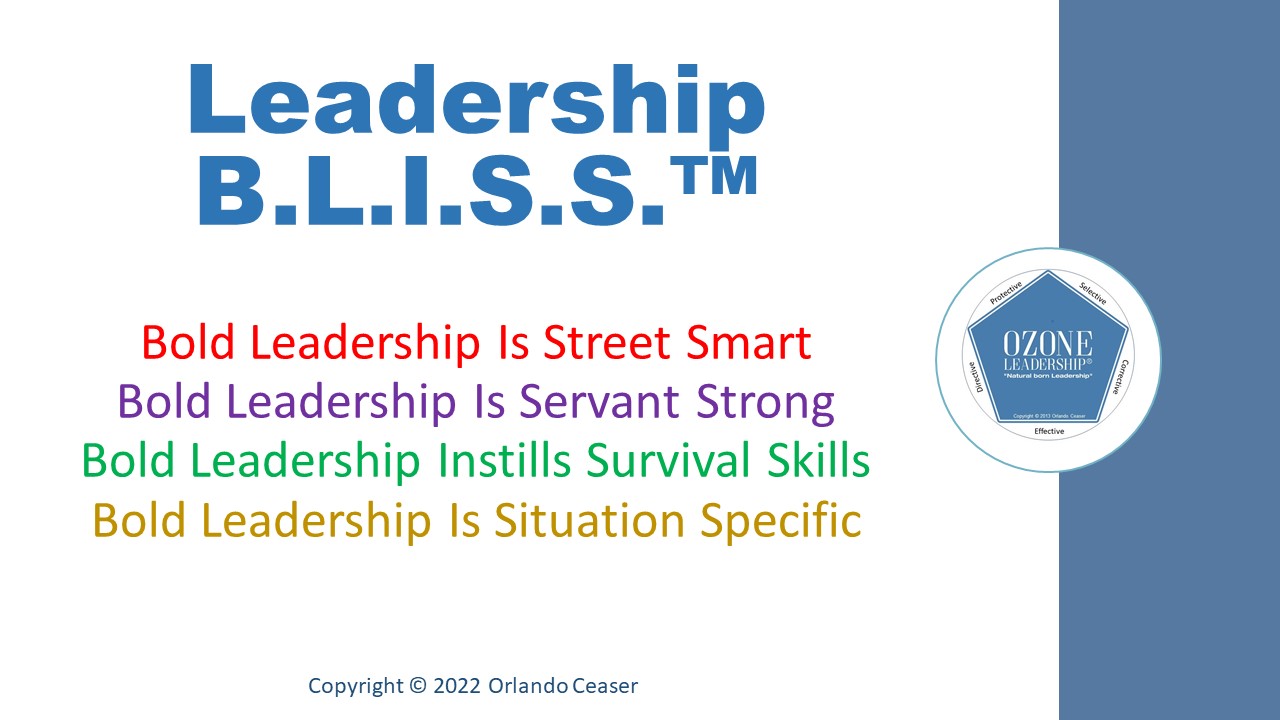
Leadership B.L.I.S.S.™ (Bold Leadership Is Street Smart)

When we think of bliss, we think of joy and happiness. Bliss is a feeling, a positive state of mind; a pinnacle of emotion. Bliss may be invigorating and satisfying. In this article, we will use bliss, as an acronym. B.L.I.S.S. will evoke a sense of power and boldness when it is linked to leadership.

  1. Bold Leadership Is Street Smart.
  2. Bold Leadership Is Servant Strong.
  3. Bold Leadership Instills Survival Skills
  4. Bold Leadership Is Situation Specific

Street Smart

Bold Leadership is Street Smart. It cultivates workplace wisdom and marketplace moxie. Bold Leadership appreciates diversity, equity, and inclusion and treats people with dignity and respect. Respect is the currency that influences the cooperation and coordination necessary to avoid danger and anticipate business downturns.

The Oxford Language Dictionary defines street smarts as “the experience and knowledge necessary to deal with the potential difficulties of life in an urban environment.” The practical application of this is being savvy enough to make the tough decision. A person demonstrating street smarts knows how to operate calmly under tough circumstances. They know how to conduct themselves in a crisis. They may have the expertise and instincts to avoid a crisis. Street smart individuals can navigate a hostile environment.

A person who is street smart has developed a heightened sense of awareness of their environment. They know diverse people and their tendencies.  They recognize cues and clues and respond in the appropriate manner through their words, body language, and actions. They are confident, but not too confident and move as if they belong in the area. They do not display an air of timidity. Their strength is just enough, not to seem confrontational. They know what to say and what not to say, where to go and where not to go; they flow as if they belong.

Bold Leadership is Street Smart. Certain aspects of street smarts can be taught and presented in a framework to help people increase their awareness. Through the powers of observation and simulations, we instruct our customer-facing employees to be friendly, and professional and to understand their surroundings. They dressed appropriately and did not bring too much attention to themselves. They cultivated relationships.  People befriended them and had their backs. They would not take unnecessary risks and be constantly following Principle Number 3 from my book Unlock Your Leadership Greatness. Principle Number 3 is becoming A Student of the Game, which means continuously learning information about their field and related areas, which includes learning about diverse clients and various circumstances.

Bold Leadership is street smart when it hires and develops toughness, resilience, and street credibility. It knows how to relate to people and pays its due to learn and understand people, backgrounds, and motivations.

Servant Strong

Bold Leadership Is Servant Strong; for it realizes its purpose is to serve others. Bold Leaders see employees holistically. Each person is an individual. I feel that “The leader must know the coordinates of each subordinate, so they can meet them where they are.” They want employees to bring their entire selves to work, engaged and participating fully. Being servant strong means empathy is an important element for engagement.

Servant Leadership is a term popularized by Robert K Greenleaf in his essay, The Servant as Leader. This concept focuses on the individual. The leader concentrates on meeting the needs of their followers. The leader’s mindset is, that if we serve or take care of the people, the people will take care of the business. Traditional leadership models are leader-focused. They were hierarchical and everyone in the organization worked for the people on top. In servant leadership, the leader works for everyone. This causes a different mindset and a shift in behavior. The Bold Leader asks questions, such as What can I do for you? Is there anything else that you need? And What else is required for you to be successful?

Survival Skills

Bold Leadership Instills Survival Skills; for it is developmental by nature. There are sets of skills and abilities that must be mastered if someone is to be successful. There are minimum standards that must be learned and graduate-level on-the-job training experiences that ensure long-term success.

Bold Leadership Instills Survival Skills; by ensuring that people are fundamentally sound and by setting high standards. Feedback is provided routinely to chart their progress. By setting high expectations, people develop into confident, courageous, and competent performers.

The survival skills make them feel safe and place them in a protective frame of mind. Unlock the Secrets of Ozone Leadership® is a book utilizing the protective attribute of the ozone layer to strengthen survival skills. Bold Leadership ensures safety is a key component of their lives.

Situation Specific

Bold Leadership Is Situation Specific; refers to its ability to shift to a higher gear when more is expected. Regardless of the situation, bold leadership can adjust to a crisis and deliver what is required for their people to develop. Paul Hershey and Ken Blanchard developed and described the concept of Situational Leadership. The idea was to work smarter and not harder and to provide leadership based on the employee’s development level. Less development required more direction; more development required less direction. There was a constant delivery of support and direction based on the changing development level of the individual. Work smarter and not harder. I would add the phrase, “because you don’t want to be a martyr.

It is imperative to add B.L.I.S.S. to our leadership. This will enable us to become street smart, strong servants, instilled with survival skills, and leadership that is specific to the situation. Inherent in any leadership philosophy and methodology is a list of do’s and don’ts that we pass along to others for safety, protection, productivity, and growth. When we obtain Leadership B.L.I.S.S.™, we must train it and envelop and develop it as a competency. Leadership B.L.I.S.S.™ (Bold Leadership Is Street Smart) is a critical leadership state with many success factors to benefit our constituents.

Copyright © 2022 Orlando Ceaser

Be More Interesting – BMI

Improve relationships, recruiting, culture, retention, and productivity

Be More Interesting (BMI)

Acronyms are nifty little devices that help us memorize concepts. Acronyms are excellent to create a mantra for repetition.

People look detached and disengaged in the presence of someone whom they feel is bland and uninteresting. They may be in a relationship with someone who is dull and appeared to be sucking the life out of them. The spark is gone, and an infusion of excitement is necessary.

My college roommate told a story of asking a question of a professor who was not very dynamic. At the end of an exceptionally long, drawn-out, boring explanation, the instructor turned around to find my roommate sound asleep and snoring. The class found this to be hysterical. I found it historical, standing the test of time.

Picture this; the first date through a dating app, two people sitting at a table and staring away from each other. They are floundering in meaningless conversation, losing interest by the minute. The situation would be much better if the parties were interesting and increases the likelihood of being interested.

The workplace may need revision to increase engagement and participation. Additionally, Recruiters can recall interviews where candidates answered questions with a lackluster demeanor. They were not able to sell themselves in a persuasive manner. They may have been suitable for hire, but their personality blocked their chances.

We remember speakers and teachers who were not able to hold our attention, which caused our minds to wander. We could save ourselves the trouble, and create livelier discussions if we could make ourselves and others more interesting. Therefore, we need people to BMI. I am not speaking about “body mass index” or the Broadcast Music Corporation; I mean to Be More Interesting.

Relationships

Relationships would be more fun, interactive, exciting, and engaging if people were more interesting. Personal development can lead to a life that is more fulfilling and enjoyable. Time is well spent and used wisely when we interact with people who have great content in their conversations. Imagine having a conversation with someone who consistently provided content that is intriguing, and humorous with a substantial amount of depth and clarity. I’m not necessarily saying that they are more intellectual, but they have depth and breadth of knowledge. Interesting could be cultivated by the following methods:

  • Read more, extensively traveled and educational exposure and life experiences.
  • A well-developed “HIT List” – refers to Hobbies Interests & Talents
  • Emotional intelligence and conversation skills emanating from self-awareness and people skills
  • A sense of humor that is not condescending, but has a hint of self-deprecation
  • A curious thirst for knowledge, as they continuously learn new things
  • Optimistic in their worldview and a positive approach to life and people
  • Empathetic and humble, while taking an interest in others

Work

Work would be more enjoyable if it were more interesting. It would be a place we would look forward to going to each day. If the work and the people in it were more interesting, productivity and culture would be amazing, especially if the interesting people were allowed to fully express themselves. Gallup’s research has linked engagement to having a best friend work. They also said that people do not leave companies but need managers. Imagine a company where managers had the requisite skills of being more interesting and more interested in the people. We could revolutionize the workplace.

Personally, we should do a self-evaluation to determine how interesting are we to other people. We could ask that question of our nearest and dearest friends and associates. But we can also ask them what could we do to increase our BMI. Take notes and try to put their suggestions into practice. Also, we could ask employees about the interesting elements in the workplace, i.e., leadership, work content, workflow, and coworkers.

Interest should not necessarily be equated to popularity and an extroverted personality. We are speaking of depth and our ability to tie your exposures, experiences, and expertise in a manner that others may find compelling.

You could also add adjectives to describe interesting. They may be;

  • Authentic, transparent, empathetic, humorous, caring, trustworthy, safe, creative, adventurous, supportive, goal-oriented, with a zest for life
  • Willing to help others succeed, generous and well-rounded
  • Loyal and less likely to leave their jobs, thus enhancing retention

When we are more interesting, our relationships flourish and our connections at work can be more vital, and productive. Being more interesting would enable us to be more creative, with less stress, and retain more information. If we adopted the mindset of BMI, we could transform ourselves, the workplace, and the people we connect with daily.

Copyright © 2022 Orlando Ceaser

The Crowd Pleaser Syndrome™ – Attention for Acceptance

The Crowd Pleaser Syndrome™

As early as I can remember, I had a craving for attention; a sweet tooth for popularity. Even when I was silent, I would look at people and want them to know me and notice me. I wanted attention, acceptance, and approval. They were my straight A’s. I wanted to play to a crowd or a small group. This Crowd Pleaser Syndrome™ (CPS) was my affliction, which fed my ego and drove me to success and notoriety. However, it also exposed insecurities and vulnerabilities.

I discovered that I was not alone, there were others like me. We needed the mentors and people who understood what we were going through. We did not have support groups to help us understand and cope with this beautiful character trait. Additionally, there were public and private assaults against our reputations for a variety of reasons.

An early manifestation of the CPS was an instance in grammar school, where I misbehaved and angered my teacher. This was during the era when teachers and corporal punishment were synonymous. The teacher called me to the front of the room for a spanking. I had the attention of everyone in the classroom. She asked me to bend over and face the class. She gave me a swift smack on my backside and sent me back to my seat. She was satisfied knowing she had dispensed justice and I felt great, knowing I gained the recognition I needed.

The Crowd Pleaser Syndrome™ is present and prevalent. It shows up at work, as individuals please their peers and supervisors. There is a tendency to deliver good news to the boss in the form of withholding negative information or results. People do not fully disclose information to analysts and the public because of the negative stock implications. Employees may be too aggressive and take unnecessary risks to look good personally. The Crowd Pleaser Syndrome™ may infuse us with the desire to win at all costs.

Crowd pleasers realize at an early age, their ability to entertain others. They may have engaging personalities and athletic and the musical prowess. Here are more Crowd Pleaser Syndrome™ characteristics.

Crowd Pleaser Syndrome™

  • Confident risk takers
  • Highly active in social and professional gatherings (parties and meetings)
  • Work hard to stand out from the crowd
  • Seek acceptance on Maslow’s Hierarchy Needs (belonging)
  • Thrive on competitive activities
  • Develop attention-getting behaviors, strategies, and tactics

Unhealthy Challenges

  • Workaholism and lacking balance by focusing only on the area giving them stimulation
  • Unethical conduct may suppress the competition and put others at risk
  • Failure to share the limelight, especially in developing others, and giving credit on group assignments
  • People tried to sabotage their careers
  • They meet the needs of others and deny themselves
  • Put others first to their personal detriment

Popularity is a stimulant which can have positive and negative effects. The Crowd Pleaser Syndrome™, when managed properly, can have a profound effect on performance, relationships, group culture, and the development of individual strengths. CPS individuals can entertain, educate, enrich, and inspire us to achieve the greatness inherent in each of us to make this a better world.

Copyright © 2021 Orlando Ceaser

Website: OrlandoCeaser.com

Watchwellinc.com

MSU (Making Stuff Up) – Credibility and Creativity

MSU C (2)

I began speaking about the concept of MSU in 1986 when training sales representatives as a Regional Operations Manager. A few representatives, when faced with a difficult question, tried to bluff their way through their answers to tough questions. Their responses contained misinformation and outright lies. A few of them demonstrated unbelievable creativity under pressure to make up fantastic stories but distorted the facts. I was rather angry because we took the truth very seriously. We boasted to have one of the best trained sales forces in the industry. You had to achieve 90% to pass our product examinations. We stated the company policy around misinformation. Their credibility and the company’s reputation was on the line, therefore MSU was forbidden. We would not tolerate MSU (Making Shit Up). I apologized for the language, but it was a profoundly serious matter. Additionally, we told them that it made them look stupid because the doctors probably forgot more about medicine then they would ever know.

I must admit that some of the responses were rather creative. We applauded creativity but not in the dissemination of product information and following company policies and procedures.

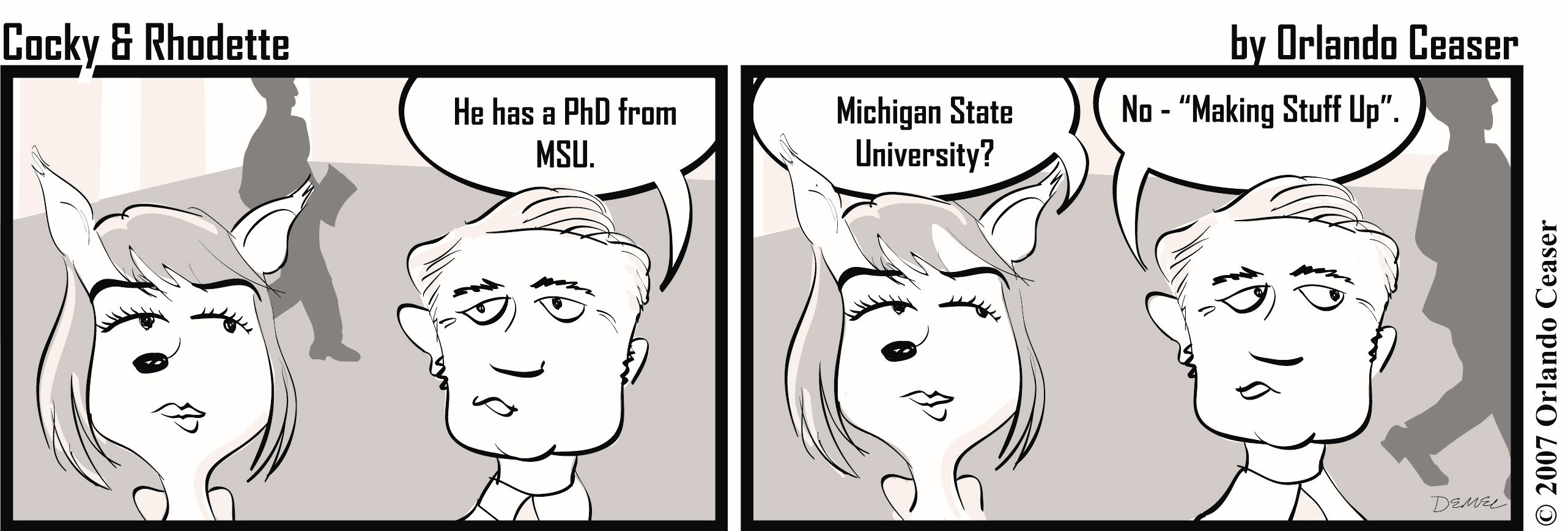
MSU was such a catchy concept that we included it in our regular training vocabulary. We would openly talk about Making Stuff Up and the dangers of resorting to that practice in answering physician questions. MSU had value as it related to creativity and other areas. When I introduced the concept of MSU I would state that it did not stand just for Michigan State University.

Years later we were training physicians on presentation skills. I decided to drop in on one of the sessions. I noticed that on one slide were the letters MSU. This piqued my curiosity and I sat for the session. The presenter opened the session by saying he wanted to talk to them about MSU and it did not just stand for Michigan State University. It stood for Making Stuff Up. I was impressed but, I sat there speechless. I did not recall reading about MSU before that fateful day in 1986 in our sales training seminar.

15 years later I was in my office as an Area Sales Director. One of our trainers (Field Development Leaders) gave me a book. The book was titled MSU (Making Something Up). And 10 years later in Zambia, South Africa, one of our pastors conducted a workshop on MSU, Making Stuff Up; obviously, it was a well-established concept.

MSU is therefore a viable practice. It is a catalyst for creativity and a warning. We must use it wisely because authenticity and transparency are required to enhance your credibility. As a leader, is important to be aware of MSU and how adopting this mindset can be used to make decisions, answer questions, solve problems and enrich our world through creative thinking and innovation.

Copyright © 2020 Orlando Ceaser

Websites: OrlandoCeaser.com

watchwellinc.com

What is your From – To Story (FTS)?

Goals
Constantly, we are exposed to stories that grab our attention. They are tales of unbelievable struggle, growth and accomplishment. People have overcome tremendous odds the and circumstances to arrive at an unforeseen destination. They may be classified as from rags to riches, from poverty to higher education, from homelessness to home ownership or from working as a janitor to becoming the principal of a school. These stories show the power of the human spirit; the magnificence of vision, goal setting, perseverance, generosity, luck and encouragement.

Our hearts were warmed a few years ago by the story of a Ted Williams, a homeless man who was called the Man With The Golden Voice. He was given a job making commercials and later returned to radio. When you think about your life, you can also create your own personal From – To Story. Look at a point in your life, a different job or think of your current position or objective in life. Where were you? Where are you? Where do you want to go? What do you want to become? What is your purpose, your destiny or your goal?

When I was younger, I would read about individuals who stated that they were the son or daughter of a sharecropper. Their bio would state, from a sharecropper’s son they rose to the position of president of their own company; from a single parent to the position of a medical doctor; from the inner city to a position in higher education. I have known individuals who have gone from an administrative assistant position to a position in sales management. These examples are all around us.

You know who you are and where you’re From, now it’s up to you to establish, what is your destination, or more specifically, what is your To? What is the right To for you? Before you arrive at your ultimate destination, there may be a series of stops along the way, therefore, there may be multiple To’s in your forecast, in your future.

What does your dream scenario look like? What is the tagline that you would want attached to the beginning of any description of your life and accomplishments? Fill in the blanks below to give yourself some practice. Thinking about your responses may fill you with a sense of accomplishment, on how well you’ve done and how far you’ve traveled. It may also show you, how far you must go and serve as a reminder of your purpose, destination and destiny.

From ________ To ___________.

From ________ To ___________.

From ________ To ___________.

From ________ To ___________.

From ________ To ___________.

I wish you success on your journey. I look forward to the day when we can discuss where you are From and your arrival to the To that is right for you. Your, From – To Story (FTS) will be a benefit to you and enrich the lives of others.

Copyright © 2019 Orlando Ceaser

Authenticity Messages from The Scrolls of Greatness™

Mothermirrorlion1
There are countless archaeological discoveries that add to our knowledge of earlier civilizations, cultures and beliefs. You heard the stories of individuals stumbling upon a discovery, which greatly increased our knowledge. There may be scrolls of information in the earth that enlighten our paths.

There are scrolls of knowledge within you that validate your greatness. These texts confirm the greatness within you. The question is, how will you search through the caves, caverns and catacombs of memories and earlier instruction, to recover and discover knowledge and wisdom to achieve your grander purpose.

There are messages on authenticity that I gleaned from my excavations. They will ultimately be published in a future work entitled Scrolls of Greatness.

An Authentic Life

“Is your life a quotation or a paraphrase of the life of another or is it the original authentic paragraph God has written for you to include in His magnificent manuscript?”

Authentic Faith

“Most of your knowledge is based on faith. You were exposed to information packaged and provided to you by strangers and people you know. You are placing a lot of faith and trust in the character, motives and authenticity of others, which is the way it should be, because you cannot verify everything.”

Authentic, Non-manipulative Love

People should know that you genuinely love them; authenticity without manipulation. You want them to be happy, expecting nothing in return, no strings attached. I told a group of students that I drove an hour and a half to speak to them and I was not being paid for it. I wanted them to know that there are people who love them and expect nothing in return, but their excellence. We must learn to give back and I was compelled to do this, because it was done for me. “A young man spoke,” I wouldn’t do it, if I was not getting paid for it.” I responded, “If you thought as highly of you, as I think of you, you would do it, because I know you are worth it.”

Forgiveness

“Forgiveness should not dependent on receiving an apology or the knowledge of an impending apology. It may not be automatic. It may be difficult. But it should be authentic when experienced and expressed.”

Observations

“Many times, your words should serve as an observation and not a critique. However, there will be times when the order should be reversed. Authenticity improves the power of your communication.”

Share the Journey

“My message seems more powerful when I profile my pain. When I accept the blame,
I seem human. When I discuss my shame, I am vulnerable and real. People relate and identify with me when they can connect and feel that I am genuine, with good intentions.

Sometimes we do our journey a disservice when people only see the finished product and not the rough parts of our development. A glimpse into the construction, deconstruction, destruction and production processes, will heighten their awareness and appreciation of our struggles and what it takes to be successful. We will connect. The authenticity of raw, without disclaimers, and revealing our flaws, will open people to our stories and increase our chances to inspire growth.

The world wants to know how we made our names, the obstacles faced and how we overcame. Otherwise, people will surmise, we obtained the prize and never made mistakes, always received the breaks, were never afraid, that we possess a passing grade, but it was easy, and we always had it made.”

Copyright © 2019 Orlando Ceaser
OrlandoCeaser.com
Watchwellinc.com

Think About It – Use the Word Drink to Trigger Motivation

Think in moderation (2)
I was driving home from work and drinking commercials began to flood my mind. I did not question their arrival, because that is one-way creativity works for me, through random associations. However, it was rather curious, since I don’t drink alcoholic beverages. The power of their advertising messages interrupted and hijacked my thoughts. Advertisers will go through tremendous lengths to convince consumers to buy their beverage when they are thirsty. They are powerful enough to make you thirsty. Their messages were very pervasive and persuasive.

Advertisers study us to see what makes us tick, our needs and then they portray their product as the solution. Advertising has a powerful influence over our thoughts and actions. This influential medium, through the power of suggestion, sells billions of dollars’ worth of beverages of all kinds. They exploit our need to be sociable, free, important, accepted and included. They even have adorable consequences that we don’t think about. One day while driving with my three-year daughter, I was drinking an orange beverage, when she responded, “Daddy, you don’t suppose to drink and drive.”

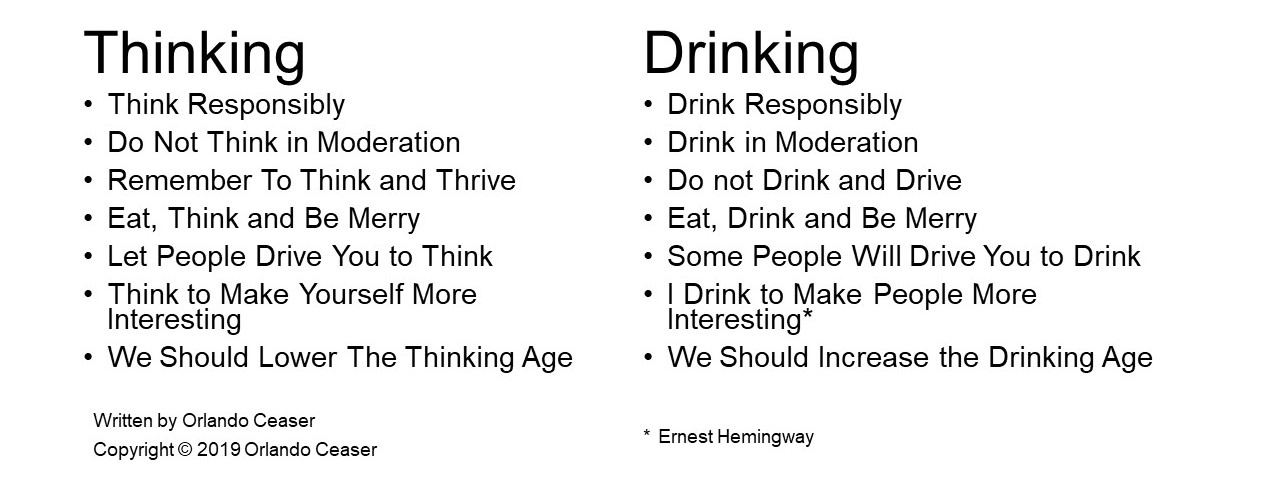
I was preparing for a presentation and therefore, doing a lot of thinking about thinking. The notion of thinking about drinking was fascinating. I wondered if I could substitute the words think and thinking in place of drink and drinking in many of the ads. I engaged in a mental exercise to insert the word think or thinking into the language of commercials or sayings about drinking. The results were interesting. One classic tagline in drinking commercials advises people to drink responsibly. I converted that phrase to say we should think responsibly. It worked. The phrase eat, drink and be merry, became eat, think and be merry. This could show the impact that thinking has on happiness.

If we could successfully make the mental conversion from drink to think, every time we heard a commercial, that would be a powerful trigger. We could use it to reinforce thoughts and behaviors, whatever the beverage being emphasized. This could, therefore, be a bonus for many of us.

As I stated earlier, association is an important creativity exercise. In association, you identify, link or relate something to another object. This causes you to not think of one without thinking of the other. We could conduct this practice in many other situations. Additionally, association is an effective memory device.

Here are seven key phrases that we should look for in commercials about drinking and other drink related conversations. The original phrases will serve as a trigger, a subconscious response to the need to reference thoughts and ultimately behaviors to enhance our thinking. We can look forward to the instructive nature of this exercise and its ability to elevate the art of thinking in our everyday lives.

Think About It (3)
It is important to open to the creative process and through association, we may come up innovative ways to address and tackle important issues. But we must be able to consistently, think about it.

Copyright © 2019 Orlando Ceaser

Are You A Tonic Or A Toxin?

Tonicortoxin4thmonk (2)
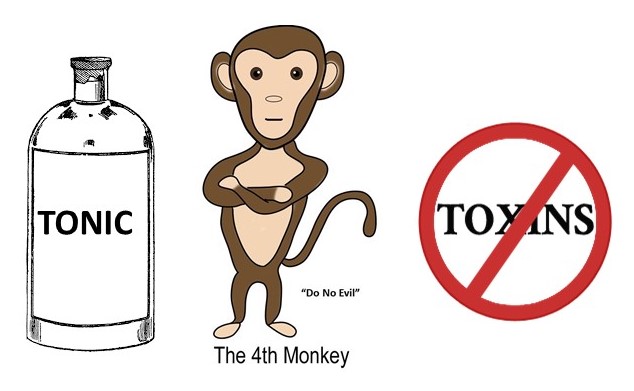
Are you a tonic or a toxin? The 4th Monkey advises you to do no evil. Is your presence positive, beneficial, and invigorating or are you negative, detrimental and draining? The answers to this question will suggest whether you are a positive or negative influence on the lives of others.

Tonic

Do people walk away from you feeling, as if their spirits have been uplifted and inspired to have a great day? Are you epinephrine or adrenaline to someone needing a boost in their mood and enthusiasm? Are you an encouragement, a refreshment, a positive dose of energy? Are you the personification of Red Bull, 5-hour Energy or any other vitamin drink you can fathom?

My father loved Western TV shows. Invariably, there was an episode with a traveling medicine man. This salesperson would have an elixir which he swore would cure everything. This amazing tonic was exactly what the people needed to feel better, instantly. The medicine man was usually a Charlatan and the elixir / tonic was usually 80% alcohol. Nonetheless, the tonic was viewed as a positive concoction.

If you are a tonic, people walk away from you feeling stronger, more positive and capable of success. Your actions are viewed favorably. When you are a tonic some of the following attributes are noticed.

• You are often invited to meetings and social functions
• People enjoy your presence and positive / constructive contributions
• People want to be around you
• People want you on their team, department or organization
• People learn from you and feel their careers are being enhanced
• People go out of their way to say nice things to you and about you
• You are sought after for advice, coaching and mentoring opportunities
• You are inclusive and ensuring that others are involved
• People recommend you and your services
• People do not hesitate to be your cheerleaders
• People want to work hard for you and do their best work

Toxin

Are you a toxin? Are you a slowly debilitating individual that sucks the life out of people and drains the energy in the room? Do people walk away from you feeling tired, irritated, weak in their demeanor and worst for having interacted with you? Are you the killjoy, the party pooper, the person elected most likely to impede? Do people change their direction to avoid you and to go out of their way not to invite you to their gatherings? If you answered yes to any of these questions you are a certifiable toxin.

The toxin is a poison. When they are added to a team, organization or social group; joy, productivity and progress are diminished. The toxin may include the following signs:

• Negative attitude and negative input to conversations
• Always have a negative, opposing view
• Will always suggest why things will not work
• The official carriers of gossip and negative news and expectations
• Politically dangerous due to the number of enemies they make
• Do not know when to be quiet
• Possess poor emotional intelligence skills (EQ)
• Believe they have all the right answers; condescending and arrogant
• Chronically disengaged and encourage others to follow their negative example
• Work to undermine programs, progress and performance
• Chronic complainers without solutions
• When people walk away, they feel listless, tired and mentally and physically fatigued
• Dissatisfied with work, constantly looking for a new job, but they never leave

Toxins are to be purged from the body and cleared by the organism / organization. This cleansing will improve health and enhance longevity. The word toxin immediately recalls images of pollutants that are hazardous to our bodies, health and well-being. Both words, tonic and toxin are applicable to our daily lives, which includes our interactions with people and our environment.

Being a tonic or a toxin can also apply to the workplace. Is the workplace a tonic, which enhances your spirits and personal growth or a toxin that intoxicates, paralyzes and brings you down?

Whether work is a tonic or a toxin can have a profound effect on your mood and development. They can influence whether you look forward to going to work every day or dread this daily ritual. A tonic can have a positive effect on your health and your interactions. However, a toxin can affect your attendance and be harmful to you and everyone who encounters you.

A toxic work environment can damage employees and make them irritated, frustrated, frightened and nervous. A tonic personality can be influenced by toxic character traits; breaking down their positive job outlook and their outlook on life. A change in leadership, location and environment may be the necessary therapy in extreme cases of toxicity. Conversely, inserting a dose of positive tonic is like delivering a breath of fresh air into a toxic workplace.

The question of the day, the question for reflection is, “Are you a tonic or a toxin?” When you determine the answer to this question. You must take the necessary steps to enhance or correct your status.

Copyright © 2019 Orlando Ceaser
Tonicortoxin4thmonk (2)