DEI Essentials

Profitable Possibilities

DEI Essentials 
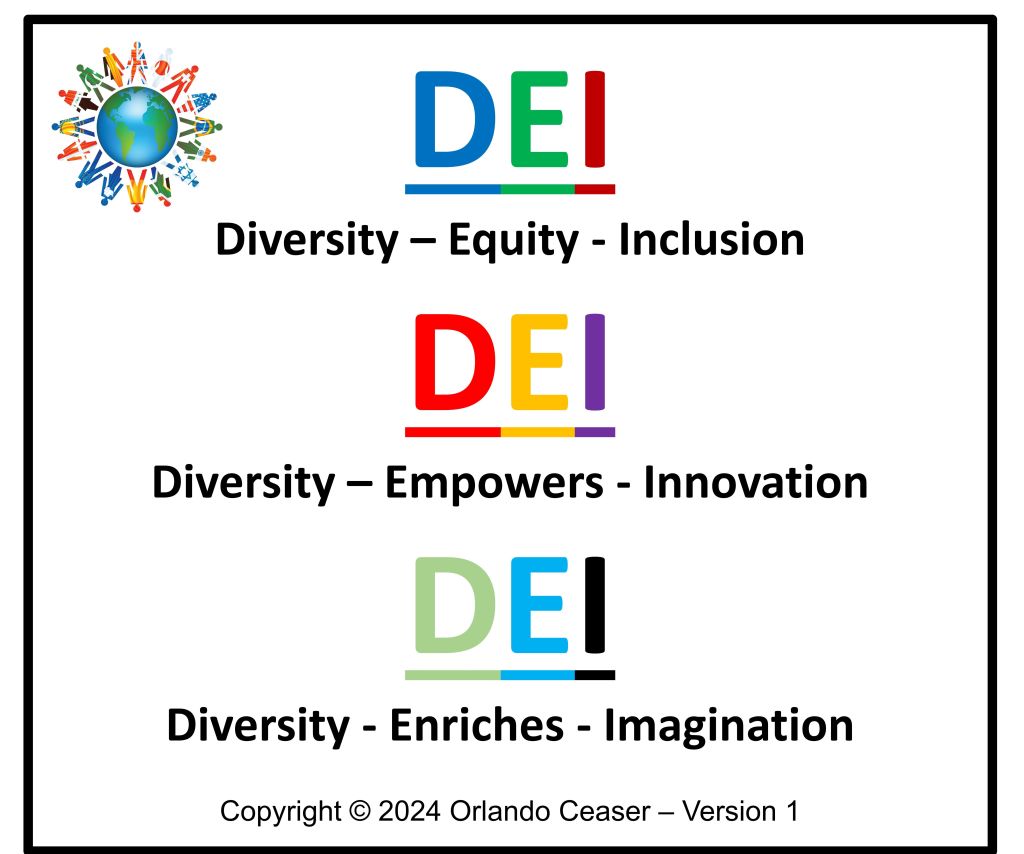
DEI stands for Diversity, Equity, and Inclusion, but there are many positive variations on these words that express the intent of the strategy and tactics for everyone.

DEI is the code of discovery that can unlock new paradigms of potential, imagination, and innovation. People think of DEI as separate from meritocracy, however, fairness would suggest that equity is essential when measuring and rewarding performance. DEI Essentials is a phrase to describe the necessary and seldom considered attributes associated with diversity, equity, and inclusion. These positive expectations and ancillary benefits are constructive. When DEI Essentials are present, there is synergy formed with the interaction of diverse and creative exchanges. They affect us on a personal and business level, enhancing decision-making, problem-solving solving and innovation. It is imperative to isolate and identify these assets to engage minds and develop better solutions.

DEI Essentials extract the best from everyone, creating a climate where dignity, respect, empathy, cooperation, and compassion are natural values. The results are a coordination of resources and ideas that lead to innovation and successful interactions. As we encourage fairness, involvement, and ingenuity, we set up an inclusive environment where people care and share, and dare to declare their greatness through strengthening relationships. We must maintain the desire to build relationships and cooperation, for they are critical to success.

“Diversity, equity, and inclusion

Must endure the chaos and confusion;

And emphasize positive potential,

And focus on DEI Essentials.”

  • Orlando Ceaser

DEI Essentials are necessary components if we want to achieve the ultimate state of effectiveness. They contain bedrock values and are the cornerstone of a thriving enterprise. They allow us to continuously push the envelope to greater frontiers. It is built on open representation, equal access to opportunity, and stimulating contributions to ensure people bring their best talent and ideas to the table. We are tapping into reservoirs of potential and possibilities.

Diversity Essentials

Diversity Essentials are characteristics that manifest our uniqueness, variety, distinctiveness, and perspectives. We developed our character through education, culture, exposure, experiences, and expertise. Diversity Essentials comprises the ways we are different, including the visible and invisible, seen and unseen. It captures the different generations and their interests. Baby Boomers are eliciting the talent and genius of Generation X, Millennials, and Gen-Z. It is an invitation to all people and ideas.

When we look at a definition of diversity, everyone should see themselves in it. We may be altruistic to a certain extent, but we need to see ourselves featured to feel as if we belong; for inclusion is a natural desire.

More of the distinctions and descriptions that describe how we are or how we feel are as follows.

Ability status, age, background, citizenship status, class, culture, development stage, educational level, ethnicity, extroversion, family status, function, gender, generation, immigration status, introversion, language, leadership styles, learning styles, life experiences, life styles, love languages, mindsets, national origin, organizational levels, other, outsider, personality types, physical attributes, political affiliation, race, regional origin, religious beliefs, sexual orientation, socio-economic status, spirituality, thinking and working styles.

Diversity Essentials are strategic business decisions that ensure that company personnel and representation reflect the customer base, community, and availability of talent. They are spontaneous revelations that believe in Win/Win situations. Diversity is more than race and gender. It is not a monster or the boogeyman to cause fear and loathing. It wants us to cultivate our abilities for the widespread improvement of projects, people, teams, countries, and the planet. Where it is practiced, organizations thrive financially in a robust culture of cooperation and innovation. Joel Barker, a Futurist who popularized paradigms and paradigm shifts, said, “Societies and organizations that most creatively incorporate diversity will reap the rewards of innovation, growth, wealth, and progress.” He also said many innovations are attributed to the outsider because they bring diverse perspectives to an opportunity.

Diversity Essentials recognizes our special nature and characteristics. We benefit extensively from the fortuitous value of working together and learning from each other.

Diversity Essentials harmonize these traits in an environment of acceptance and belonging, which allows each individual to be free, fulfilled, and fruitful.

Equity Essentials

Equity Essentials cultivates respect for fairness and the potential to be treated fairly to reach our potential to express our greatness with unfettered access to opportunity. There is an expectation of excellence. Meritocracy is a key component because the organization cannot function successfully unless it is staffed appropriately with hard-working, highly skilled employees.

Equity Essentials must be established and verifiable to potential and current employees, as well as investors. Equity Essentials assures us that we are attractive to top talent. People are attracted to places where sound, enforceable policies are in place. They wanted to be treated fairly in a setting of equal opportunity. Employee reaction should be validated in company surveys and individual conversations.  People do not feel they have an equal opportunity where favoritism and nepotism run rampant without leadership emphasizing fairness. It is one thing to have written policies against favoritism and nepotism, but if they are not enforced, they are meaningless.

Equity Essentials provides feedback on micro-inequities, bias, acceptance of generations, and increasing engagement levels. They educate us and improve our awareness of anomalies that are barriers to high performance. Integrity is an integral part of our operations, and we must elevate and celebrate core values that reflect who we are and want to become.

Inclusion Essentials

Inclusion Essentials are premeditated acts to involve others. We are pieces to puzzles and may contain missing perspectives and ideas for concepts, programs, and problems. We may have what is needed for the evolution, development, and growth of our peers or mankind in general. We cannot afford to isolate individuals who may hold the keys to our success.

Inclusion Essentials may manifest as practices, rules, and regulations that establish a climate of access and full participation. People want to be accepted in an environment of authenticity where they genuinely belong. When people know that they are valued and aligned with high expectations, in a caring group, they will not want to disappoint us. When we hold them accountable and solicit their contributions, they will stand up and stand out. There is joy in being part of something larger than each individual. They will bask in the association of being connected to fulfilling and worthwhile work.

DEI Essentials flourish, as it nourishes inquiry, constructive relationships that lead to better coordination, problem solving, and reduced conflict.

DEI Essentials promote a level playing field where individual talent and effort are encouraged and rewarded. People willingly release energy and discretionary effort as they engage in excellence and are committed to a cause greater than themselves.

Copyright © 2025 Watchwell Communications, Inc.
DEI vs VEI – “Variety is the Spice of Life, Imagination, and Innovation”

DEI is a strategy to alter the climate in the workplace, build company culture, and capitalize on different talents and perspectives. It reflects customers’ makeup and ensures that many groups are represented. DEI is also necessary to ensure that organizations have a workforce that meets their staffing needs. However, despite its intent and documented positive results, DEI is controversial. Many believe that when DEI is implemented correctly, it is effective and has company and employee benefits.

The word diversity is primarily linked to affirmative action and reverse discrimination. Diversity is more than race and gender, but some people fail to see this. DEI applies to many valuable attributes and creates an environment where innovation can enhance teamwork and improve company culture. Equity and inclusion should be human rights. A successfully implemented DEI strategy in your culture is a win-win proposition. Additionally, it helps employers staff organizations today and in the future.

The variety among members of our species is visible and invisible. We have idiosyncrasies, peculiarities, and eccentricities that make us stand out from our peers. People should realize that their uniqueness is not a weakness, but a viable asset. DEI allows this to happen.

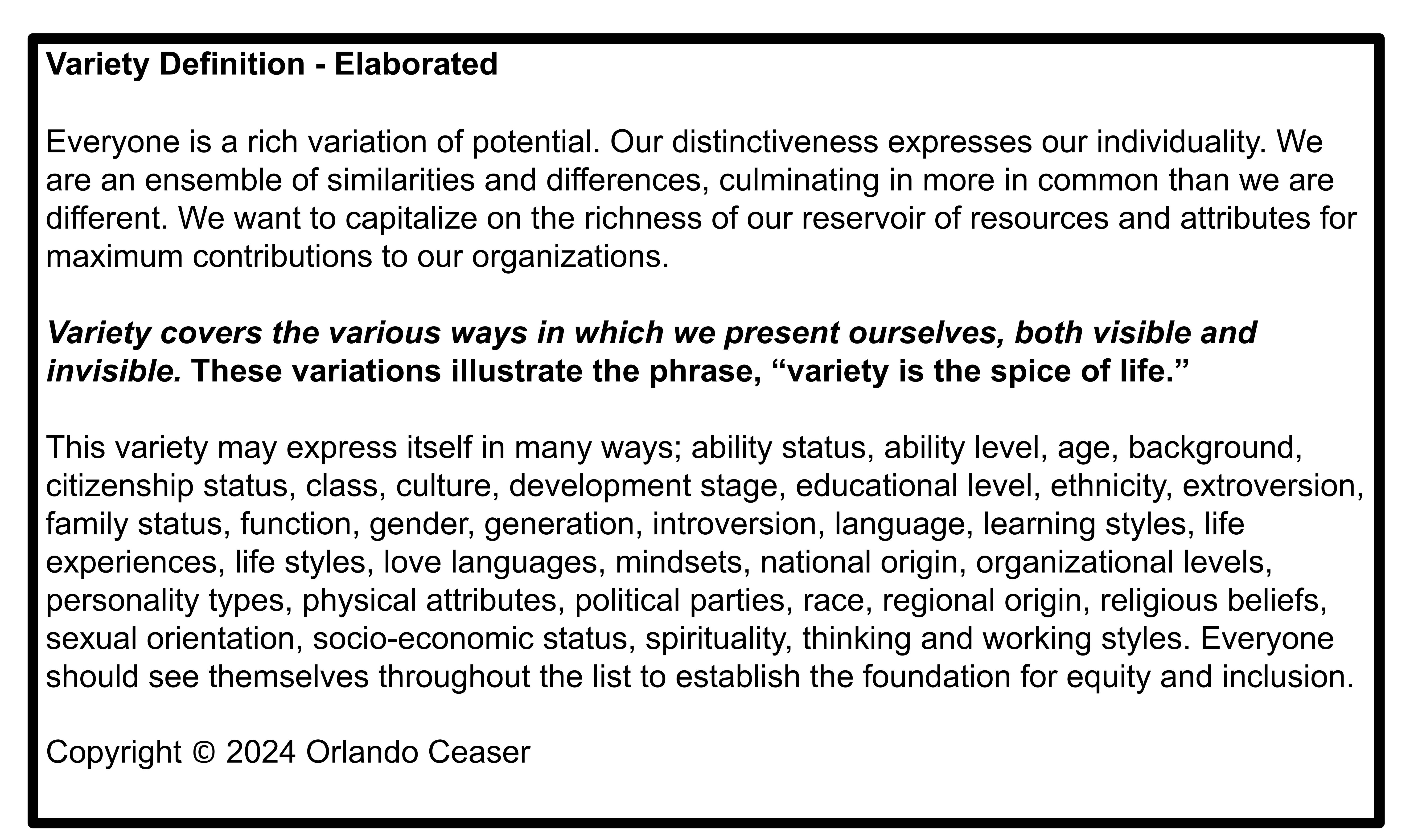
Consider the following kaleidoscope of values that highlights our differences. Everyone should see themselves in multiple words in the definition. When this is observed, it is not seen as a special program only for particular groups of individuals. Additionally, one does not feel left out and excluded.

Despite challenges to DEI, many organizations have remained steadfast in their commitment because they have seen the business transforming power of DEI. However, others have removed their support, due to pressure and negative impact on business. For example, consider the situation with Bud Light sales when a boycott was engineered after a social media post featuring a transgender actor. Bud Light went from number two to number three in sales and they had to shuffle company executives to distance themselves from the controversy.

Eliminating DEI programs prevents people from experiencing and benefitting from the fullness of DEI. Resistance to history, unconscious bias, micro-aggression, micro-inequities, and other diversity training are lost opportunities to better understand each other.

I propose the ‘V’ word, as a replacement for individuals confounded by the ‘D’ word. The principles present in DEI are valuable to all employees. We want to create an accepting, fair, inclusive, and belonging climate. Ultimately DEI can influence imagination and innovation. Variety should be used to accentuate our similarities and differences for growth and development.

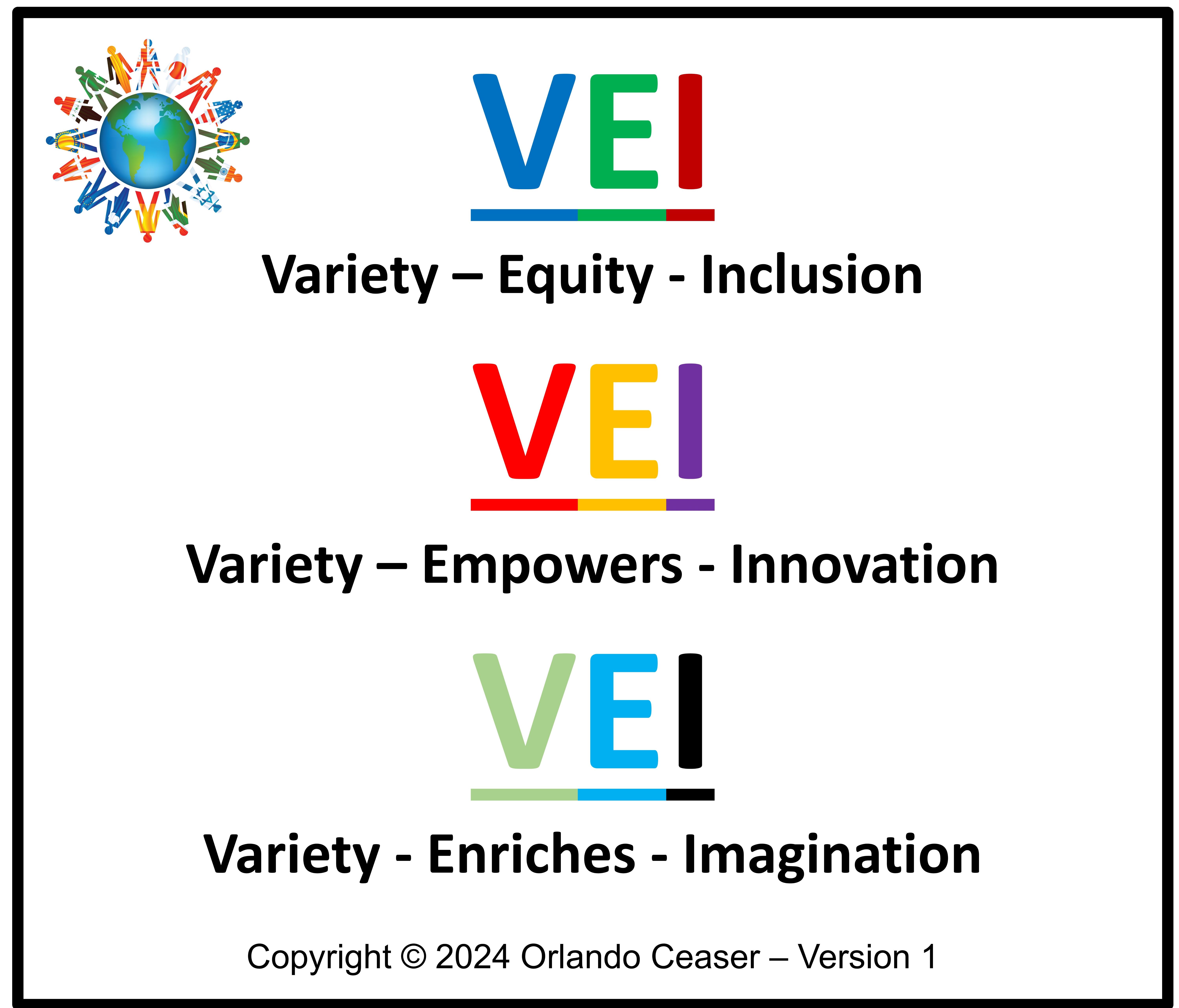
Variety in the acronym may minimize controversy. I reworked the chart using variety as a neutral word for diversity while maintaining the highlights.

VEI addresses the advantages of our distinctiveness. We can enhance value by creating a positive company culture, where individuals and teams perform at a higher level.

Everyone has distinct qualities that make us unique. Variety as a replacement word may allow people to come to the table and use their various and sundry skills to bring out the best in everyone for the good of everyone in the enterprise. My premise is that substituting ‘Variety” for “Diversity” will help us achieve benefits for all employees.

Copyright © 2024 Watchwell Communications, Inc.

DEI & Rudolph the Red-Nosed Reindeer – “Uniqueness is not a weakness”

Gene Autry was a military hero, who became an actor and singer. He sang the Christmas classic, “Rudolph the red-nosed reindeer.” It is a delightful song, enjoyed by young and old. However, this cheerful song delivers a powerful message about encountering and handling differences. Let us examine Rudolph the red-nosed reindeer and its meaningful conversations about diversity, equity, inclusion, belonging, and accepting others.

The song begins with a reference to the reindeer popularized in Clement Clarke Moore’s, “The night before Christmas”, also known as “A visit from St. Nicholas.” It begins with a roll call of Santa Claus’ reindeer that of course omits the name of Rudolph. As you recall, Rudolph was different from the other reindeer because of the luminescent quality of his nose. His nose was so shiny that it had either reflective qualities or it glowed like a light. This was enough to make him the object of ridicule and ostracism by the other reindeer.

This lack of acceptance is seen when children and adults are confronted with someone who is different from them. Our initial response is to make fun of the person and then isolate them because of their characteristics, traits, heredity, or idiosyncrasies. We may recall when we were young and begged for acceptance and approval. Even to this day, there is something about us that makes us stand out from the crowd. We feel self-conscious and wish that our difference could go away. If possible, we will change our stories and appearance so others will like us. When we are new and different, we carry a tremendous unnecessary burden. We view our “uniqueness as a weakness.“

At work or in school, simply being the new person, the new kid on the block, the person who is unknown, becomes a source of teasing or isolation. We often wondered,” if they would only get to know me, they would see that I’m just like them. I am a good person. “Rudolph was a reindeer, so he surely had a similar appearance, except for his nasal peculiarity. But suppose he was of a different color, from a different region of the country, or had a different ability. We usually ask the different parties to fit in, when the real focus should be on including and accepting them into the group.

Bullying is also a response shown toward those who are different. The song does not indicate that Rudolph was bullied, but we can only assume that preventing him from “playing in any reindeer games” was not accomplished in the most delicate manner.

The song does not tell us what Santa Claus was doing during the hazing or if he even knew about it. But, as a good leader, he engineered a very strategic response. He knew the talent and value of all his reindeer. He evaluated the weather system for his next journey and realized he was going to encounter many blizzards. He knew the problem could be solved by the reindeer, but he needed to show his acceptance of Rudolph the talented reindeer. The leader has vision and can often see what others cannot.

Santa Claus knew the skills and abilities of each reindeer. He knew that the appropriate circumstance would allow for each skill to be revealed. He knew Rudolph had a special gift and could provide navigation assistance on those wintry nights when delivery of toys to children around the world, would be difficult. Snowstorms would provide opportunities where others, including the reindeer, could benefit from the gift of Rudolph, the red-nosed reindeer.

We can give Santa credit for waiting for the appropriate time to unveil his strategy. He could have given the reindeer the opportunity to work it out amongst themselves, as so many people do in similar situations. We would say such things as,” kids are just being kids, learning to navigate tricky situations will only make the recipient stronger and teach them valuable life skills. We say that which does not kill them will make them stronger, to paraphrase Friedrich Nietzsche the philosopher. The reindeer performed similar initiation rites to others in the group that had other distinctions from their peers. They saw their treatment of Rudolph as being harmless and natural.

The defining moment came,” one foggy Christmas Eve, Santa came to say: Rudolph with your nose so bright, won’t you guide my sleigh tonight?” Many managers, leaders, and parents look for the opportune moment to use the skills of their people; the right moment to show the world and the individual their true value. However, it would be prudent to consistently look for ways to utilize the talents of their people. They should know the coordinates of their subordinates, so they can meet them where they are.

We can only assume that in the fictitious conversation, Santa’s encouraged Rudolph and told him about the value of his difference. He made him feel that he was something special and should never feel that he was not important and did not have a place. I’m sure he made him feel like an essential member of the team. He validated his worth by asking him to lead the team by moving up to the front of the line.

You remember the successful conclusion to the song. “Then all the reindeer loved him, as they shouted out with glee, Rudolph the red-nosed reindeer, you’ll go down in history!” We know that in life, responses to differences may not always lead to a happy ending. Sometimes the individuals have lingering insecurity, damage to their self-esteem, and underlying resentment from the initial exclusion. But, when the difference that is ridiculed or denied is used for the benefit of the group, the organization, institution, family, or community becomes more vital. Everyone learns a valuable lesson about diversity, equity, inclusion, belonging, and acceptance. We are hopeful that when the person is accepted, they don’t become complicit and act in the same manner when they encounter other people who are different.

Suppose we remember the Rudolph days of our lives and commit ourselves to preventing them from happening to others. In that case, we will maximize their future contributions to our teams, families, organizations, and communities. We will perform a noble act when leading by example with the lessons learned from Rudolph the red-nosed reindeer.

Unlock Your Leadership Greatness and other leadership resources can be found at OrlandoCeaser.com or amazon.com.

Copyright © 2013 Orlando Ceaser

The Magic Words to Openness and Belonging

One of my favorite stories was Ali Baba and the 40 Thieves. What I remember most is the secret words that opened the side of the mountain and revealed a phenomenal treasure. The magic words were, “Open Sesame.” I often wish there were such a phrase we could use in our interactions with people. This iconic phrase would make them feel comfortable enough to share their inner treasures with us. When they are comfortable, accepted, and included, suspicion would disappear. Defense mechanisms would not be activated, and evasive tactics would not be employed.

In our current environment, we need to understand people who are different from us. We value diversity, equity, and inclusion. However, employees often wear invisible self-preservation armor for protection. How can we share our interests if we are not comfortable with each other? Silence, lack of participation, and minimal interaction are diversionary methods. They may seem like a good idea, but the lack of openness may be counterproductive. I support an environment which is an OASIS (Open And Share Information Safely). People in this climate will unleash their full potential and feel a sense of belonging at work.

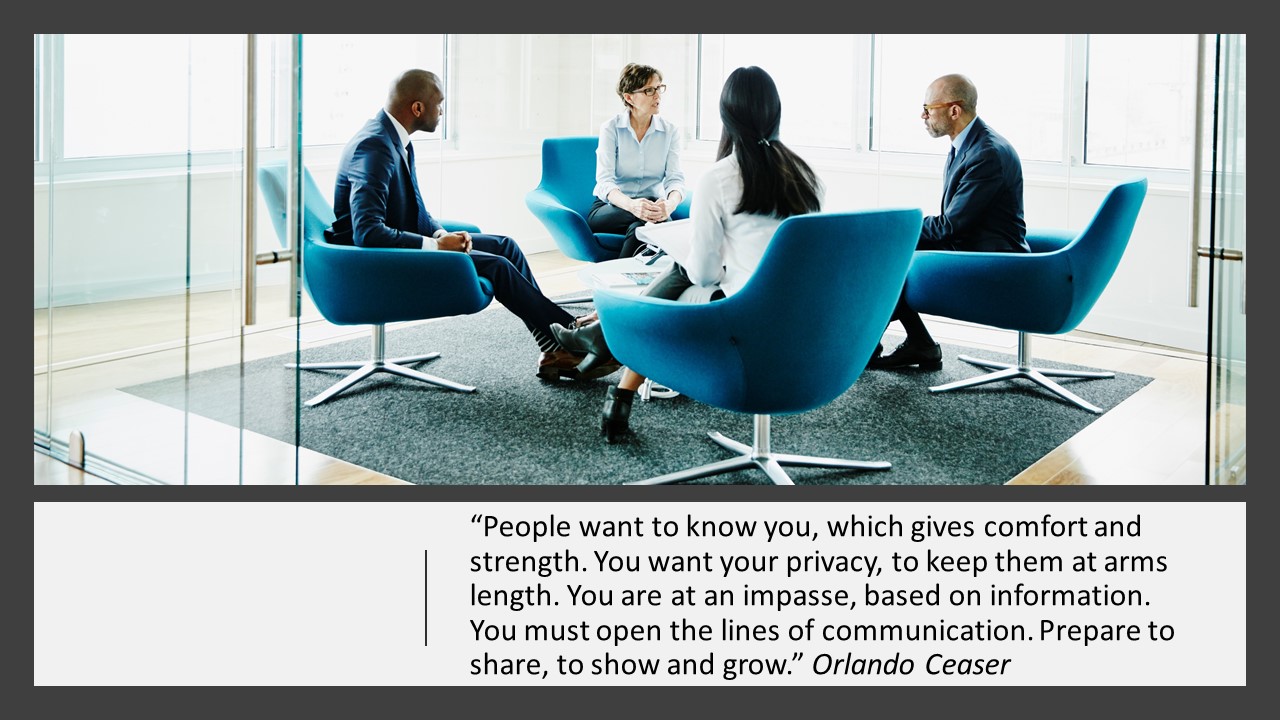
A constant refrain I heard early in my career, was that people did not know me. People wanted me to tell them more about me, so that they could identify with me. They wanted information outside of work, about family, interests, beliefs, and hobbies. But I was reluctant. Initially, I felt full disclosure, would lead to overexposure. Eventually lowered my shield with certain people, after I developed trust in their intentions.

There are reasons for being guarded; reserving or withholding feelings. We may hear, see, or experience events that prevent us from revealing too much. I engaged in many conversations over lunch. During these discussions I learned the difference in perspective that existed among my peers. During one such conversation, we discussed discrimination. The opening premise by a well-intentioned manager, was that the only kind of discrimination that existed in the United States was economic. They went on to say that if you have the money you can live anywhere without any difficulty. This perspective differed from my personal history and my knowledge of many celebrities who encountered problems in certain neighborhoods. There were broken windows and graffiti and reckless damage to their property. It became clear to me, from this discussion and others, that our different experiences shaped our perspectives, which caused us to view the world differently.

People retract like a turtle or armadillo when they do not feel safe. They will not take a risk or step out on a limb with their perspectives and opinions. I knew someone who went as far as to not place family pictures on their desk. They wanted to separate work from home and keep the company out of their personal affairs. When we open ourselves, we will see the similarities that accentuate our differences and create a powerfully productive connection. I would call this a piece offering. By piece offering I do not mean peace, as in the absence of war, but piece, as in giving them a part of ourselves, to open to a greater dialogue and understanding of each other.

There was a manager who told every ethnic joke imaginable. He was humorous at the lunch table and people enjoyed his witty stories. One day, I pulled the manager aside and said, “I am probably depriving you of some of your best material, by being present here.” He paused, thought, smiled, and looked me in the eyes and said, “you’re probably right.” He did not receive points for sensitivity and not bringing up those stories in my presence. I could argue that he was careful, but the stories may have been told, but not in my presence. If the stories existed for others, they also existed for me and should not have been part of the workplace.

If we are to understand each other better, we must open to each other. If we are to open to each other, we must create a climate where people feel comfortable, accepted, included, and treated equally. There are not any magic words to convince people to be vulnerable. However, by giving of ourselves, even small amounts, and to create the right climate, we can set the stage for a marvelous relationship based on trust and reciprocity where people feel safe. Ultimately this results in a workplace with productivity and innovation that is beneficial for everyone.

Copyright © 2021 Orlando Ceaser

Check out my web-sites at OrlandoCeaser.com and Watchwellinc.com for more content and resources. Contact information is also available at the sites.

A Call to Decency & Integrity (D&I)

The 4th Monkey (3)

Decency is not a trade he frequently discuss. Yet, people know what it is when they see it. We would agree that people who are decent are trustworthy, with strong character traits, such as integrity. They are respected and held in high esteem. Decency is an acquired state. It is a function of diligence, conditioning, and a propensity to do the right thing. It is combination of characteristics, attitudes, and positive personal values, which causes people to gravitate to the as a magnet.

You may not have it as a goal, nonetheless it is a byproduct of being a good person. Decency is a positive side effect of good behavior. The individuals possess high moral standards and a solid reputation and track record.

Google defines decency as “behavior that conforms to accepted standards of morality or respectability.” It is often used in the context of someone being modest.

Decency surfaced on my first interview trip as a district sales manager. I was sent to help a district manager fill vacant sales of territories. The company had a structured interview program based on behavioral questions. We looked for competencies or behaviors necessary to do the job. Past performance / behavior was a predictor of future performance. Whereas there were no questions related to decency, it was evident, among the candidates.

One candidate rose to the top of my list. He had the requisite potential to be an outstanding sales rep. This was during a time when we were hiring recent college graduates for sales positions. There was one sales territory that was hard to fill. My favorite candidate evoked the word decency. He had the requisite skills, but I kept thinking, he is a thoroughly decent individual.

Decency translated into a culmination of many positive character traits. His overall demeanor was supported by quantifiable, specific behavior related outcomes.

Our interviewing questions covered such areas as presentation skills, product knowledge, administrative abilities, persuasion, teamwork, tenacity, resilience, creativity, and organizational skills.

Sandwiched between his answers were examples of

  • Fairness, equality, and good judgment
  • A hard-working personality
  • Faith centered living
  • Integrity and moral behavior with clients and competitors

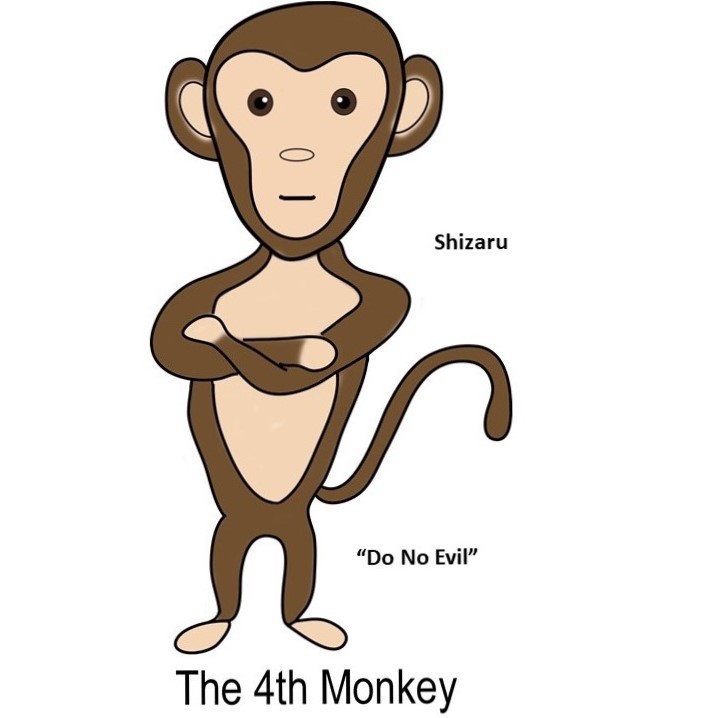
Decency is an attribute, we relish in people who lead us, serve us, and befriend us. They have integrity which is characterized by the 4th Monkey (Shizaru) which is “Do No Evil”. Decency is not something we feel we can teach, but believe it was necessary for longevity and success in the long term. It may be a function of upbringing, conditioning, modeling behavior, practice, and reinforcement. Decency is often described as; you know it when you see it, or you can feel its presence in your gut.

In a highly competitive marketplace, decency can be a tiebreaker in hiring employees and building relationships and collaborations. We should determine whether candidates can play well in the sandbox, are good listeners and strong team players. They could essentially play well with others, driven by a sense of fairness and purpose, emotional intelligence, likability, and a desire to excel and achieve their inner greatness.

When we visually survey our workers and coworkers, if we find they have a sense of decency we could probably see the following.

  1. Authenticity
  2. Integrity
  3. Honesty
  4. Strong work ethic, based on productivity, quality and execution
  5. Treats people fairly, with dignity and respect
  6. Moral character as reflected in the stories they tell
  7. A sense of fair play

Answer the following question. Are you a decent human being? How do you know this to be true? Asked the coworker, relative or friend if they would consider you a decent person. Ask for examples.

The decent human being is the team player that people like to work with and want on their teams. Strong character individuals are sought after in every interaction that is important to us. It is advantageous to associate with decent people and hire, develop and promote in our organizations.

Copyright © 2020 Orlando Ceaser


The 4th Monkey – “Do No Evil”

I am reissuing, with a few modifications, my most popular blog post, for your consideration. The universal application of these age-old concepts is a tremendous value that should guide our behavior and interactions with each other.

We grew up with the story of the three monkeys. I imagine that many of us have the same interpretation of what they represent. We were exposed to pictures or statues. One monkey had his hands over his eyes, the second monkey with hands over his ears and the third monkey’s hands were over his mouth. They were see no evil (Mizaru), hear no evil (Kikazura) and speak no evil (Iwazura). There were actions and behaviors demanded of us based on the three monkeys, but nothing was said about the fourth monkey. The fourth monkey was do no evil (Shizaru).

four-wise-monkeys

The stories of the four monkeys were popular in Japan in the 17th century. Their origin is between 2 and 4 BC in China. The Storyologer web-site (www.storyologer.com) has this account of Mahatma Gandhi who carried around a small statue of the three monkeys.  “Gandhi had a statue of three monkeys in three different postures. One was shutting his mouth with his hands, the other was shutting his ears similarly and the third one had put hands on his eyes. A visitor to his house became curious and questioned Gandhi about the various postures of the monkeys. Gandhi politely replied, “The one shutting his mouth tells us that we should not speak ill of anybody. The one shutting his ears tells us that we should not hear the ill of anybody. And the one shutting his eyes tells us that we should not see the ills of anybody. If we do so, we will have all goodness and nothing but goodness.”

Travelers will often find local markets with carved depictions or artwork featuring the three monkeys. My wife was able to purchase an angelic model of the same concept. There are three angels; one was covering her eyes, one was covering her ears and the other was covering her mouth. However, the fourth monkey was not shown. The 4th monkey, when pictured, is usually shown folding his arms (the body language of being closed) or covering his crotch to signify inactivity.

The different interpretations of the four monkeys is fascinating. In Buddhist tradition it meant don’t spend your time preoccupied with evil thoughts. In the West it relates to not facing up to our moral responsibility, for example turning a blind eye. But in my household, the monkeys were presented to us as a model of proper behavior. Our parents wanted us to identify with the images, to supplement our moral code.

See no evil (Mizaru)

We were told to pay attention to people and location(s). The idea was that if we were in the right location, we would minimize seeing trouble develop before our eyes. This was applicable in school and at work. We were instructed against being at the wrong place at the wrong time or the wrong place right. We were also told not to look for bad things in people or in certain situations. There are people who see bad things when they don’t exist, which could explain the manifestations of bias, stereotypes and profiling. We were not taught to be naïve, but to be careful and respectful.

Hear no evil (Kikazaru)

We were told to shield ourselves from bad language and bad intentions. We should stay away from people who spoke ill of others and gossiped. If we were not in the wrong place we could minimize hearing things that we should not hear. We were also instructed not to listen to foul or vulgar language. If we heard people language, especially regarding someone’s evil intentions, we could use the evil information to do good or to help others, that would be permissible.

Speak no evil (Iwazura)

Speak no evil was used to discourage gossiping or speaking ill will about someone. We were told to watch our language and to speak kind words. “If you can’t say anything good about someone, don’t say anything” was a part of this same philosophy. Adults told us that spreading bad news or malicious information could come back to haunt us. We should also, apply this same advice to the workplace.

There is a misconception around the concept about someone. This misconception has led people to adopt a code of silence in the workplace when a person is not pulling their own weight. We would rather silently complain or resign, before talking about an employee who was not working. We would not want to be labeled a snitch or a stool pigeon. In the streets people would say, “snitches get stitches”. To speak evil of someone means telling a lie, varying false witness or defaming their reputation. However, it is our responsibility to find a way to report injustice, illegal behavior and practices that undermine people and the organization. Our intention should be to speak the truth in love without malice or premeditated negative objectives.

One way to break the code of silence is by offering incentives to whistleblowers. These individuals are people who step forward and report unlawful activities in an organization. They are generally paid a 10% bounty if the measure goes to court and fines are levied against the lawbreakers. In neighborhoods where people know the perpetrators of violence, but fail to come forward, there are no such incentives. Residents may be afraid of retribution, as the rationale for their silence. We must also realize that justice requires telling the truth and this should not be regarded as speaking evil of someone.

Do no evil (Shizaru)

The fourth monkey’s actions are truly related to the others. The workplace is a common place for the four monkeys to be used as an operating system. Employee bullying and intimidation, sexual-harassment claims, the presence of racial discrimination, unconscious bias and sexually charged language and actions exists in many organizations. Where improprieties and liberties are taken with people’s rights in the form of disrespectful words and actions, there are laws in place to prevent and punish these actions. Employees, who adopt a see no evil, hear no evil, speak no evil mindset are not helping to develop a positive company culture or a respectful workplace

Do no evil is a perfect monkey to enforce the values of character and integrity. He reminds us of proper behavior and etiquette. Our choices have consequences and the more we can emphasize a positive corporate culture and a respectful workplace the more effective our organizations will be become. There is conduct and behavior norms which must be identified, emphasized and enforced vigorously. Character will minimize stress in the workplace and reduce the number of lawsuits and discipline related to improper behavior.

The do no evil mindset would influence our participation in the political process. Our dialogue in conversations around those who are different from us or have different opinions would be positively affected. If we operated each day thinking in terms of do no evil, we would be more empathetic in understanding of each other. We would put ourselves in the shoes of our neighbors and seek to understand their point of, listen to their words and lay the foundation for greater chemistry instead of conflict.

How can we create an environment in our workplaces, families and communities, where people are held accountable for their own unlawful actions and the private citizens who come forward can feel safe and protected? If the fourth monkey was modeled, we would have less of a cause to talk about Mizaru (see no evil) and Kikazuru (hear no evil).

Do no evil and speak no evil should be magnified and connected to many of our guiding principles of behavior.  The Golden Rule and its equivalent in many cultures advise us to treat people the way we want to be treated. The Platinum Rule which asks us to treat people the way they want to be treated. The 10 Commandments implores us not to do a series of acts which could be seen as evil, such as murder, stealing, etc. you are instructed to love your neighbor as yourself. If we began from a position of love it is easier to think in terms of speak and do no evil.

We must clearly outline expectations of behavior and the judgment related to them to improve the climate in our organizations, homes and places where people meet. Correct action is essential to achieving healthy results in our relationships.

The imagery and practices espoused by the 4th monkey holds the key to making this possible. I am hopeful that by emphasizing the fourth monkey, we can improve our behaviors, connections, interactions and relationships with everyone.


Copyright © 2016 Orlando Ceaser


The Black Panther Strikes

BlackPanter

The Black Panther movie strikes a chord with movie goers around the world. It is shattering box office records. It is catalytic in its messaging, story-line and visual excitement. People are using it to express profound pride, as it delivers lessons on universal themes, humanity, equality, diversity and inclusion, as well as the pursuit of excellence.

I have seen the movie 3 times, including 3-D and IMAX. Each time I walked away with greater insight. I read the comic book as a youth, so this is nostalgic and a long time coming.

Poetry and the arts allow us the opportunity to express ideas which are magnified with individual interpretation. When translated, transferred and transformed through the prism of our experiences, the results can be nothing short of amazing. Here is my poetic take on the Black Panther experience.

The Black Panther Strikes

The Black Panther strikes;

The images inspire imagination;

Invite, excite and ignite

The embers of genius

Until we remember with fascination

The universal themes and memes

That elicit dreams of excellence

That stream a new ideology;

That emphasizes and empathizes

To aspire desire,

To fire a higher reach,

Through awe and technology.


The Black Panther strikes,

As a cultural phenomenon,

For those among us who’d like an icon;

A super hero with super powers

That look like us with a face like ours;

To build confidence and regal speech,

To show what is possible,

When obstacles are breached;

When an illusion is legal,

But is shifted

And confusion is lifted

And giftedness is the new twist

To enlist us in the new success,

Which is true success.


The Black Panther strikes;

To the heart of the marginalized;

The underserved and disenfranchised;

The heirs, apparently in poverty,

Seeking their cultural identity;

Phenomenally packaged in energy.

They speak seeking a symphony,

In harmony and synergy.


Empathy and intellect can remove

Barriers, as we get involved

And agree to work to solve

The problems that surround us

And have bound us.

We must lift every man,

Woman and child to a place of forgiveness,

Where we can be reconciled;

To share, prepare and repair;

To lift each other from despair.


The Black Panther strikes,

Directly to community;

Inciting citizens in unity;

And stirs the blending of generations

Through tribal traditions

And pageantry.

We show young people

Who they can be

And celebrate their ancestry;

Seeking challenges to prove they’re free.

Science, technology, engineering and math;

Can help us blaze a wider path;

To channel the rage

And engage on a stage

That is larger than we

Intended, but to accept

The mantel and comprehend;

What we should support,

What we should defend.


The Black Panther strikes

To protect the family

And project the family,

As the center of cultural identity;

The truth is, we are all related,

Although our lineage is debated.

We have the capacity;

To help others improve their lot.

We can’t afford to hoard

Resources, when we’ve got

The power through distribution,

To offer solutions.


The Black Panther strikes

A story to which we can all relate;

To entertain and educate

And inspire action

Through universal mores

Of dignity and deliverance,

Eloquence and excellence;

Leadership and tough decisions;

Technology executed with precision.

Ancestors deserving a connection;

Connective tissue is in each of us

Enabling us to adjust,

So that we love and trust.


The Black Panther strikes,

Through imagination and truths,

From elders down through our youth;

For Millennials and women have value,

The men and young boys have talent

And though steeped in the values of tradition,

The motives that drive ambition;

They are inspired through art and technology;

That transcends pathology;

And through mythology

Explore new pathways

Beyond injustice and inequality.


The Black Panther strikes,

So close to home.

There are delegations of youth

At the screenings;

Reporters postulating the meaning,

As millions with African descent,

Extoll the messages and what they represent

And seeing it as a rallying cry;

A cry to honor our first investors

To honor our elders and ancestors;

Imploring us not to forget,

Their sacrifices, wisdom and toil,

For roots and foundation

Enrich the soil.


Copyright © 2018 Orlando Ceaser

The Hindre™ – A Secret Force of Exclusion

the_hindre (1)

The Hindre™ is a person whose purpose is to keep you down, drain your confidence, stunt your growth, hold you back, and prevent you from moving forward. They will hinder you from realizing your potential and living up to your expectations. They are stationed in households and organizations to thwart progress and stymie success by discouraging siblings and offspring from achieving their dreams. The Hindre™ will disillusion people who have the ability and talent to make a positive difference. (The illustration of the Hindre™ is provided by United Press syndicated cartoonist Charles Boyce, creator of “Compu-toon”).

We encounter this nemesis of negativity at various stages of our lives. This individual is responsible for creating a hostile environment of exclusion that says we are not invited, we are not good enough and we are not wanted. The Hindre™ are in businesses and other organizations prepared to sabotage individuals viewed as a threat. They are active when difference enters an organization, so that the status quo is maintained. They are people who place fear in your heart by making you believe you are inadequate and do not have the skills to succeed, unless given special accommodations.

A first encounter with the Hindre™ is during your youth. Exposure is at school or in the home. They may lash out against you in the form of a bully, to hurt your feelings. The experience may have left you angry, embarrassed or ashamed. As you grow in age and maturity they show up in school, relationships, family, and activities and on the job. They are sometimes subtle or bold, undercover or out in the open, covert or overt in their actions. However, they may seem to support you, while discouraging you from taking a risk and disparaging you behind your back to diminish what others think of you.

The Hindre™ show up when people and ideas are the weakest and most vulnerable. In school when you are forming your dreams and goals for the future, they bring their brand of sarcasm, laughter, cynicism and ridicule to shake your confidence, break your spirit and damage self-esteem.

At work they appear in many forms. They may seem harmless, objective and well meaning. But they use their credibility to tear down your ideas and cast suspicion and doubt on your performance. If you are highly regarded, they may use language behind your back such as, “you would think with their education and experience they would know better or perform at a higher rate.” These secret attacks are pervasive, persuasive and slowly reduce your standings in the eyes of peers and supervisors.

Talent will bring the Hindre™ to the surface. Talent activates their discouragement mechanism to hinder high performance. If you are silent and under performing they are dormant and content. But when you flex your creative muscles and express your skills, abilities and talent, they are pressed into action.

Exclusion at Work

In business the Hindre™ lurks in the hallways, meeting rooms and work stations. They are dormant until someone threatens the status quo with new ideas, especially if these new ideas come from the wrong people. The Hindre™ always looks for reasons why ideas will not work and how the ideas of others may work better. They allegedly have the interests of business at heart, when they shift focus and direct their critique to the flaws in your perspectives.

The Hindre™ is sometimes driven by unconscious and conscious biases and prejudices. They restrict access to employment opportunities, neighborhoods, certain groups, membership to exclusive clubs for women and resources to complete a project or proposal.

The work of the Hindre™ has cost companies and countries billions of dollars annually in lost engagement and productivity, revenue and innovation. New ideas are suppressed. People are not fulfilled. Opportunities are passed or missed as the company is deprived of the full richness of its talent pool. On a larger scale entire neighborhoods and countries are deprived of entrepreneurs, leaders and positive role models. The Hindre™ is the ultimate Devil’s Advocate, running unrestrained throughout our lives.

In meetings they shadow your comments. They come to life when their target begins to speak. When others speak they are relatively quiet, but when you talk, they are on the edge of their seats, ready to launch a counter offensive to pounce on your ideas. Many times, they will submarine your ideas as irrelevant and inappropriate, only to repackage as their own at a later date.  Therefore, you should keep track of your ideas, so that when they resurface you can claim credit for them.

When you are aware of the existence of the Hindre™, they are very predictable. Your mindset will to prepare excessively to ensure that your comments are well thought out, yet open for constructive challenge. You can use the presence of the Hindre™ to make you stronger.

The Hindre™ is known for discrediting groups of people and diminishing their accomplishments by saying that they are in over their head, they only got here through a special program and alluding that they may not be qualified.

In Talent Management and succession planning meetings the Hindre™ is present. They shoot down candidates with little objective information, but with a plethora of subjective innuendos. They have done their homework and will twist the facts or limit the admission of positive information that could benefit talent to the organization. The Hindre™ want to restrict your movement and limit and deny access to people, assignments and information that will make you successful.

What can you do?

We must develop the vision to spot them in a crowd and to know that they exist even though we are not sure of their location. Being hidden may give them power if they can catch you by surprise. Sometimes exposure and the knowledge that you know who they are can rob them of their strength. You can develop techniques to question their comments or answer them in a thoughtful intelligent manner. When you are skilled you can cast doubt on their motives, which can be risky, without the audience support. If rendered ineffective, they may go away, go underground and try to discourage others or think of an alternative way to stunt your development.

You must build confidence and surround yourself with people who are supportive, mentors, coaches, true friends and trusted allies. If you do not place this fundamental fortress of protection in place, they will cause you to doubt yourself, especially if no one is coming to your assistance. You must develop effective allies who have your back and will alert you to attacks from unsuspected Hindre™. Occasionally, someone may ask two questions which you should take seriously.

  1. How well do you know a particular person?
  2. What does this person have against you?

This may be a warning advising you to be careful around a particular person. Listen carefully to these comments as they are trying to tell you something significant about the Hindre™ in your midst.

Not every critical person or critique is from a Hindre™. You must subject the comments to a qualifying test. If they are instructive and productive, you would accept them. If their comments mean well and will make you better, you should welcome them. Try to determine the intent and motives of the person, the value and benefits of the comments and the potential consequences of action and inaction.

The Hindre™ may be powerful. We need to resist, but we may not be strong enough individually to withstand their fury. We need advocates and allies to jump to our defense. We need to cultivate teams of believers who will stand next to us when we are challenged inappropriately.

The Hindre™ is active, damaging dreams, poisoning relationships, restricting productivity and stifling the growth of communities, countries and continents. The Hindre™ undermine the joy we could experience without the persistent nay saying, negative nemesis that seeks to deprive us of our greatness. We must be aware of their existence, their presence in our environment and their mission to undermine our effectiveness. They are among the secret forces of inclusion in our environment. Therefore, we must develop tools to nullify their impact and cultivate allies to support us and fortify our positions.

Copyright © 2009 Orlando Ceaser


Rudolph the Red Nosed Reindeer – Lessons in Handling Differences

We are often started with the commercialization of Christmas. We are reminded to not lose sight of the reason for the season. This is valuable advice for Christians and others during this reverent time of year.

We grew up with Gene Autry Christmas classic of Rudolph the red-nosed reindeer. It is a delightful song, but also delivers a powerful message about encountering and handling differences. This song could start meaningful conversations about accepting others.

The song begins with a reference to the reindeer popularized in Clement Clarke Moore’s, “The night before Christmas”, also known as “A visit from St. Nicholas.” It begins with a roll call of Santa Claus’ reindeer that of course omits the name of Rudolph. As you recall, Rudolph was different from the other reindeer because of the luminescent quality of his nose. His nose was so shiny that it had either reflective qualities or it glowed like a light. This was enough to make him the object of ridicule and ultimately ostracism by the other reindeer.

This lack of acceptance is seen when children and adults are confronted with someone who is different from them. Our initial response is to make fun of the person and then to isolate them because of their characteristics, traits, heredity or idiosyncrasies. Many of us recall when we were young and begged for approval. Even to this day, there is something about us that makes us stand out from the crowd and the crowd lets us know it.

At work or is school, simply being the new person, the new kid on the block, the person who is an unknown, becomes a source for teasing or isolation. We often wondered,” if they would only get to know me, they would see that I’m just like them. “Rudolph was a reindeer, so he surely had a similar appearance, except for his nasal peculiarity. But suppose he was of a different color, from a different region of the country or had a different ability.  He would have manifested a difference that would have caused him difficulty until he was accepted. We usually ask the different party to fit in, when the real focus should be on them being accepted by the group.

Bullying is also a response shown toward those who are different. The song the does not indicate that Rudolph was bullied, but we can only assume that preventing him from “playing in any reindeer games” was not always accomplished in the most delicate manner.

The song does not tell us what Santa Claus was doing during the hazing or if he even knew about it. But, as a good leader, he engineered a very strategic response. He knew the talent and value of all of his reindeer. He evaluated the weather system for his next journey and realized he was going to encounter numerous blizzards. He knew that the solution to his problem existed among the ranks of his reindeer. He knew he had one reindeer that could help navigate the wintry delivery of toys to boys and girls around the world. This opportunity would be well received it if every reindeer benefited from his gift.

We can give Santa credit for waiting for the appropriate time to unveil strategy. He could have given the reindeer the opportunity to work it out amongst themselves, as so many people do in similar situations. They say such things as,” kids are just being kids, learning to navigate difficult situations will only make the recipient stronger and teach them valuable life skills and that which does not kill them will make them stronger, to paraphrase Friedrich Nietzsche the philosopher. Maybe the reindeer performed similar initiation rites to others in the group that had other distinctions from their peers. Maybe they solve their treatment of Rudolph as being harmless and natural.

The defining moment came,” one foggy Christmas Eve, Santa came to say: Rudolph with your nose so bright, won’t you guide my sleigh tonight?” Many managers, leaders and parents look for the opportune moment to use the skills of their people. The right moment to show the world and the individual, that they recognize their true value and wish to share this value with every member on the team. We can only assume that in the fictitious conversation, Santa’s encouraged Rudolph and told him about the value of his difference. He made him feel that he was something special and should never feel that he was not important and did not have a place. I’m sure he made him feel like an important member of the team. He validated his value by asking him to lead the team by moving up to the front of the line.

You remember the happy ending to the song. “Then all the reindeer loved him, as they shouted out with glee, Rudolph the red-nosed reindeer, you’ll go down in history! We know that in real life, responses to differences may not always lead to a happy ending. Sometimes the individuals have lingering insecurity, damage to their self-esteem and underlying resentment from the initial exclusion. But, so often when the difference that is ridiculed or denied is used for the benefit of the group, the organization, institution, group or community becomes stronger. The people learn a valuable lesson about inclusion. We are hopeful that when the person is accepted they don’t become complicit and act in the same manner when they encounter other people who are different.

If we remember the Rudolph days of our lives and commit ourselves to prevent them from happening to others, we will maximize their future contributions to our teams, families, organizations and communities. We will perform a noble act when leading by example with the lessons learned from Rudolph the red-nose reindeer.

Copyright © 2013 Orlando Ceaser

More works from Orlando Ceaser in Unlock Your Leadership Greatness and Unlock the Secrets of Ozone Leadership available at amazon.com and http://www.orlandoceaser.com.

Protectionism in a competitive marketplace

Protectionism is designed to discourage others from competing for your talent or resources. Barriers are put in place to keep markets, company, or department restricted from outside forces. People try to artificially maintain or mandate the status quo, because it is a beneficial, but questionable policy.

Insecure organizations who are afraid to lose top talent will institute external mean to keep their people, which may deny their people freedom, benefits and promotional opportunities.

Protectionism is a preemptive strike aimed at discouraging others from hiring or tampering with your personnel. Countries try to control their markets by setting up impediments to prevent others from fairly competing with their industries and companies.

Protectionism is at work inside organizations. A regional manager was constantly near the top of the organization in sales. He experienced very little turnover in his sales organization, through promotions or resignations. Many in the organization were puzzled to learn that stellar results were not accompanied by promotions. Conversations with the regional manager revealed that the top performers, in his estimation, were somehow flawed and not ready to receive more responsibility. This manager’s protectionism policies were personally beneficial, yet detrimental to the career growth of many hard-working employees. He did not want to go through interviewing to replace them and training a new crew. Careers were inhibited because he had labeled them as insufficient to assume greater responsibility.

A successful sales representative accepted a promotion to the human resources department. She wanted to return to the field as a manager. After several years, she had lunch with a sales manager. He lamented the fact that she wanted to stay in HR. She was shocked at his opinion and asked why he felt she did not want to return to the sales force. He said he had been told by an HR director that she was happy with her new career path and it did not want to leave. Needless to say, she was stunned by the misinformation and the inaccurate portrayal of her career objectives. The protectionist policies of her department backfired and she subsequently resumed her sales career.

Protectionism leads to the creation of policies to restrict the penetration of their borders by competing companies. One company raided another company and hired some of their best sales people, when they started a new division. The losing CEO was angry by their practice. He instructed his lawyers to write a letter to the company stating his displeasure and threatened legal action. The response he received was carefully worded. The acquiring CEO defended his hiring practices. He asked the other CEO to see his actions as the risk of doing business. He suggested the people were leaving on their own volition. If the people were happy they would not have been so anxious to leave. Needless to say, the other company continued to hire his representatives, but at a slower pace.

People will gravitate to top talent. In the era of social media, networking events, savvy recruiters and employee referral fees, the best performers will be identified. There is an incentive to keep people happy and there is an incentive to recruit them to other organizations.

The hiring CEO delivered a very powerful message. What can be done to minimize employee’s propensity to jump ship? What can be done to the culture to make them want to stay with your organization longer term?

Organizations can change managerial mindsets to mandate mutual benefits for all parties involved. This philosophical shift is initiated and enforced by senior leadership. Intuitively, it is difficult to pour a lot of effort and time into someone, only to see them walk away to a perceived better opportunity. As stated earlier, there are risks involved in developing people. At some point, you will have more people than you have promotable positions. This may cause some people to be patient and wait for better jobs internally; however others may be impatient and look for greener pastures outside of the organization. You have to chalk this up to the price of doing business and wish them well.

There are tremendous advantages short and long term for a full scale long term development program. This may ultimately lead to future business alliances and collaborations with companies who have hired your people. It may also be a recruiting tool for prospective employees. A reputation for hiring and developing talent can lead to an influx of extraordinarily qualified candidates. Higher employee engagement levels and productivity is currently seen as a positive benefit of a stronger culture.

If you constantly assess and provide opportunities for personal and career growth, you minimize employee flight. Today, Millennials are subject to career impatience, if you do not sufficiently reward and challenge them, your organization will constantly be under pressure due to rapid turnover.

Sensors can be put in place in the form of stronger leaders and mentors to assess and regulate career development. Employees will gain an up-to-date, real world view of their skills and abilities and prospects for career development. Organizations have established career academies, equipped with resources, such as class room work and online training programs to help employees can grow their technical and life skills.

Protectionism in theory is about holding on to your talent against unfair pilferage, but it will work against you in the long run. You must update your training and development practices to create stronger leaders. Additionally, you must:

  • Pay attention to the company culture to treat people with respect and harness their skills and abilities.
  • Provide an honest assessment of performance through clear cut performance objectives and regular evaluations
  • Career discussions should be held to understand and to share employer and employee expectations
  • Develop confidence in your training and development program to rapidly replace people who leave the organization or leave the team
  • Strong managers and leaders are necessary to ward off protectionist tendencies, as they strive to develop the best teams imaginable

Organizations have been known to offer retention bonuses during a time of uncertainty, such as during mergers and acquisition, to keep their top talent. A variation of this practice is to ensure that the best performers receive the best rewards, whether financial, special projects or greater career opportunities.

Protectionism is usually a policy instituted when an organization fails to put a coherent people strategy in place. In their haste to prevent people from leaving, they  blame outside forces for problems in their culture. Protectionism practices that strikeout at the employee or toward outside forces are rarely successful. Organizations should look internally at their leadership practices and career development strategies, to see if they can be more conducive to creating a culture where leaving the organization is to difficult for an employee to imagine or implement.

Copyright © 2014 Orlando Ceaser 

Free e-book, Leadership Greatness through High Performance Poetry at http://www.orlandoceaser.com