Cartoons for the Chaos in Corporate Communities – Cocky and Rhodette

Corporations are communities of citizens who are ideally committed to a common vision. They are able hopefully resilient, with the capacity to withstand change, reinvent themselves and introduce new business paradigms, in order to succeed. These companies are survivors. They truly represent the “survival of the fittest” mentality. Corporations are staffed with individuals who have the survived a myriad of corporate reorganizations, growth spurts and culture adjustments. They have demonstrated the ability to adapt to change by adopting techniques necessary to avoid extinction.

Cockroaches and rodents have existed on this planet for millions of years. Cockroaches have been around an estimated 240 million years and rodents were probably chasing them for a good number of those years. They are truly survivors, exhibiting adaptive behaviors that have enabled them to adjust to changing circumstances.

The personification of these two characters is in the form of a cockroach named Cocky and a rodent known as Rhodette. They represent and will articulate the thoughts and feelings of employees in Corporate America. They will speak through reenacting scenarios that happen every day in some company around the world.

Cocky is a male and Rhodette is female. They are co-workers. Their biographies speak to their diversity. They manifest their diversity in many ways, such as gender, thinking styles, age, genus, species, educational levels and introversion versus extroversion, to name a few distinctions. Cocky learned business from his father Coach (co is from cockroach and ach is from roach), whereas Rhodette received her business acumen from her mother Rhoda. Cocky and Rhodette are close friends who spend many hours talking about business and comparing and despairing over the current environment in their company where the emphasis on production has a few casualties among the rank and file. They have revised their personal strategies for growing their careers. They speak for the masses although they also, have leadership responsibilities.

Cocky does not totally live up to his name. Whereas, he is self confident, he is also quiet and introspective; a true introvert. He knows when to keep his mouth shut. He may appear to be low key, but this is an adaptive quality, survival tactic. He can be commanding, when necessary. He will frequently sit in meetings and speak only when he has something significant to say. He is appalled by the amount of hot air released in meetings, as people speak to hear themselves talk. He is also disappointed when management condones and rewards this type of behavior. He sees his role as a pioneer to help others to adjust to corporate life. He has been promoted numerous times based on his productivity and the support of advocates, coaches and mentors. He says he is a realist, who fears he will go only as far as the company will let him. He is ambitious and has no desire to leave the organization.

Rhodette is flashy, extroverted and her electric personality makes her the major energy source in any gathering of employees. She can seemingly get away with outrageous statements. She is a strategic thinker and her mind and forceful presentation demeanor are threatening to others. She is aware that she has to be careful in how and when she states her views. She has been coached on her need to increase her self- awareness. She is a team player and her actions are usually to benefit the company or her teammates, not to acquire power, stroke her ego or build a fiefdom. She is a great sounding board for Cocky and their interactions are insightful and at times hilarious. They look out for each other and provide constant feedback, which helps them grow personally. Through their networks they are also able to gather information on internal competitors who may try to undermine their performance and career growth.

Cocky and Rhodette are both managers in a large corporation but their escapades and situations are found in smaller organizations. Their poignant comments and witty observations are thought provoking with educational lessons for everyone. They have coaches and mentors to assist them in their development. They are also connected with many employees within the company to help them report accurately on performance and levels of engagement.

Cocky and Rhodette have given birth to a new creation, Cocky, Jr. The perspectives of teenagers are expressed through the eyes of Cocky, Jr. and Rhodesia. They are hilariously representing thought-provoking issues experienced by teenagers and the adults who interact with them.


Copyright © 2007 Orlando Ceaser
The Power Of Paying Positive Attention (POPPA)

success

I admire people who have a reputation for making people feel noticed and special. Presidents have been lauded for their ability to remember people’s names and making them feel as if they were the only people in the room (John F. Kennedy and Bill Clinton). Others also, they have the keen sense to recognize and comment on any changes in a person’s appearance or behavior. You may be such a person. You have an eye for detail. You know the right questions to ask, and the appropriate comments to make. These individuals have the power of observation and paying positive attention.

Additionally, individuals have a knack for always pointing out when something is wrong. But, we will spend time focusing on the people who have the power of paying positive attention to something that is right. These individuals may have the gift because it comes to them naturally, so they have the knack for it. Or they may have acquired the knowledge of the impact it has on people. They have the knack or the knowledge. Therefore, they have the intuition or received instruction on the value of paying positive attention to others.

We could describe this skill with an acronym (Power Of Paying Positive Attention). It can have a profound effect on productivity, performance, productivity and relationships.

When you watch something carefully, continuously over time, you formulate a mental baseline of how things are. This is cemented in your memory. If something changes, alarm bells signal a deviation from the norm. You may not know what changed immediately, but you are aware that something is different. Observation and perception notify the brain.

POPPA is a great skill to demonstrate in the workplace, home and school. It helps to establish and strengthen relationships. The power of paying positive attention causes you to focus on people and every aspect of their beings. You look them in the eyes. You notice them and ask questions about the quality of their work. You remember their names. You ask questions about the pictures in their workspace and other symbols in which they have pride. You may comment on their backgrounds, families, education and interest as appropriate. They feel important. You value their contributions at work and are authentically concerned about them as individuals with families and a life outside of work. You see the employee, peer or classmate as a total person with long term professional and personal interests.

If you treat people as if they matter, they may ultimately live up to your projections and live up to and exceed your expectations. If you treat people as if they exist and make them feel important, and did not invisible, you will ultimately reap the benefits of an engaged and inspired person.

We are equipped with our 5 senses, highlighted by the senses of sight and hearing to enhance our powers of observation. It does not cost us anything, but a small investment of time to notice someone. If the average human being could walk around with a fictitious cartoon bubble over their head, it would say, “Notice me” or “Please see me.” They want to feel significant, special, substantial, loved and connected.

While observing a sales representative making a presentation a manager noticed that he was obviously preoccupied. There were points in the call when additional information was needed and he was usually very adept at picking up signals and following through with the right questions. After the presentation, rather than point out the obvious oversights, he asked if everything was alright. He discovered that he had personal matters that compromised his thinking and performance. The manager adjusted his coaching accordingly.

A District Sales Manager working with a star performer was confronted with the following situation. During one of her presentations, there was tension in the air on. The sales representative was noticeably reluctant as she was visibly holding back when a strong challenge was required. The company’s reputation was being assaulted and her usually strong personality folded in the moment. The manager asked, “What would you have done if I was not present with you today?” She outlined her strategy and why she did not pursue a more aggressive stance. She told him what she would have said ordinarily if he wasn’t there. She did not want to challenge the doctor in the presence of sales management, so she was reserved.

The manager gave her the following advice. “When I work with you I want to see reality. If I coach behavior that is not your usual behavior I leave feeling that I had a productive day. But my comments would have been a waste of time. You would leave feeling that the words were meaningless because they did not apply to you. If you don’t want me to waste my time, show me what is real and trust the process that I will handle each moment as a teaching and growth opportunity.” The power of paying positive attention allowed him to recognize a change in behavior and to coach to improve performance.

Lastly, there are times in our lives where we give routine responses. We are simply going through the motions in our very busy days. We feature the same words, whether it is in a greeting or part of the key messages delivered in a conversation or presentation. It is important to get these words right, but do not become bored or distracted with repetition. This may cause you to lose focus and fail to pay attention. You may miss an opportunity to connect with someone on a different level and strengthen a relationship. Watch the person’s face and body language to detect the messages they are sending to denote interest or a reaction to your words.

Our interactions in the workplace, at home and in school are environments where we should engage with other people by showing them that they matter. As a species, we want to be recognized and respected, belong and accepted. If we positively and authentically comment on their appearance, behavior, and performance, the compliment will inspire them to work harder to become more competent, which will have a profound impact on their confidence and they will complement your work culture, family, team, and organization.

Copyright © 2017 Orlando Ceaser

First Quarter – New Year’s Resolution Reboot

We are approaching the end of the first quarter. How is your New Year’s resolution going for you? Usually, about this time, many resolutions have been abandoned and kicked to the curb. The good intentions have fallen by the wayside and people walk away as defeated as they were this time last year. However, a seemingly failed attempt at a change in behavior for self-improvement can be salvaged with persistence and the right perspective.

For example, health club attendance usually spikes at the beginning of each year.

People are usually well engaged, as measured by attendance in classes or in the workout facility. The first three weeks are filled with enthusiasm. However, this year the enthusiasm waned after the first week. What is going on? Why are people disenchanted and disengaged so quickly? Is this indicative of results in other areas where resolutions are generated? Are they becoming harder and harder to sustain? We need to think of a different way of approaching our resolutions to give them greater sustainability.

We need to look at New Year’s resolutions as is a promise; and we like to keep our word. We need to see our resolutions as a computer program that simply needs to be realigned. What is really required is a resolution reboot.

Additionally, we should not confine our performance into a tight time frame, but to see it as a work in progress. A resolution reboot is necessary and admissible as evidence of our long term commitment. It is permissible as a continuation of the implementation of your growth strategy. We will reboot as many times as necessary until the program is fully functioning and running smoothly.

We must see our resolution as a part of an overall plan. Included in this strategy is our propensity to stop and start until the task is completed. It is our nature to not necessarily get something right the first time.  We have a tendency to collect a series of false starts, a few glitches before we are running like a well oiled machine.

Don’t beat yourself up if the early returns on your performance against your goal are not successful. Humans have a history of persistence until we reach our objectives. From learning how to walk, talk, think and run, the beginning stages did not go as planned.

Many of our goals as defined and described are like New Year’s resolutions. They had a rough beginning, but eventually became a part of our daily routine. We must approach our current resolutions simply as goals with things need to work on.

When a computer is not acting according to plan or specifications, the manufacturer usually asks us to reboot the program to see if it corrects itself. Whenever I have a computer issue, invariably I am asked to turn off the equipment and reboot. The same happens when I have a problem with my cable service. I am asked to please turn off the system for 30 seconds and turn it on to allow it to reboot itself. Many times this corrects the problem, as if the machine knows what is appropriate and aligns itself with the proper behavior. There is something therapeutic about shutting yourself down, rethinking your position, recommitting yourself to the goal and reminding yourself what success looks like.

You may need to try the same procedures to restart your resolutions, while keeping your goal in mind.

The early stages of your New Year’s resolution should not be seen as a performance failure, but as a temporary setback to regroup and rededicate yourself. Even if you are one of those individuals who backed away from your exercise goals after the first week, the game is not over. Tell yourself that your discontinuation was expected. It is a part of your well-planned routine to keep you working on your resolution until you get it right.

With the remaining days in the month and year, stay dedicated to your resolution. You know it is needed and the right thing to do for your development.  View the early returns as data and make the necessary course corrections to get you back on track. What worked for you in the early stages?

I remember training for the marathon and following the Galloway method. He suggested continuing to move forward, even if you had to stop and walk, but eventually you will reach your goal. So get Ready – Recommit – React – Reboot.  Keep moving and each  successful step in the right direction will get you closer to your overall goal.

Copyright © 2017 Orlando Ceaser


Personal development – Learning for others

A librarian posed a question to me that I heard many times in my career.” Are leadership or other training programs of any value?” She has seen many managers attend training programs and return completely unchanged. She wondered if the programs were a complete waste of time and money.

The success of training programs is determined by the manager and their supervisor. The manager must attend the training session with an objective in mind. There should be something in the content that they feel will help them become a better manager/leader. Their supervisor should hold them accountable and ensure that they return from the training session with the answers to two questions;

  1. What did you learn?
  2. How will you use this information to be a better performer?

It is optimal for the manager to have these questions in mind before attending the training, to prompt them to search for critical information, techniques and relationships. It is important for them to be open to how they will benefit, how it will change their current behavior and how it will influence their present goals and performance objectives. There may also be aspects of the training they can use to target specific individuals/teams.

If managers return from a training program and nothing has happened in their behavior and vocabulary, we can deduce that the program was not used it to its maximum benefit. Additionally, some managers feel that information is power and are therefore reluctant to share. However, managers should incorporate the techniques and vocabulary from the training into their everyday speech. They should share with their peers and direct reports, subject matter from the training. They should show how their peers, direct reports and supervisors can benefit from the information obtained.

Training should be seen as crucial for the individual and everyone within their sphere of influence. Acquiring knowledge, experiences and resources should be for the benefit and distribution to self and others. The same holds true when acquiring other information, such as reading a book. When you are reading you are not reading for just one. You are reading to develop yourself and learning for others.

A manager relocated seven times during his career in the pharmaceutical industry. There were a number of occasions when he wondered why he had to move so often, when others achieved similar milestones without as many moves. It dawned on him one day that when he moved, it increased his exposure, experience and expertise in many areas. This additional information allowed him to be of greater value to his people. He realized that growth was not just about him and this increased his eagerness to gain information for the benefit of others.

There are several other strategies managers can use to ensure that a transformation occurred when they attend training programs. They are as follows:

  1. Multiple uses of the training programs

Managers can be shown the value of the training beyond their immediate job; it increases the likelihood of them utilizing the training and gaining practice in the principles and techniques. For example, a training program around situational leadership contains principles that can be used at work, home, community meetings, places of worship and associations they belong to. If they use the information in these multiple sessions it increases the value and return on investment, regarding time, energy and money spent.

  1. Share with others

When managers make it a practice to have meetings to discuss the information learned that multiply the value of the training. Many individuals sit down with their teams to review the information learned and to discuss how it will be used to improve individual and team performance. The successful implementation and transfer of this data may actually have the people look forward to them learning new things, because they will benefit from the new knowledge.

  1. Ask about the program

If someone returns from training and do not share information, ask questions. They may be flattered or encouraged that others are interested enough in the training to want to know more. People may inadvertently hold their manager accountable by asking questions about the value of the program, the changes in the organization because of the program and how the information can be used to make them better employees?

  1. Use the information to improve yourself

Recognize that information learned by their manager can make them a better performer. If they have ambition to rise within the organization, what they learn can help them improve as well. Even if they do not have plans for advancement, it is imperative that they learn as much as possible in their current role. The more they know the more valuable they are to self and the organization. Bear in mind that the current appointment environment is fluid. It is impossible to stand still without being passed by or passed over. Expectations are higher everyday and the more skilled they are, the more likely they are to regain employment in the event of a job loss.

discretionary-effort-model

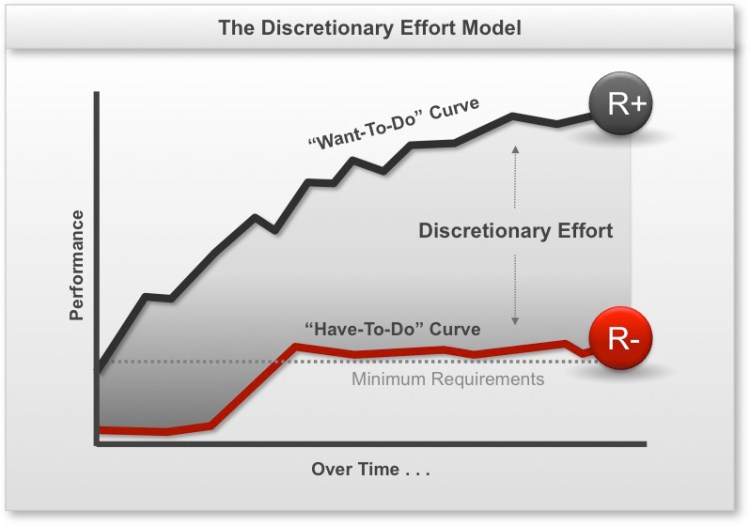
The second question that came out of my discussion with the librarian was, “Why should people change, if there boss is not changing?” There are many individuals feel they will do just enough to keep their job and maintain sufficient raises and increase in performance rankings. People feel better when they are functioning at their best. When they are fulfilled and engaged, they are working on all cylinders and the work can be fun.

There is a factor known as discretionary effort. Aubrey Daniels International says “Discretionary effort is the level of effort people could give if they wanted to, but above and beyond the minimum required.” An increase in discretionary effort could be brought on by positive reinforcement and feeling as if they are a part of the team. However, if the manager is not providing positive reinforcement, it is still imperative for the individual to engage in self defense activities. These actions involve a making themselves more valuable to the organization, which in turns increases their value to potential employers. As they take control of their careers, implementing their strategy for advancement could help them tremendously in the long run.

In summary, when managers realize that there development contributes to the development of others, this multiplying effect gives additional power to their job. Additionally, you should always grow, because it is good for you. You should make yourself better, because being better positively influences everyone around you, regardless of your manager’s perspective on the training they attend.

Copyright © 2017 Orlando Ceaser

The 4th Monkey – “Do No Evil”

We grew up with the story of the three monkeys. I imagine that many of us have the same interpretation of what they represent. We were exposed to pictures or statues. One monkey had his hands over his eyes, the second monkey with hands over his ears and the third monkey’s hands were over his mouth. They were see no evil (Mizaru), hear no evil (Kikazura) and speak no evil (Iwazura). There were actions and behaviors demanded of us based on the three monkeys, but nothing was said about the fourth monkey. The fourth monkey was do no evil (Shizaru).

four-wise-monkeys

The stories of the four monkeys were popular in Japan in the 17th century. Their origin is between 2 and 4 BC in China. The Storyologer web-site (www.storyologer.com) has this account of Mahatma Gandhi who carried around a small statue of the three monkeys.  “Gandhi had a statue of three monkeys in three different postures. One was shutting his mouth with his hands, the other was shutting his ears similarly and the third one had put hands on his eyes. A visitor to his house became curious and questioned Gandhi about the various postures of the monkeys. Gandhi politely replied, ‘The one shutting his mouth tells us that we should not speak ill of any body. The one shutting his ears tells us that we should not hear the ill of any body. And the one shutting his eyes tells us that we should not see the ills of any body. If we do so, we will have all goodness and nothing but goodness.’

Travelers will often find local markets with carved depictions or artwork featuring the three monkeys. My wife was able to purchase an angelic model of the same concept. There are three angels; one was covering her eyes, one was covering her ears and the other was covering her mouth. However, the fourth monkey was not shown. The 4th monkey, when pictured, is usually shown folding his arms (the body language of being closed) or covering his crotch to signify inactivity.

It is fascinating the different interpretations of the four monkeys. In Buddhist tradition it meant don’t spend your time preoccupied with evil thoughts. In the West it relates to not facing up to our moral responsibility, for example turning a blind eye. But in my household, the monkeys were presented to us as a model of proper behavior. Our parents wanted us to identify with the images, to supplement our moral code.

See no evil (Mizaru)

We were told to pay attention to people and location(s). The idea was that if we were in the right location, we would minimize seeing trouble develop before our eyes. This was applicable in school and at work. We were instructed against being at the wrong place at the wrong time. We were also told not to look for bad things in people or in certain situations. There are people who see bad things when they don’t exist, which could explain the manifestations of bias, stereotypes and profiling. We were not taught to be naïve, but to be careful and respectful.

Hear no evil (Kikazaru)

We were told to shield ourselves from bad language and bad intentions. We should stay away from people who spoke ill of others and gossiped. If we were not in the wrong place we could minimize hearing things that we should not hear. There was an exception: if we could acquire evil information and use it to do good or to help others, that would be permissible.

Speak no evil (Iwazura)

Speak no evil was used to discourage gossiping or speaking ill will about someone. We were told to watch our language and to speak kind words. “If you can’t say anything good about someone, don’t say anything” was a part of this same philosophy. Adults told us that spreading bad news or malicious information could come back to haunt us. We should also, apply this same advice to the workplace.

Some of us have adopted a code of silence in the workplace and would not tell when someone was not pulling their own weight. We would rather silently complain or resign, before talking about a employee who was not working. It is our responsibility to find a way to report injustice, illegal behavior and practices that undermine people and the organization.

One way to break the code of silence is by offering incentives to whistleblowers. These individuals are people who step forward and report unlawful activities in an organization. They are generally paid a 10% bounty if the measure goes to court and fines are levied against the lawbreakers. In neighborhoods where people know the perpetrators of violence, but fail to come forward, there are no such incentives. Residents may be afraid of retribution, as the rationale for their silence.

Do no evil (Shizaru)

The fourth monkey’s actions are truly related to the others. The workplace is a common place for the four monkeys to be used as an operating system. Employee bullying and intimidation, sexual-harassment claims, the presence of racial discrimination and sexually charged language and actions exists in some organizations. Where improprieties and liberties are taken with people’s rights in the form of disrespectful words and actions, there are laws in place to prevent and punish these actions. Employees, who adopt a see no evil, hear no evil, speak no evil mindset are not helping to develop a positive company culture or a respectful workplace

Do no evil is a perfect monkey to enforce the values of character and integrity. He reminds us of proper behavior and etiquette. Our choices have consequences and the more we can emphasize a positive corporate culture and a respectful workplace the more effective our organizations will be become. There is conduct and behavior norms which must be identified, emphasized and enforced vigorously. Character will minimize stress in the workplace and reduce the number of lawsuits and discipline related to improper behavior.

How can we create an environment in our workplaces, families and communities, where people are held accountable for their own unlawful actions and the private citizens who come forward can feel safe and protected. If the fourth monkey was modeled, we would have less of a cause to talk about the other three monkeys.

Do no evil should be magnified and connected to many of our guiding principles of behavior.  The Golden Rule and its equivalent in many cultures advise us to treat people the way we want to be treated. The Platinum Rule which asks us to treat people the way they want to be treated. The 10 Commandments implores us not to do a series of acts which could be seen as evil, such as murder, stealing, etc.

We must clearly outline expectations of behavior and the judgment related to them to improve the climate in our organizations, homes and places where people meet. Correct action is essential to achieving healthy results in our relationships.

The imagery and practices espoused by the 4th monkey holds the key to making this possible. I am hopeful that by emphasizing the fourth monkey, we can improve our behaviors, connections, interactions and relationships of all kinds.

Copyright © 2016 Orlando Ceaser

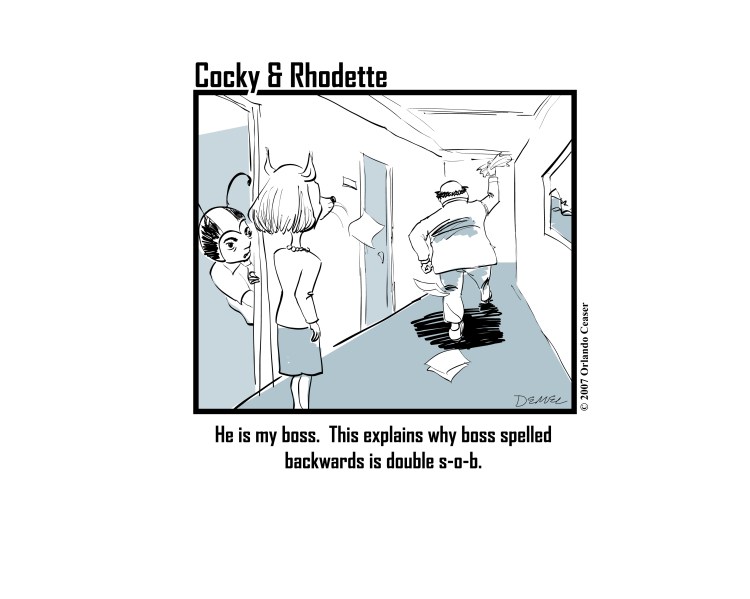
I work for a Monster

Double_S-O-B_C


I grew up with a different generation of monsters. The monsters in the movies and television of my day had the same objective as the ones today, to shock and terrify. They strive to literally frighten you out of your mind. Please indulge me for a moment as I ask you to play a game. Answer this question “If my worst manager was a monster, who would they be?” To play along with me you must have a picture of your worst manager, a manager from the past or a diabolical manager you heard about from someone else.

I grew up watching a program called Shock Theater. The hosts were zombie musicians who were probably the inspiration for the look of Michael Keaton in the movie Beetlejuice. The program was a prelude to the Creature Features segments on late night television. There were 4 favorite monsters or categories that dominated the movies in my childhood; the Wolfman, Dracula, the Mummy, Frankenstein and various reptiles or mutated animals that were exposed to radiation. For this segment let’s concentrate on the top four; Wolfman, Dracula, Frankenstein and the Mummy.

My favorite character was Lon Chaney, Jr. who played the Wolfman. He was a frustrated man who was bitten by a werewolf and had to spend the rest of his life howling at the full moon. He was always seeking a cure and looking for sympathy from anyone who would listen to his tale of woe and help rescue him from his fate. He was a normal person during good times, which was during daylight hours and things were going well. However, under pressure, he changed into something frightening and unrecognizable.

He wanted to be different, but was overpowered by the curse. Have you seen the Wolfman Manager in your organization? They appear to be nice, but are tormented by change. Therefore, their full moon experience could be pressure of any kind. Their poor sales results could cause pressure, a difficult boss or skill deficiencies due to incompatibility with their job could turn them into terrible creatures. The Wolfman Manager blames something or someone else for their cruel behavior. They were forced to be tough and it was agonizing for them because it was, out of character and against their temperament. In the presence of their boss, they would reluctantly turned into something horrible, due to fear or the need to become something to match leadership expectations.

Then there was Dracula, the vampire. He was charismatic, smooth talking and mesmerizing. He spoke with a distinctive accent and people were drawn to his charm, appearance and professional demeanor. He was royalty; after all he was a Count. But Dracula was still a blood sucker, a manipulator who planned to render his victims hopeless and under his control. His intent was to drain others until they were no longer of use to him, other than to locate another food source. You may have seen a vampire walking around your company with that same arrogant, cold, uncaring look. The look that says they are interested in you for what you can do for them. The Vampire Managers walk around feeling, as if they would be there forever and no one would discover their secret intentions to victimize others. You may wonder if somewhere, there is a coffin containing their native soil, somewhere hidden in the office.

The Mummy was cursed to guard the tomb or temple of his beloved. He was slow of foot, but was loyal, relentless and powerful. I’m speaking of the older version played by Boris Karloff, not the newer versions found in the Brandon Fraser movies, but the plot is the same. There is a creature driven by an overpowering love and allegiance for the object of their affection. This person within your organization has an undying love for power and ambition, status quo and will destroy anyone who tries to harm or change it. They will blindly institute unethical policies and cover them up, especially if an investigation is pending or inevitable. This individual will persistently pursue anyone who has anything negative to say about the company or anyone they personally admire within the organization. They will practice a technique known as delayed retaliation to seek revenge against their enemies. They will also be the micromanaging monster who slowly follows you and hovers over you.

An organization began a process of offering 360° feedback to its managers. The managers enlisted the help of their peers, direct reports and their supervisor. When they received less than flattering commentary, they smiled and thanked everyone for their contributions. Over the next several months, the Mummy Manager did everything within their power to slowly, relentlessly, strike back against those who offered disparaging feedback. The mummy within the organization is wrapped up, as a metaphor for hiding either their identity or their intentions.

Lastly, there was Frankenstein, named after his creator. He was a collection of body parts, that were sewn together to create a living breathing inhuman being. Frankenstein’s monster was depicted as mindless and easily irritated. He was created to be controlled and to demonstrate the power and influence of the scientist. He was the earlier version of the zombie. Frankenstein became identified with his creation. When the Frankenstein Monster saw his reflection and what he had become, he became angry. He realized how different it was from everyone else and that people were afraid of him. He was deliberately created to be controlled as an example of his creator’s intellect and power. He ultimately turned on his master.

The Frankenstein Manager appears in many organizations as the protégé who was shaped, mentored and created in the ruthless image of their sponsor. He is loyal, as long, as it is a benefit to him, but when they received negative feedback, they will revolt. He is a henchman who follows blindly. Eventually, the protégé will turn on its creator, causing much instruction in its wake. After the monster received or learned all they could from their master, it may cast the mad scientist mentor aside.

Each generation, even the Millenials, has its own monsters; whether it is the Wicked Witch of the East, Aliens, the Predator, zombies, Jason of Friday the 13th or Freddy Krueger from Nightmare on Elm Street, they can be compared to the leadership styles of many of the leaders seen in organizations around the world. The traits of these frightful creatures are found in the leadership practices of some managers who believe they must resort to fiendish tactics or insensitive methods in order to get results. Where there is a monster, there is fear. Where there is fear, there needs to be a strategy to relieve people from the threat of the monster and the power it has over the employees in the workplace. To be successful, you must be wise enough to identify the managers with monster tendencies and develop the right skills and resources to stay safe. When you realize that your manager is a monster, you must act appropriately and find the correct strategy to take care of yourself.

Copyright © 2016 Orlando Ceaser

Will there be a Mutiny on your watch? Is there a silent rebellion on your team?

People who have been tolerant of oppressive leadership/management behavior eventually revolt.  Mutiny is on their minds and it describes a revolutionary action. In an organization that has owners, principals and stockholders mutiny does not occur by physically taking over a facility or its leadership. It occurs by people determining that they will not give 100%. They will not be totally engaged at work. They will not give their best. Employees will adopt an “over my dead body” mindset, which means they theoretically would rather die than give their total cooperation to an organization that does not respect them. Workers have decided that the company does not deserve their best, therefore their best ideas, solutions and discretionary effort will be withheld.

A sales representative approached his mentor and told him about the dissent in his district. Apparently, the district was fed up with the leadership inadequacies of their District manager. He listed several failures in emotional intelligence and examples of managerial malpractice. He wanted to know the path they should take to bring their discontent to higher authorities. They were going to stage a mutiny. Their mutiny was not going to be a work stoppage nor were they going to physically remove their manager from his position. In essence, they wanted to schedule a meeting with their regional manager on their grievances. They wanted to know if they were going through the proper channels to get results. The team was to meet with the regional sales manager to complain about the District Manager’s tactics and the impact on morale and performance.

The curious part of the discussion was the performance history of the regional sales manager. In his prior role as a district sales manager, his team complained about his management style. He was notorious for lacking emotional intelligence and created an environment of fear and intimidation. He exhibited the same tendencies present in his current subordinate. How sympathetic would he be to their claims about a hostile work environment?

The representative was advised to go through the proper channels. They felt more comfortable contacting Human Resources to state their case. HR, by remit, would investigate their issues and take the necessary actions. Additionally, he was advised to not be seen as the ring leader in this uprising. The Regional manager in question was also notorious for retaliating against individuals who challenged him or stood in his way.

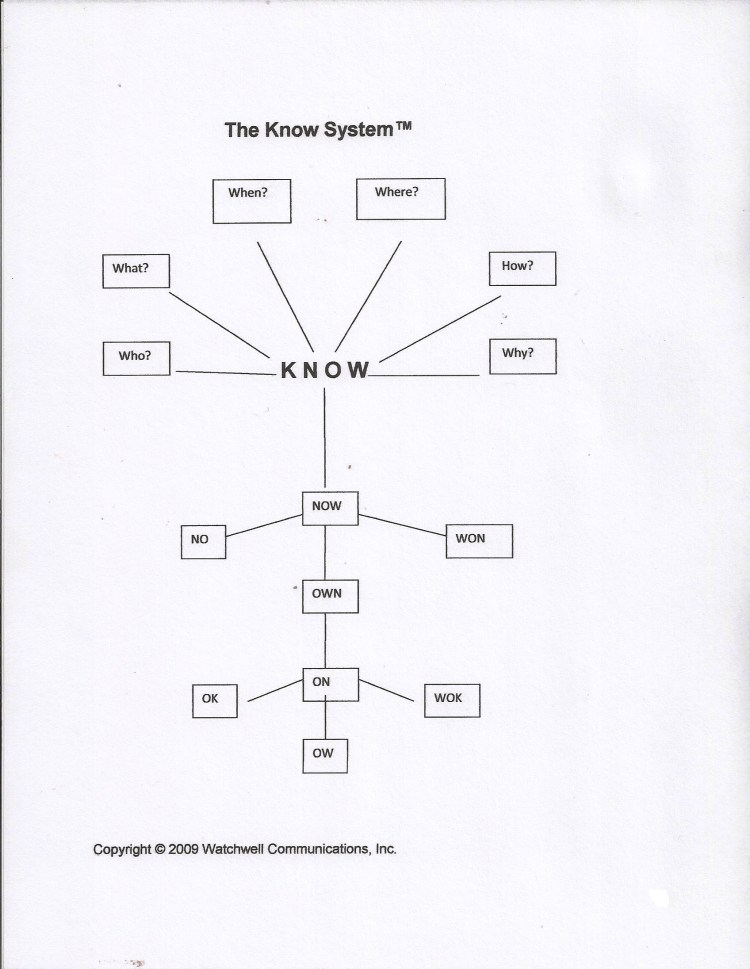
Managers can evaluate their culture through The Know System™ which could provide a simplified look at their environment. The Know System™ featured in the book The Isle of Knowledge is a decision making model which is also useful for individual and group coaching exercises. It is easy to use and allows the participants to accumulate information to enhance the quality of their decisions and discussions. The system is devised from the word Know. The user should ask a series of questions to gather information. Let’s look at 6 words from the word Know and a few related questions that apply to company culture.

  1. Won – What would a winning culture look like to you? What type of atmosphere, level of engagement and customer satisfaction scores would represent success to you?
  2. Know – What do you know and need to know about your culture and the people in your organization? (This can be enhanced with the words who, what, where, when, how and why, if appropriate)
  3. Now – What are you doing now to ensure a healthy habitat? Are you placing priority on the proper indicators?
  4. No – What are you doing that you need to stop doing? What goes against your culture and stated values that you need to say no to? What do your people want you to eliminate or stop doing?
  5. On – You must be vigilant at all times to monitor culture and maintain a proper cultural air quality. What are you doing to track leading indicators of a great culture? How are you measuring your work environment?
  6. Own – Do you own the culture as evidenced by leadership behavior? How are you holding yourself and others accountable? How are you reporting your performance and interest in a strong culture to your people?

knowsystemchart1

The beauty of our current leadership/managerial landscape is that many organizations have ascribed to the notion of a healthy work environment. There are employee surveys and satisfaction surveys, as well as engagement surveys to take the temperature or climate of the organization. These surveys can uncover problems and managers can be presented with data and held accountable for changing their environment. These surveys are strengthened with direct contact with management and human resources to ensure the environment is conducive for maximum productivity.

Is imperative as a leader to gauge how your people are responding to your direction and the culture in your environment. It is also apparent that many leaders are promoted because they excelled in their previous sales position, but are not cut out for management. You should try to train and develop these individuals, but in some instances it is not a good match and a decision should be made to place the person in the right job.  A worst-case scenario may develop where people mentally abandon the company, but stay on the job, because the company failed to address a main contributor to their toxic culture.

When the organization does not feel like a respectful place, people feel that the company has let them down and cannot be trusted. Mutiny or thoughts of mutiny is an indication that the current culture has failed or is failing many of its workers. They may resort to subversive action and taking matters into their own hands.

Mutiny may show itself as a single silent action called a resignation. Your top performers or the most influential members on your team may leave, causing a chain reaction of departures. Management must be accessible and periodically and personally check the culture pulse of the organization. People must believe that leadership is authentic, transparent and sincere when leaders speak of core values. Trust will be enhanced when people really believe that they are the number one resource in the organization. Otherwise, silent mutinies will going unchecked, unnoticed and leaving people unfulfilled.

Copyright © 2016 Orlando Ceaser


Managing your personal power supply

The Spin class was about to begin. Gayle, the instructor, stated, “I lost power yesterday.” She said she was in her home when suddenly, a loud noise was heard and her electricity went off. We stretched, continued a light conversation and launched into a rigorous routine. I wondered during the class, “How many times, as individuals, have we lost power in our lives? Did we give it away or was it taken from us? Are there certain situations or individuals who cause us to lose power? Who are they and why does this happen? What are the early warning signs before there is a loss of power?

The loss of power is readily detectable. You have that feeling of loss of confidence, which is demonstrated by your body language, vocabulary and actions. Many times the loss of power at home or at work may come as a surprise. However, just as in nature there is a flash of lightning or thunderclaps before a storm, you can rely on certain indicators as precursors to a storm. You can anticipate someone’s presence, behaviors, as a good sign that a storm and potential power loss is on the way.

We should be aware of the signs of losing power and fortify your defenses. This will require us to increase our competence, confidence and network of individuals who will cooperate with us in our efforts to enhance our power position. There are times when we lose power and look around us and everyone seems to have theirs. What can we do to maintain or regain our power during a power outage? Power outages may be due to:

  1. Burnout
  2. Lack of confidence
  3. Power drainers
  4. Power mongers

Burnout

We can lose power by expending too much energy. We may fail to prioritize and try to do too many things at once. Processing too many projects at one time will lead to an increase in stress. Lack of sleep and irritability may negatively affect your disposition. You may become moody and easy to anger. Our lives are running at many revolutions per minute (rpm’s). We create to do lists (TDL’s) to keep track of our obligations. To do lists are getting longer and serve as a repository of unlimited tasks of varying priorities. We may fail to rank the items or every item seems to be important, which will lead to none of them being important. If we don’t put a filter on the funnel, we will be overwhelmed. This state of overload will lead to burnout, a breakdown and a loss of power. You must realize that some items on your list may not be covered or should be delegated or deleted.

Lack of confidence

Sometimes lack of confidence can lead to a loss of power. You may be faced with the possibility that you are not as good as you think you are and are afraid that others will discover your shortcomings. A way to address this fear is to conduct a self assessment of your skills and abilities. Be honest with yourself. You should relentlessly study your craft until we are an expert in your field. This may require study and validation which will give you the necessary credentials to ward off any challenges. If you lack confidence or courage you may doubt your abilities and lose the power of conviction needed to be successful.

Power drainers

Some people exist as leaches in the workplace, at home and wherever you engage in relationships. They will drain your power through constant complaining. Negative thoughts and the complaints will drain your energy supply. Their negative disposition and complaint oriented disposition puts everyone in a bad mood. They are not satisfied with anything and they never bring a solution to the myriad of problems they detect. When they enter the room, you can feel the life being sucked out of the place. Engagement levels seem to go down and the level of interaction and cooperation is reduced. The focus is on the speed of ending the meeting and getting back to work away from this malcontent.

The power drainers are time wasters. They do not respect time. They will barge into your office or workspace and tell you the latest gossip and shortcomings of the organization. Many power drainers have a running conflict with their peers and want you to come in as a peacemaker, which is time consuming and emotionally exhausting.

Power mongers

Power mongers are perpetrators who like to hoard power and use it over people based on their level of influence or authority. They will take the power away from you in a meeting. If you have the floor in a meeting they will ask the questions to shift the emphasis to them. I attended a meeting where one participant had more handouts on my subject than I did and spent the meeting time explaining their handouts which took away my power and control of the meeting. The better preparation and communication skills may address some of the issues of the power mongers.

The manager who asks you to do something because they said it does everything to shut down questions from the meeting attendees. Power mongers also work by using intimidation to get results. They will level threats at people who do not complete assignment correctly. A power monger will embarrass people in front of their peers. They may do this deliberately to show who’s the boss? A new manager at a paper recycling plant announced to his employees that he wanted them to fear him. He went on to exercise this management style as an egocentric power monger.

A power monger believes that information is power and takes this concept to the extreme. They delegate information sparingly. A manager had access to updates from the home office that would have been useful to one of his subordinates making a presentation. Rather than call him off to the side before the meeting and provide the updates, he strategically interrupted during the meeting with the latest news from headquarters. You may need help in dealing with a power monger, who negatively uses power. This can be done by working with mentors, advocates and power brokers. These individuals have the wisdom, insight and influence to assist you in relating to the power mongers.

Power brokers

Powerbrokers are individuals who use power effectively to get results. These individuals should be utilized and studied in order to gain their assistance. You want to use their techniques to minimize personal power outages. These individuals can be identified and cultivated at work, networking groups, referrals from their contacts and through personal introductions.

Work with powerbrokers to increase your confidence; improve your influence skills and knowledge of your area of interest and expertise. Conduct a personal assessment; improve your communication skills and your knowledge of your subject. Your objective is to isolate the individuals and circumstances that drain your power and counteract their affect on you. This will enable you to be stronger and effective in harnessing your power supply and minimizing instances where you lose power.

Copyright © 2016 Orlando Ceaser

Itemize Individual Contributions to Team Results

Career_in_a_Box[1]

An interview is an excellent opportunity to blow your own horn, trumpet individual performance and brag about your accomplishments in a politically correct environment. However, in our team oriented culture, we sometimes forget that individual accomplishment is important. Frequently in an interview, candidates answer questions highlighting team accomplishments. They falsely believe the interview is a place only to celebrate team achievement. After all, we are constantly immersed in the value of effectively utilizing teams to reach corporate objectives. It seems only logical to use team vernacular in the interview to respond to the behaviorally based interview questions.

Candidates may fail to realize, that it is difficult for the interviewer, especially one who lacks a lot of interview experience, to extract an individual’s role in team centered answers. Therefore it is incumbent upon you as a candidate to isolate and itemize your contributions to the overall success of the team. The interview therefore, becomes a safe place for you to clarify and celebrate your individual accomplishments.

As a member of the team, you are expected to use team specific language while working on the job. We know it is important for you to coordinate your activities and collaborate with others to achieve a synergistic effect. But in the midst of daily activities, it is important for you to keep a record of your unique input to the overall project. This may involve questions asked, suggestions made and challenges delivered to accepted practices or ideas. In a team oriented department / organization, it is sometimes difficult to separate individual results from team performance. However, a strategic approach is necessary to isolate and itemize your contributions, as you climb the corporate ladder or interview for a job in another organization.

You must develop a “We / I” mentality. State that “We achieved a certain result and I was able to contribute in this achievement;” Then specifically itemize your contributions. The “We / I” based orientation is hard to do at first, but with practice and training, it will become a natural part of your conversation. The conversation that helps you develop an up-to-date resume, examples to be used in an interview and information necessary to grow your skills and abilities. It is critical to have an accurate perception of your strengths and weaknesses, so that you will know where they need to be enhanced. If you know your strengths, competencies, abilities, skills and talents, you can utilize them to effectively and accurately assess results and explain your actions.

The objective of “We / I” is not to put yourself in competition with your team members. It is not an opportunity to tell how you are more important to the team than your teammates. Part of the success of the team is the collective contributions of each member and the synergy created to get results. The idea of working in order to get credit for your actions can be counterproductive to the smooth working of the group. I believe the old adage that states,” consider the amount of work that can be done if we didn’t worry about who got credit for the results.” It is important in a team setting for everyone to work for the betterment and efficiency of the team to succeed as a unit.

Many organizations will tout the value of their teams. Some of these organizations will design their incentive programs to reward team performance. However, they will also assess individual performance. They will breakout or itemize individual performance through concentrating on particular behaviors. Recognizing these individual behaviors and distinctions are important when deciding career growth, promotions and succession planning.

Interviewers ask follow-up questions to determine the candidate’s role in their department’s success. When the candidates language and examples are structured in the context of what “we accomplished” the interviewer has to work too hard to obtain information. Many may not be patient enough and place the candidate in the” Not Interested” pile.  not interested”

Do not want the interview to incur the extra effort required to probe for individual contributions. You should provide concrete examples of your ideas; strategies and challenges that helped the team become better. You do not want to make it difficult for them to determine if you were an active member of the team or a member hiding behind the team’s reputation with very few ideas of your own. Interviewers look for the leadership role played in achieving results, rather than someone who just served as a follower or implementer of the ideas of others.

Candidates are frustrated by a perceived inconsistency between a team oriented culture and individualistic specific questions in an interview. When they receive the feedback that they did not specifically itemize their contributions to the team, they are confused. They feel as if the organization is sending mixed messages. Therefore, organizations need to clarify and ask people working in a team environment to track their individual contributions to the team and the reasons behind the request. We can compare this to team performances in other areas of our lives, whether in the field of athletics, academia, music or community activities. Success may be measured by the overall group achieving a goal, but there may be individual statistics, ideas, questions or actions that help the group reach its objectives.

If you’re working in a group where team performance is paramount, undoubtedly you are constantly thinking about achieving team objectives. These thoughts about achieving objectives will lead to actions that will inspire, challenge or push the team toward success, however it is measured. There will come a time when this project, job or assignment is over and you decide to move on to a different role. When you arrive at the different role, at some point in the interview, they will want to know the success of your team and your role in helping that team excel. The more clarity they can gain around your contributions, the better they will be able to determine if you are a person they need to fill the vacant position. Protect your career, assess your contributions and establish a system to itemize your contributions to the overall success of your group, team, Department or organization.  This will lead to better interviews and pave the way for a successful career through clearly stating the scope of your performance.


Copyright © 2016 Orlando Ceaser

How to go from an Extra in a job interview to a Starring Role

Interview_Trick_C

Have you discovered that you were an extra in a job interview, when you thought you were auditioning for the lead role? Usually, you do not find out about this reality, but if it is discovered, how do you handle the knowledge? Allow me to use the movie metaphor throughout this article to make a few points that will hopefully be of benefit to you.

When interviewing internal candidates within an organization, there is usually a preferred candidate. This person is the odds on favorite, a person who it is their job to lose, who will get the job unless they are an embarrassment and fall on their face during the interview. Don’t be naïve going to the interview thinking that this is not a reality. What can you do to shift the odds in your favor or set yourself up or your next career move?

Secondly, even when interviews involve candidates from outside the organization, judging by recommendations, review of resumes, and telephone screening, there are still candidates who on paper, the interviewer may feel have an edge. What should be your mindset going into the interview? You should assume that you are interviewing against a pool of talented individuals and securing the job will require your best performance. You cannot be distracted by the competitive field of talent. You should feel thankful for the chance to show the world why you are the person for the job and did deliver a powerful, mind altering performance.

Interview preparation

Prepare yourself for a courageously effective interview, as if you were competing against the most potent candidates in the universe. You must know yourself thoroughly and be ready to present your credentials in the most authentic, persuasive and powerful means possible. Your focus should be on delivering the best audition, reflective of your skills and abilities, to perform the job at a very high level. Your research into the organization should enable you to craft a strategic vision of how you could do the job better than anyone else. You should visualize yourself in the job, performing the job and achieving beyond managerial and company expectations.

It is company policy in many organizations to post a job, even when a person has been identified to fill the position. This may seem like a sham, but it does provide an opportunity for other people to audition for the vacancy. It may feel as if you are going through the motions and it may feel unfair, but it provides an opportunity that would not be there without the Human Resource Department (HR) involvement.

I have been on both sides of the situation. I have had people who were targeted for a specific role as a part of their professional development. When the role became available, I wanted to immediately put them in the job, however I was told by HR that the job needed to be posted and others given the opportunity to pursue the position. In other words, the people had to earn the position. HR wanted people throughout the organization to have a chance to pursue available and appropriate positions. Otherwise, people would leave jobs and be replaced based on favoritism and preferential treatment. It was better for the organization and the rationale made sense to me. However, it was incumbent upon the interviewers to be open-minded. This was a challenge and everyone had to be held accountable, which required challenging the judgment of everyone involved in order to arrive at a fair and equitable decision. There were instances where initial feelings were changed, based on the skills and abilities of a better candidate.

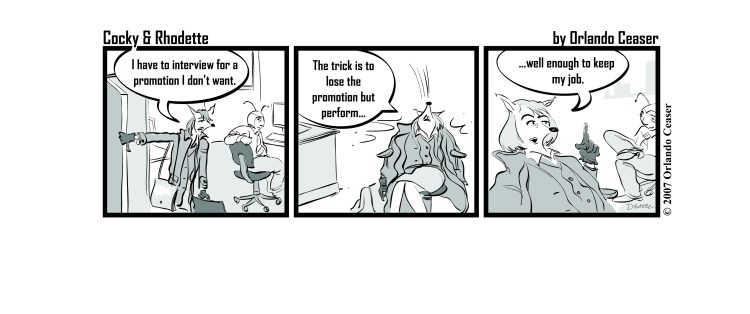
I have experience interviewing for a job when I knew I was a part of a crowd scene. I was an extra, to allegedly give credibility to the interviewing process. I did not want the job, but I was encouraged to interview for the job because it would be beneficial for my career. Interviewing for a job requires preparation time, which I did not want to spend because I wanted a different position. I did not want to deliver a poor interview because it would take me out of consideration for the job I really wanted. The feedback I received, after I did not get the job, was they could tell that my heart was not in the interview. I thought that was amazing, since I told them in the beginning that I did not want to interview for the position. My presence in the interview, gave credibility to the person and the interview process. It also showed my willingness to be a team player.

Initially, I felt they could have given the job to the individual without putting me through the process of preparing and executing multiple interviews. Serving as an interview extra however, ultimately worked in my favor. He was an amazing candidate and ultimately I got the assignment I wanted.

How should you perform when you suspect that you are an extra in the interviewing process? Should you follow through with the interview? Should you complain to those interviewing about your suspicions? Should you withdraw your name from consideration because you view it as a waste of time?

Many managers would suggest you approach the situation from a strategic point of view. They would suggest that you consider the following;

  • The interview process may not be as open-minded as you would like
  • The interview is an opportunity to showcase your talents, skills and abilities
  • The interview allows you to network and expose other individuals to your career aspirations
  • The interview allows you an opportunity to practice your interviewing skills in a manner sanctioned by the organization (receiving interview practice by interviewing for jobs outside the organization would not be smiled upon)
  • You could enter the interview with the mindset of making it very difficult for the interviewers to offer the job to their preferred candidate
  • Your stellar performance could set you up for a recommendation from the interviewers for an even better positionThe moral of the interview process is that even though you may knowingly or unknowingly be an extra in the interview process, it is a golden opportunity to network and showcase your talents. It can be the move that can set you up for an even greater job, building relationships, advocates and individuals anxious to recommend you and potentially bring you onto their team.


  • Copyright © 2016 Orlando Ceaser